

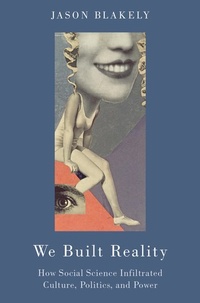
We Built Reality
How Social Science Infiltrated Culture, Politics, and Power
Published on 24. July 2020
Book
Hardback
184 pages
978-0-19-008737-1 (ISBN)
Description
Over the last fifty years, pseudoscience has crept into nearly every facet of our lives. Popular sciences of everything from dating and economics, to voting and artificial intelligence, radically changed the world today. The abuse of popular scientific authority has catastrophic consequences, contributing to the 2008 financial crisis; the failure to predict the rise of Donald Trump; increased tensions between poor communities and the police; and the sidelining of nonscientific forms of knowledge and wisdom. In We Built Reality, Jason Blakely explains how recent social science theories have not simply described political realities but also helped create them. But he also offers readers a way out of the culture of scientism: hermeneutics, or the art of interpretation. Hermeneutics urges sensitivity to the historical and cultural contexts of human behavior. It gives ordinary people a way to appreciate the insights of the humanities in guiding decisions. As Blakely contends, we need insights from the humanities to see how social science theories never simply neutrally describe reality, they also help build it.
Reviews / Votes
[Jason Blakely] achieves something quite remarkable in this little book. He convincingly makes an ambitious argument which has significant implications for how we consider the role of expertise, narrative, and ideology across our societies ... I would encourage everyone interested in social policy particularly or social science generally to read this book. It will provoke fruitful thinking and open up new perspectives. * Kevin Hargaden, Doctrine and Life * We Built Reality reads smoothly and quickly, in part, because rather than retreating into dry neutrality Blakely takes up the storyteller's mantle and offers us a curated cultural map of the created crises of our present age. * Patrick Gilger, S.J., American Magazine * In We Built Reality, Blakely distills and applies his prior, more theoretical work into a powerful indictment of those social scientists who claim to be more "objective" and "reality-based" than work like Rosa's value-laden account of resonance. * Frank Pasquale, Brooklyn Law School, author of The Black Box Society * Blakely's lively and impassioned prose is a revelation, popularizing critical social science. He compiles the subtle and not-so-subtle ways in which we are persuaded to see ourselves, and society as a whole, as mechanical objects in need of expert guidance and manipulation, rather than as reflective agents narrating a past and imagining a better future... [his book] should be at the foundation of a new, more generous, view of our nature, destiny, and purpose. * Frank Pasquale, Church Life Journal * Blakely's is an acute and ominous analysis of the ways in which the understandable prestige of the hard sciences in modern culture has, alas, been accompanied by an unwholesome parasitism, by which the authority of scientific method has been conscripted into the service of insidious forms of fraudulent and often destructive 'expertise. * David Bentley Hart, author of The Experience of God and The New Testament * This book is an essential contribution and absolutely must be read widely. It explains what's wrong with attempts to explain human action and culture with reductive theories modelled after mechanistic natural science. It is not just that these explanations don't work; it is also that simplistic versions of these theories are accepted as valid self-descriptions by many. The resulting changes in self-understanding can do a lot of damage. Witness the role of the notion of 'economic man' in the financial disaster of 2008. But Blakely gives many other examples. * Charles Taylor, Professor Emeritus of Philosophy, McGill University * We Built Reality is worth considering for its illumination of the ways in which so much ground-breaking social science ultimately leads not to a broader understanding but a narrower reimagining of humanity. * Religion & Liberty *More details
Language
English
Place of publication
New York
United States
Target group
Professional and scholarly
Dimensions
Height: 143 mm
Width: 216 mm
Thickness: 14 mm
Weight
318 gr
ISBN-13
978-0-19-008737-1 (9780190087371)
Copyright in bibliographic data and cover images is held by Nielsen Book Services Limited or by the publishers or by their respective licensors: all rights reserved.
Schweitzer Classification
Other editions
Additional editions
Book
07/2020
Oxford University Press Inc
€42.00
Shipment within 15-20 days
E-Book
06/2020
OUP eBook
€17.49
Available for download
E-Book
06/2020
OUP eBook
€17.49
Available for download
Person
Jason Blakely is Associate Professor of Political Science at Pepperdine University. He is the author of Alasdair MacIntyre, Charles Taylor, and the Demise of Naturalism and, with Mark Bevir, of Interpretive Social Science (Oxford).
Content
Introduction: Election Day 2016
Part I: The Market Polis
Chapter 1. Our Free Market Scientists
Chapter 2. Republic Inc.
Part II: I, Robot
Chapter 3. Genes and Machines
Chapter 4. The Machinist Ethos
Part III: Scientific Violence
Chapter 5. Sciences of Zero Tolerance
Chapter 6. Empire of Light
Conclusion: Reading Social Science Again
Notes
Acknowledgments
Index
Part I: The Market Polis
Chapter 1. Our Free Market Scientists
Chapter 2. Republic Inc.
Part II: I, Robot
Chapter 3. Genes and Machines
Chapter 4. The Machinist Ethos
Part III: Scientific Violence
Chapter 5. Sciences of Zero Tolerance
Chapter 6. Empire of Light
Conclusion: Reading Social Science Again
Notes
Acknowledgments
Index