

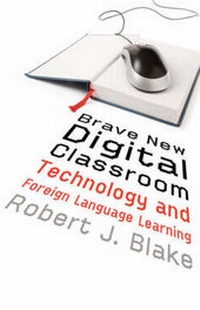
Brave New Digital Classroom
Technology and Foreign Language Learning
Published on 22. September 2008
Book
Paperback/Softback
240 pages
978-1-58901-212-7 (ISBN)
Description
"Brave New Digital Classroom" deftly interweaves results of pedagogical research and descriptions of the most successful computer-assisted language learning (CALL) projects to explore how technology can best be employed in the foreign-language curriculum to assist the second language acquisition process. Directed to all language teachers - whether at the school or the postsecondary level, with or without prior experience - this book focuses on how to use new technologies effectively. Blake urges teachers to move beyond a simple functional competence of knowing how to use the tools toward first a critical competence - realizing what the various tools are good for - and ultimately a rhetorical competence of knowing how the tools will help transform the learning environment. This book examines the effective use of a range of technologies, from Internet sites through computer-mediated communication such as synchronous chatting and blogs, to distance learning. At the end of each chapter questions and activities demonstrate the interactionist, learner-centered pedagogy Blake espouses.
An invaluable reference for experienced researchers and CALL developers as well as those of limited experience, "Brave New Digital Classroom" is also ideal for graduate-level courses on second language pedagogy. It will also be of interest to department chairs and administrators seeking to develop and evaluate their own CALL programs.
An invaluable reference for experienced researchers and CALL developers as well as those of limited experience, "Brave New Digital Classroom" is also ideal for graduate-level courses on second language pedagogy. It will also be of interest to department chairs and administrators seeking to develop and evaluate their own CALL programs.
Reviews / Votes
" Brave New Digital Classroom serves many purposes and can be used within multiple levels of instruction, making it one of the best buys on the market... [An] indispensable tool within the CALL environment and will prove to be an essential resource for present and future FL educators." -- Modern Language Journal "A concise, well-written, and accessible book that will appeal to language teachers, educators, and researchers who are interested in learning more about CALL research and best practices in the FL classroom. The organization and presentation of the content and the breadth of the discussion in this book reflect Blake's insightful and thorough concerns about the different aspects of technology-enhanced FL curricula." -- Language Learning & Technology "This small but highly resourceful book is the first of its kind to offer a comprehensive summary of technologies developed to assist language learning, with an emphasis on foreign language classrooms." -- Issues in Applied Linguistics "This is an easy introduction to sound practice in application of computer technology in language instruction." -- eLanguage.netMore details
Language
English
Place of publication
Washington, DC
United States
Target group
College/higher education
US School Grade: College Graduate Student and over
Product notice
Paperback (trade)
Dimensions
Height: 215 mm
Width: 140 mm
Thickness: 18 mm
Weight
285 gr
ISBN-13
978-1-58901-212-7 (9781589012127)
Copyright in bibliographic data and cover images is held by Nielsen Book Services Limited or by the publishers or by their respective licensors: all rights reserved.
Schweitzer Classification
Other editions
New editions
Book
02/2013
2nd Edition
Georgetown University Press
€31.50
Article exhausted; check for reprint
Persons
Robert J. Blake is director of the UC Consortium for Language Learning and Teaching and professor of Spanish and classics, University of California, Davis.
Content
Foreword by Dorothy M. ChunPreface 1. SLA, Language Teaching, and Technology: An Overview 2. Web Pages in Service of L2 Learning 3. CALL and Its Evaluation 4. Computer Mediated Communication (CMC) 5. Distance Learning for Languages: Does It Measure Up? 6. Putting It All Together Appendix to Chapter 5 Glossary References Index