

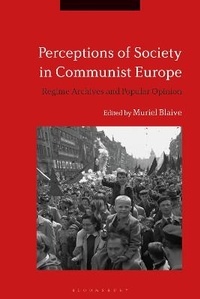
Perceptions of Society in Communist Europe
Regime Archives and Popular Opinion
Published on 18. October 2018
Book
Hardback
264 pages
978-1-350-05171-3 (ISBN)
Description
Drawing on archival sources from Czechoslovakia, Poland, East Germany, Romania and Bulgaria, Perceptions of Society in Communist Europe considers whether and to what extent communist regimes cared about popular opinion, how they obtained their information, and how it helped them implement and maintain their rule.
Contrary to popular belief, communist regimes sought to legitimise their domination with minimal resort to violence in order to maintain their everyday power. This entailed a permanent negotiation process between the rulers and the ruled, with public approval of governmental policies becoming key to their success. By analysing topics such as a Stalinist musical in Czechoslovakia, workers' letters to the leadership in Romania, children's television in Poland and the figure of the secret agent in contemporary culture, as well as many more besides, Muriel Blaive and the contributors demonstrate the potential of social history to deconstruct parochial national perceptions of communism.
This cutting-edge volume is a vital resource for academics, postgraduates and advanced undergraduates studying East-Central European history, Stalinism and comparative communism.
Contrary to popular belief, communist regimes sought to legitimise their domination with minimal resort to violence in order to maintain their everyday power. This entailed a permanent negotiation process between the rulers and the ruled, with public approval of governmental policies becoming key to their success. By analysing topics such as a Stalinist musical in Czechoslovakia, workers' letters to the leadership in Romania, children's television in Poland and the figure of the secret agent in contemporary culture, as well as many more besides, Muriel Blaive and the contributors demonstrate the potential of social history to deconstruct parochial national perceptions of communism.
This cutting-edge volume is a vital resource for academics, postgraduates and advanced undergraduates studying East-Central European history, Stalinism and comparative communism.
More details
Language
English
Place of publication
London
United Kingdom
Publishing group
Bloomsbury Publishing PLC
Target group
College/higher education
Dimensions
Height: 236 mm
Width: 154 mm
Thickness: 20 mm
Weight
540 gr
ISBN-13
978-1-350-05171-3 (9781350051713)
Copyright in bibliographic data and cover images is held by Nielsen Book Services Limited or by the publishers or by their respective licensors: all rights reserved.
Schweitzer Classification
Other editions
Additional editions
E-Book
10/2018
1st Edition
Bloomsbury Academic
€37.49
Available for download
Person
Muriel Blaive is Advisor to the Director for Research and Methodology at the Institute for the Study of Totalitarian Regimes, Czech Republic. She is the editor, together with Christian Gerbel and Thomas Lindenberger, of Clashes in European Memory: The Case of Communist Repression and the Holocaust (2010).
Content
List of Figure
List of Contributors
Acknowledgements
Introduction, Muriel Blaive (Institute for the Study of Totalitarian Regimes, Czech Republic)
Part I: From Postwar to Stalinism
1. Secret Agents: Reassessing the Agency of Radio Listeners in Cold War Czechoslovakia (1945-1953), Rosamund Johnston (New York University, USA)
2. Practices of Distance, Perceptions of Proximity: Trade Union Delegates and Everyday Politics in Post-World War II Romania, Adrian Grama (Central European University, Hungary)
3. A Case Study of Legitimization Practices: The Czechoslovak Stalinist Elites at the Regional Level (1948-1951), Marian Lozi (Institute for the Study of Totalitarian Regimes, Czech Republic)
4. Policing the Police: The 'Instructor Group' and the Stalinisation of the Czechoslovak Secret Police (1948-1951), Molly Pucci (Trinity College Dublin, Ireland)
Part II: From Stalinism to Real Existing Socialism
5. Constructive Complaints and Socialist Subversion in Stalinist Czechoslovakia: E.F. Burian's Scandal in the Picture Gallery, Shawn Clybor (Dwight-Englewood School, USA)
6. Perceptions of Society in Czechoslovak Secret Police Archives: How a 'Czechoslovak 1956' Was Thwarted, Muriel Blaive (Institute for the Study of Totalitarian Regimes, Czech Republic)
7. Crises and the Creation of Institutions for Assessing Popular Consumption Preferences in Communist Bulgaria, 1953-1970, Martin K. Dimitrov (Tulane University, USA)
8. Who is Afraid of Whom? The Case of the 'Loyal Dissidents' in the German Democratic Republic, Sonia Combe (Centre Marc Bloch, Germany)
Part III: From Real Existing Socialism to the End - and Beyond
9. Did Communist Children's Television Communicate Universal Values? Representing Borders in the Polish Series Four Tank-Men and a Dog, Machteld Venken (Vienna University, Austria)
10. Between Censorship and Scholarship: The Editorial Board of the Czechoslovak Academy of Sciences, 1969-89, Libora Oates-Indruchova (Graz University, Austria)
11. 'How Many Days Have the Comrades' Wives Spent in a Queue?' Appealing to the Ceausescus in Late-Socialist Romania, Jill Massino (University of North Carolina at Charlotte, USA)
12. Authenticating the Past: Archives, Secret Police, and Heroism in Contemporary Czech Representations of Socialism, Veronika Pehe (Institute for Contemporary History, Czech Republic)
Bibliography
Index
List of Contributors
Acknowledgements
Introduction, Muriel Blaive (Institute for the Study of Totalitarian Regimes, Czech Republic)
Part I: From Postwar to Stalinism
1. Secret Agents: Reassessing the Agency of Radio Listeners in Cold War Czechoslovakia (1945-1953), Rosamund Johnston (New York University, USA)
2. Practices of Distance, Perceptions of Proximity: Trade Union Delegates and Everyday Politics in Post-World War II Romania, Adrian Grama (Central European University, Hungary)
3. A Case Study of Legitimization Practices: The Czechoslovak Stalinist Elites at the Regional Level (1948-1951), Marian Lozi (Institute for the Study of Totalitarian Regimes, Czech Republic)
4. Policing the Police: The 'Instructor Group' and the Stalinisation of the Czechoslovak Secret Police (1948-1951), Molly Pucci (Trinity College Dublin, Ireland)
Part II: From Stalinism to Real Existing Socialism
5. Constructive Complaints and Socialist Subversion in Stalinist Czechoslovakia: E.F. Burian's Scandal in the Picture Gallery, Shawn Clybor (Dwight-Englewood School, USA)
6. Perceptions of Society in Czechoslovak Secret Police Archives: How a 'Czechoslovak 1956' Was Thwarted, Muriel Blaive (Institute for the Study of Totalitarian Regimes, Czech Republic)
7. Crises and the Creation of Institutions for Assessing Popular Consumption Preferences in Communist Bulgaria, 1953-1970, Martin K. Dimitrov (Tulane University, USA)
8. Who is Afraid of Whom? The Case of the 'Loyal Dissidents' in the German Democratic Republic, Sonia Combe (Centre Marc Bloch, Germany)
Part III: From Real Existing Socialism to the End - and Beyond
9. Did Communist Children's Television Communicate Universal Values? Representing Borders in the Polish Series Four Tank-Men and a Dog, Machteld Venken (Vienna University, Austria)
10. Between Censorship and Scholarship: The Editorial Board of the Czechoslovak Academy of Sciences, 1969-89, Libora Oates-Indruchova (Graz University, Austria)
11. 'How Many Days Have the Comrades' Wives Spent in a Queue?' Appealing to the Ceausescus in Late-Socialist Romania, Jill Massino (University of North Carolina at Charlotte, USA)
12. Authenticating the Past: Archives, Secret Police, and Heroism in Contemporary Czech Representations of Socialism, Veronika Pehe (Institute for Contemporary History, Czech Republic)
Bibliography
Index