

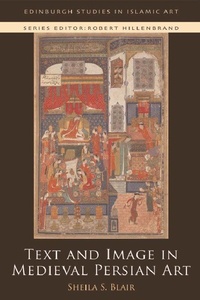
Text and Image in Medieval Persian Art
Published on 18. January 2019
Book
Paperback/Softback
352 pages
978-1-4744-4632-7 (ISBN)
Description
Focusing on 5 objects found in the main media at the time - ceramics, metalware, painting, architecture and textiles - Sheila S. Blair shows how artisans played with form, material and decoration to engage their audiences. She also shows how the reception of these objects has changed and that their present context has implications for our understanding of the past. Greater Iranian arts from the 10th to the 16th century are technically some of the finest produced anywhere. They are also intellectually engaging, showing the lively interaction between the verbal and the visual arts.
Reviews / Votes
Beautifully produced and extensively illustrated. -- D.H. KENNETT * British Brick Society Information * This splendid new book by one of the leading scholars of Islamic art manages that most difficult task-making a serious contribution to scholarship while being accessible to a wide range of readers and attractive to them. It is not a survey but five case studies: a 10th-century ceramic bowl, a 12th-century copper alloy rosewater sprinkler, a 14th-century tomb, a 15th-century manuscript painting, and a 16th-century carpet. Blair (Boston College; Virginia Commonwealth Univ.) beautifully describes and analyzes each in its immediate and its broadest historical context. Each object works like a pebble thrown into water, producing expanding circles of related objects, people involved in its manufacture and commission, and later works in its tradition or directly reflecting it in some way. The stories are diverse but fascinating and often end with consideration of the works in today's world. The writing is clear and accessible. Scholars will appreciate the many new insights and remarkably rich and current bibliography. The many illustrations, most in color, are of splendid quality. Individual chapters or the book as a whole would be suitable for use in college courses.' -- L. Nees, University of Delaware * CHOICE * Sheila Blair is an acknowledged world authority on epigraphy and this book is a scrutiny of five specific examples, arranged chronologically. -- Jane Jakeman * The Art Newspaper *More details
Series
Language
English
Place of publication
Edinburgh
United Kingdom
Target group
College/higher education
Illustrations
139 colour illustrations, 1 black and white table
Dimensions
Height: 244 mm
Width: 172 mm
Thickness: 17 mm
Weight
880 gr
ISBN-13
978-1-4744-4632-7 (9781474446327)
Copyright in bibliographic data and cover images is held by Nielsen Book Services Limited or by the publishers or by their respective licensors: all rights reserved.
Schweitzer Classification
Person
Sheila S. Blair is the Norma Jean Calderwood University Professor of Islamic and Asian Art and the Boston College and Hamad bin Khalifa Endowed Chair of Islamic Art, Virginia Commonwealth University.
Content
Preface; Introduction; I. The Art of Writing: A Bowl from Samarqand; 1. Provenance; 2. The Ceramic Setting; 3. Inscriptions; 4. Script; 5. Clientele; 6. Wider Horizons; 7. Afterlife; II. Perfuming the Air: A Rosewater Sprinkler from Herat; 1. Provenance; 2. The Geographical and Historical Setting; 3. Metalwares from Herat; 4. Patronage; 5. Function; 6. Decoration; 7. Afterlife; III. Monumentality under the Mongols: the Tomb of Uljaytu at Sultaniyya; 1. Construction and Redecoration; 2. Reasons for Redecoration; 3. The Pious Foundation; 4. The Architectural Setting; 5. The Tomb as Inspiration for later Mongol Rulers; 6. The Tomb as inspiration for the Ilkhanids' Rivals; 7. Afterlife; IV. A Romantic Interlude: The Wedding Celebration from a Manuscript with Three Poems by Khwaju Kirmani; 1. The Text and its Calligrapher; 2. The Illustrated Folios; 3. Adding the Paintings; 4. The Royal Setting; 5. The Role of Women; 6. Afterlife; V. Proclaiming Sovereignty: The Ardabil Carpets; 1. Provenance; 2. The Inscription; 3. Gifts to shrines; 4. Why Ardabil in the 1540s?; 5. The Repurposed Jannat Saray; 6. Afterlife at the Shrine; 7. Afterlife in the West; VI. Conclusion; Bibliography.