

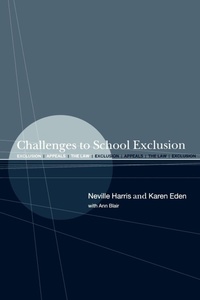
Challenges to School Exclusion
Exclusion, Appeals and the Law
1st Edition
Published on 30. March 2000
Book
Paperback/Softback
224 pages
978-0-415-23081-0 (ISBN)
Description
Permanent exclusion is the most severe sanction a school can impose on a child and the number of permanently excluded children is rising. Based on systematic observation of exclusion appeal panel hearings.Challenges to School Exclusion offers a unique insight into the appeal process. It focuses on:
*mechanisms by which parents and children can challenge permanent exclusion
*the law and current practice
*the social context of exclusion
*reforms of the appeal system made by the School Standards and Framework Act
*the DfEEs latest guidance on pupil inclusion.
Challenges to School Exclusion is the first study to examine permanent exclusion. The findings reveal serious deficiencies in the appeal system, including a frequent failure to deal fairly with excluded children. The text will be of particular interest to head teachers, local education authorities, school governors, education lawyers and education charities.
*mechanisms by which parents and children can challenge permanent exclusion
*the law and current practice
*the social context of exclusion
*reforms of the appeal system made by the School Standards and Framework Act
*the DfEEs latest guidance on pupil inclusion.
Challenges to School Exclusion is the first study to examine permanent exclusion. The findings reveal serious deficiencies in the appeal system, including a frequent failure to deal fairly with excluded children. The text will be of particular interest to head teachers, local education authorities, school governors, education lawyers and education charities.
Reviews / Votes
'This book deserves recognition as the standard (academic and law-based)text on school exclusion.' - Bob Morris, Education Law Association Bulleting'... Excellent book' - Times Educational Supplement
More details
Language
English
Place of publication
London
United Kingdom
Publishing group
Taylor & Francis Ltd
Target group
College/higher education
Professional and scholarly
Academic, Postgraduate, Professional, and Professional Practice & Development
Illustrations
9 s/w Tabellen
9 Tables, black and white
Dimensions
Height: 229 mm
Width: 152 mm
Thickness: 13 mm
Weight
374 gr
ISBN-13
978-0-415-23081-0 (9780415230810)
Copyright in bibliographic data and cover images is held by Nielsen Book Services Limited or by the publishers or by their respective licensors: all rights reserved.
Schweitzer Classification
Other editions
Additional editions
and Ann Blair | Karen Eden | Neville Harris
Challenges to School Exclusion
Exclusion, Appeals and the Law
E-Book
11/2002
Routledge
€69.99
Available for download
and Ann Blair | Karen Eden | Neville Harris
Challenges to School Exclusion
Exclusion, Appeals and the Law
E-Book
11/2002
Routledge
€69.99
Available for download

and Ann Blair | Karen Eden | Neville Harris
Challenges to School Exclusion
Exclusion, Appeals and the Law
Book
04/2000
1st Edition
Routledge Falmer
€139.86
Article exhausted; check different version
Persons
Neville Harris is Professor of Law at the School of Law and Applied Social Studies at Liverpool John Moores University. He has written extensively on education law and is the senior editor of the Education Law Reports. Karen Eden is a research officer at the Trust for the Study of Adolescence based in Brighton. She has also worked as a research fellow in the School of Law and Applied Social Studies at Liverpool John Moores University. Ann Blair is a lecturer in law at the University of Leeds. She has worked in local government and has served as a school governor.
Content
1.Introduction 2.Education and Redress of Grievance 3.Disciplines in Schools: Social Theory and Law 4.Exclusion in Practice: The Social Context to School Exclusion 5.School Exclusion: The Legal Framework 6.The Governing Body's (Discipline Committee's) Reinstatement Meeting 7.The Exclusion Appeal Panels 8.Bringing Appeals: Access to the Arrangements 9.Exclusion Appeal Hearings 10.Conclusion