

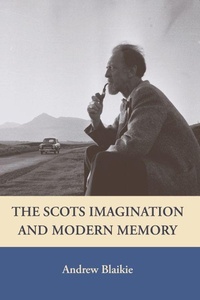
The Scots Imagination and Modern Memory
Published on 20. August 2013
Book
Paperback/Softback
272 pages
978-0-7486-1787-6 (ISBN)
Description
Andrew Blaikie explores how different, but connected, ways of seeing infuse relationships between place and belonging. He argues that all memories, whether fleeting glimpses or elaborate narratives, invoke imagined pasts - be these of tenement life, island cultures, vanished moralities, even the origins of social science. But do these recollections share a common frame of reference? Are our perceptions conditioned by a collective social imaginary?
We see the impact of modernity on Scottish culture in visions of nation and community from the late eighteenth century on, from Adam Ferguson's ideas on civil society through John Grierson's pioneering of documentary film to structures of feeling in popular fiction. Landscape as the symbolic 'face of Scotland', with its attendant mental contours have been produced and debated in genres including travel literature, social commentary, novels and magazines, but it is the changes in how we capture and present images, particularly given recent technological changes in photography, which have affected the ways we identify and remember.
Broadly sociological in approach, the range of Blaikie's analysis lends itself equally to those interested in social history, cultural geography and visual or memory studies.
Key Features
Analyses relationships between memory and local and national identitiesProvides interpretive connections between sociology, history, cultural geography and visual studiesContains 25 black and white illustrations and numerous case studies
We see the impact of modernity on Scottish culture in visions of nation and community from the late eighteenth century on, from Adam Ferguson's ideas on civil society through John Grierson's pioneering of documentary film to structures of feeling in popular fiction. Landscape as the symbolic 'face of Scotland', with its attendant mental contours have been produced and debated in genres including travel literature, social commentary, novels and magazines, but it is the changes in how we capture and present images, particularly given recent technological changes in photography, which have affected the ways we identify and remember.
Broadly sociological in approach, the range of Blaikie's analysis lends itself equally to those interested in social history, cultural geography and visual or memory studies.
Key Features
Analyses relationships between memory and local and national identitiesProvides interpretive connections between sociology, history, cultural geography and visual studiesContains 25 black and white illustrations and numerous case studies
More details
Language
English
Place of publication
Edinburgh
United Kingdom
Target group
College/higher education
Professional and scholarly
Product notice
Paperback (trade)
Unsewn / adhesive bound
Illustrations
20 black and white illustrations
Dimensions
Height: 234 mm
Width: 156 mm
Thickness: 18 mm
Weight
408 gr
ISBN-13
978-0-7486-1787-6 (9780748617876)
Copyright in bibliographic data and cover images is held by Nielsen Book Services Limited or by the publishers or by their respective licensors: all rights reserved.
Schweitzer Classification
Other editions
Additional editions
Andrew Blaikie
Scots Imagination and Modern Memory
E-Book
08/2013
Edinburgh University Press
€29.49
Available for download
Previous edition

Andrew Blaikie
Scottish Lives in Modern Memory
Book
Polygon at Edinburgh University Press
€39.78
The article will not be published
Person
Andrew Blaikie is Professor of Historical Sociology at the University of Aberdeen. He is author of Illegitimacy, Sex and Society: Northeast Scotland, 1750-1900 (1994) and Ageing and Popular Culture (1999).
Content
Acknowledgements; List of illustrations; Chapter 1 Scotland and the places of memory; SECTION 1 ENCOUNTERING MODERNITY: Chapter 2 Before and after modernity: the legacy of Adam Ferguson; Chapter 3 The eyes of modernity: John Grierson's sociology; SECTION II PLACING IDENTITIES: Chapter 4 Among the wee Nazareths: myths of moral community; Chapter 5 Retrieving 'that invisible leeway': landscapes, cultures, belonging; SECTION III LOCAL VISIONS: Chapter 6 A pattern of islands: photographs in the cultural account; Chapter 7 Remembering 'The Forgotten Gorbals'; Chapter 8 Finding ways home; Index