

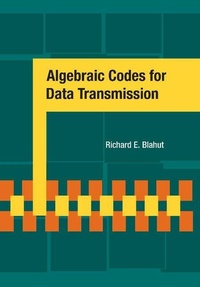
Algebraic Codes for Data Transmission
Published on 27. October 2011
Book
Paperback/Softback
498 pages
978-0-521-55659-0 (ISBN)
Description
The need to transmit and store massive amounts of data reliably and without error is a vital part of modern communications systems. Error-correcting codes play a fundamental role in minimising data corruption caused by defects such as noise, interference, crosstalk and packet loss. This book provides an accessible introduction to the basic elements of algebraic codes, and discusses their use in a variety of applications. The author describes a range of important coding techniques, including Reed-Solomon codes, BCH codes, trellis codes, and turbocodes. Throughout the book, mathematical theory is illustrated by reference to many practical examples. The book was first published in 2003 and is aimed at graduate students of electrical and computer engineering, and at practising engineers whose work involves communications or signal processing.
More details
Language
English
Place of publication
Cambridge
United Kingdom
Target group
Professional and scholarly
College/higher education
Product notice
Paperback (trade)
Illustrations
Worked examples or Exercises
Dimensions
Height: 244 mm
Width: 170 mm
Thickness: 27 mm
Weight
851 gr
ISBN-13
978-0-521-55659-0 (9780521556590)
Copyright in bibliographic data and cover images is held by Nielsen Book Services Limited or by the publishers or by their respective licensors: all rights reserved.
Schweitzer Classification
Other editions
Additional editions
Richard E. Blahut
Algebraic Codes for Data Transmission
E-Book
02/2005
1st Edition
Cambridge University Press
€54.49
Available for download
Richard E. Blahut
Algebraic Codes for Data Transmission
Book
02/2003
Cambridge University Press
€157.30
Shipment within 15-20 days
Person
Content
1. Introduction; 2. Introduction to algebra; 3. Linear block codes; 4. The arithmetic of Galois fields; 5. Cyclic codes; 6. Codes based on the Fourier transform; 7. Algorithms based on the Fourier transform; 8. Implementation; 9. Convolutional codes; 10. Beyond BCH codes; 11. Codes and algorithms based on graphs; 12. Performance of error-control codes; 13. Codes and algorithms for majority decoding.