

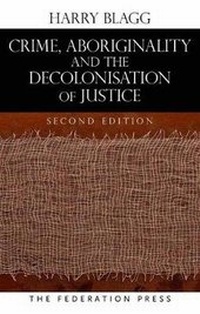
Crime, Aboriginality and the Decolonisation of Justice
2nd Edition
Published on 3. June 2016
Book
Paperback/Softback
224 pages
978-1-76002-057-6 (ISBN)
Description
Crime, Aboriginality and the Decolonisation of Justice explores contemporary strategies which might reduce the extraordinary levels of imprisonment and victimisation suffered by Aboriginal people in Australia. These are problems that continue to rise despite numerous inquiries and reports.
The book argues that the key factor in resolving these problems is investment in Aboriginal-owned and controlled justice, and justice-related processes, and focuses on how goals of reduced levels of imprisonment and victimisation of Aboriginals might be achieved. It explores the potential for â?~hybridâ?T initiatives in the complex â?~liminalâ?T space between Aboriginal and non-Aboriginal domains, for example, Aboriginal community/night patrols, community justice groups, healing centres and Aboriginal courts. This new edition covers emerging issues such as Foetal Alcohol Spectrum Disorders (FASD) in the context of the role being played by Aboriginal women in creating new engagement strategies that bring together clinicians, lawyers and police to deal with the problem through locally managed alternatives to the formal justice system and reports on the consequences of the Commonwealth Government's contentious 'intervention' in remote Northern Territory communities in 2007.
Harry Blagg disputes the relevance of the western, urban, criminological paradigm to the Aboriginal domain, and questions the application of both contemporary innovations such as restorative justice and mainstream models of policing. He also refutes allegations that Aboriginal customary laws condone violence against women and children, pointing to the wealth of research to the contrary, and suggests these laws contain considerable potential for renewal and healing. This book maintains that unresolved questions of colonisation, decolonisation and sovereignty lie at the heart of debates about criminal justice in post-colonial Australia.
The book argues that the key factor in resolving these problems is investment in Aboriginal-owned and controlled justice, and justice-related processes, and focuses on how goals of reduced levels of imprisonment and victimisation of Aboriginals might be achieved. It explores the potential for â?~hybridâ?T initiatives in the complex â?~liminalâ?T space between Aboriginal and non-Aboriginal domains, for example, Aboriginal community/night patrols, community justice groups, healing centres and Aboriginal courts. This new edition covers emerging issues such as Foetal Alcohol Spectrum Disorders (FASD) in the context of the role being played by Aboriginal women in creating new engagement strategies that bring together clinicians, lawyers and police to deal with the problem through locally managed alternatives to the formal justice system and reports on the consequences of the Commonwealth Government's contentious 'intervention' in remote Northern Territory communities in 2007.
Harry Blagg disputes the relevance of the western, urban, criminological paradigm to the Aboriginal domain, and questions the application of both contemporary innovations such as restorative justice and mainstream models of policing. He also refutes allegations that Aboriginal customary laws condone violence against women and children, pointing to the wealth of research to the contrary, and suggests these laws contain considerable potential for renewal and healing. This book maintains that unresolved questions of colonisation, decolonisation and sovereignty lie at the heart of debates about criminal justice in post-colonial Australia.
More details
Edition
2nd New edition
Language
English
Place of publication
Annandale, NSW
Australia
Target group
Professional and scholarly
Edition type
New edition
Dimensions
Height: 235 mm
Width: 159 mm
Weight
362 gr
ISBN-13
978-1-76002-057-6 (9781760020576)
Copyright in bibliographic data and cover images is held by Nielsen Book Services Limited or by the publishers or by their respective licensors: all rights reserved.
Schweitzer Classification
Other editions
Previous edition

Book
02/2008
Federation Press
€53.47
Article exhausted; check for reprint
Person
Harry Blagg is Professor of Criminology and Associate Dean of Research at the Law School, University of Western Australia. He has worked on projects monitoring the recommendations of the 1991 Royal Commission into Aboriginal Deaths in Custody, Aboriginal Customary Laws, Policing on Indigenous and other marginal youth, Indigenous self-policing initiatives in Australia, the impact of family violence on Indigenous communities, and violence prevention programs for Indigenous communities.
His current research interests include diversionary responses to the problem of Foetal Alcohol Spectrum Disorders (FASD) on Aboriginal communities, integrating Aboriginal and mainstream strategies in providing support for Aboriginal women escaping family violence, court innovations, and the role of Aboriginal women in the creation and maintenance of community self-policing. He has published extensively on these issues, including a number of critiques of â?~restorative justiceâ?T as it impacts on Indigenous people.
His current research interests include diversionary responses to the problem of Foetal Alcohol Spectrum Disorders (FASD) on Aboriginal communities, integrating Aboriginal and mainstream strategies in providing support for Aboriginal women escaping family violence, court innovations, and the role of Aboriginal women in the creation and maintenance of community self-policing. He has published extensively on these issues, including a number of critiques of â?~restorative justiceâ?T as it impacts on Indigenous people.
Content
Preface to the Second Edition
1. Introduction: Decolonising Criminology
2. Criminal Justice as Waste Management: Modernity and its Shadow
3. Aboriginal Youth: Culture, Resistance and the Dynamics of Self-Destruction
4. Restorative Justice: A Good Idea Whose Time has Gone?
5. Aboriginal People and Policing
6. Aboriginal Self-Policing Initiatives
7. Silenced in Court: Aboriginal People and Court Innovations
8. Family violence
9. Aboriginal Customary Law: From Denial to Recognition
10. Aboriginal Customary Law: From Recognition to Abolition?
11. Governance from Below: Community Justice Mechanisms, Crime and Disorder
Concluding Comments: Moving Forward
1. Introduction: Decolonising Criminology
2. Criminal Justice as Waste Management: Modernity and its Shadow
3. Aboriginal Youth: Culture, Resistance and the Dynamics of Self-Destruction
4. Restorative Justice: A Good Idea Whose Time has Gone?
5. Aboriginal People and Policing
6. Aboriginal Self-Policing Initiatives
7. Silenced in Court: Aboriginal People and Court Innovations
8. Family violence
9. Aboriginal Customary Law: From Denial to Recognition
10. Aboriginal Customary Law: From Recognition to Abolition?
11. Governance from Below: Community Justice Mechanisms, Crime and Disorder
Concluding Comments: Moving Forward