

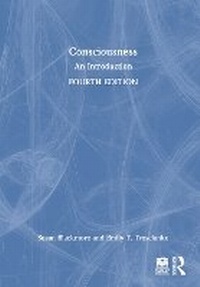
Consciousness
An Introduction
4th Edition
Published on 19. April 2024
Book
Hardback
766 pages
978-1-032-29257-1 (ISBN)
Description
Now in its fourth edition, this highly popular text is the definitive introduction to consciousness, exploring the key theories and evidence in consciousness studies ranging from neuroscience and psychology to quantum theories and philosophy.
Written by mother and daughter author team Susan Blackmore and Emily Troscianko, the book examines why the term 'consciousness' has no recognised definition. It also provides an opportunity to delve into personal intuitions about the self, mind, and consciousness. Featuring comprehensive coverage of all core topics in the field, the book explains why the problem of consciousness is so hard. Theories of attention and free will, altered states of consciousness, and the differences between conscious and unconscious are all explored. Written with students of psychology, neuroscience, and philosophy in mind, this edition has been thoroughly updated throughout, and includes expanded coverage of panpsychism, illusionism, predictive processing, adversarial collaboration, psychedelics, and AI.
Complete with key concept boxes, profiles of well-known thinkers, and questions and activities designed for both independent study and group work, Consciousness provides a complete introduction to this fascinating field, and is essential reading for students of psychology, philosophy, and neuroscience.
Written by mother and daughter author team Susan Blackmore and Emily Troscianko, the book examines why the term 'consciousness' has no recognised definition. It also provides an opportunity to delve into personal intuitions about the self, mind, and consciousness. Featuring comprehensive coverage of all core topics in the field, the book explains why the problem of consciousness is so hard. Theories of attention and free will, altered states of consciousness, and the differences between conscious and unconscious are all explored. Written with students of psychology, neuroscience, and philosophy in mind, this edition has been thoroughly updated throughout, and includes expanded coverage of panpsychism, illusionism, predictive processing, adversarial collaboration, psychedelics, and AI.
Complete with key concept boxes, profiles of well-known thinkers, and questions and activities designed for both independent study and group work, Consciousness provides a complete introduction to this fascinating field, and is essential reading for students of psychology, philosophy, and neuroscience.
Reviews / Votes
'This is a monumental achievement - an accessible introduction to the science and philosophy of consciousness that somehow manages to be up-to-date, comprehensive and penetrating. The authors treat each topic (and there are many) with depth, panache, and enthusiasm. Superbly organized, and even-handed without being vanilla, this is essential reading for anyone interested in the philosophy, psychology, and neuroscience of consciousness.'Andy Clark FBA, FRSE. Professor of Cognitive Philosophy, University of Sussex, UK, and Author of The Experience Machine: How Our Minds Predict and Shape Reality
'An eminently readable, deeply literary primer tailored [to undergraduates and] all those curious about where that voice inside their head comes from. This text delves into the myriad ways philosophies from the East and the West have sought to integrate the subjective, inner world of emotions and thoughts, into the objective, tangible universe. Eschewing a singular doctrinal stance, -ism or theory, the text sheds light on the diverse strategies scholars, psychologists, and neuroscientists employ to grapple with the central enigma at the heart of existence - the fact that we can experience anything.'
Christof Koch, Meritorious Investigator, Allen Institute, Seattle, US
'This book is a terrific introduction to the deep and fascinating puzzle of consciousness. Blackmore and Troscianko delight, illuminate and intrigue the reader, as well as outlining a wide variety of perspectives on consciousness, from the psychological and neuroscientific, to the spiritual and the literary.'
Nick Chater, Professor of Behavioural Science, Warwick Business School, UK, and author of The Mind is Flat
'The classic introduction for consciousness studies: Competent, entertaining and accessible. It covers an enormous range of topics from machine consciousness to altered states and secular spirituality. Do check out this new and largely expanded edition!'
Thomas Metzinger, Philosophisches Seminar, Johannes Gutenberg-Universitaet Mainz, Germany
'This is my favourite book on consciousness. The authors' love for the subject shines through. It is fantastically readable, introducing complex ideas by explaining the personalities and histories that led to their development.'
Jackie Andrade, Professor of Psychology, University of Plymouth, UK
'The Fourth Edition of Consciousness (Blackmore and Troscianko) lives up to the excellent contribution of the previous editions. This book is a much needed resource for students and scholars, summarizing a vast range of theories and perspectives on consciousness, and taking a careful, skeptical, and above all a rational approach to each one. The authors are not fooled by the magicalism or spiritualism that has infiltrated so much of the literature. The correct scientific theory of consciousness probably lies somewhere within this book.'
Michael Graziano, Professor of Neuroscience and Psychology at Princeton University, US
More details
Edition
4th edition
Language
English
Place of publication
London
United Kingdom
Publishing group
Taylor & Francis Ltd
Target group
College/higher education
Postgraduate and Undergraduate
Illustrations
247 farbige Abbildungen, 80 Farbfotos bzw. farbige Rasterbilder, 167 farbige Zeichnungen, 2 farbige Tabellen
2 Tables, color; 167 Line drawings, color; 80 Halftones, color; 247 Illustrations, color
Dimensions
Height: 246 mm
Width: 174 mm
Weight
1840 gr
ISBN-13
978-1-032-29257-1 (9781032292571)
Copyright in bibliographic data and cover images is held by Nielsen Book Services Limited or by the publishers or by their respective licensors: all rights reserved.
Schweitzer Classification
Other editions
Additional editions
E-Book
04/2024
4th Edition
Taylor & Francis
€68.49
Available for download
E-Book
04/2024
4th Edition
Taylor & Francis
€68.49
Available for download
Book
04/2024
4th Edition
Routledge
€65.00
Shipment within 10-20 days
Previous edition
Book
04/2018
3rd Edition
Routledge
€185.70
Article exhausted; check for reprint
Persons
Susan Blackmore is a psychologist, TED lecturer, and writer researching consciousness, memes, meditation, and anomalous experiences, and is Visiting Professor in Psychology at the University of Plymouth. She is the author of multiple books on consciousness, including The Meme Machine (1999), which has been translated into 18 languages; Zen and the Art of Consciousness (2011); Seeing Myself: The New Science of Out-of-Body Experiences (2017); and Very Short Introduction to Consciousness (2017).
Emily T. Troscianko is a coach, writer, and researcher affiliated with Oxford University. She is interested in mental health, readers' responses to literature, and how the two might be linked-as well as what both have to do with human consciousness. Her monograph Kafka's Cognitive Realism (2014) explores the strange phenomenon we call the 'Kafkaesque' and her Hunger Artist blog for Psychology Today investigates the science and experience of eating disorders and recovery.
Emily T. Troscianko is a coach, writer, and researcher affiliated with Oxford University. She is interested in mental health, readers' responses to literature, and how the two might be linked-as well as what both have to do with human consciousness. Her monograph Kafka's Cognitive Realism (2014) explores the strange phenomenon we call the 'Kafkaesque' and her Hunger Artist blog for Psychology Today investigates the science and experience of eating disorders and recovery.
Content
Introduction Section One: The Problem 1. What's the problem? 2. What is it like to be ...? 3. The grand illusion Section Two: The Brain 4. Neuroscience and the correlates of consciousness 5. The theatre of the mind 6. The unity of consciousness Section Three: Mind and Action 7. Attention 8. Conscious and unconscious 9. Agency and free will Section Four: Evolution 10. Evolution and animal minds 11. The function of consciousness 12. The evolution of machines Section Five: Borderlands 13. Altered states of consciousness 14. Reality and imagination 15. Dreaming and beyond Section Six: Self and Other 16. Egos, bundles, and theories of self 17. The view from within? 18. Waking up