

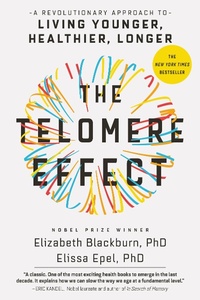
The Telomere Effect
A Revolutionary Approach to Living Younger, Healthier, Longer
Published on 2. January 2018
Book
Paperback/Softback
416 pages
978-1-4555-8798-8 (ISBN)
Description
This New York Times bestselling book—coauthored by a Nobel Prize Winner and a health psychologist—explores the aging process and how specific lifestyle changes related to telomeres can increase longevity.
Have you wondered why some sixty-year-olds look and feel like forty-year-olds and why some forty-year-olds look and feel like sixty-year-olds? While many factors contribute to aging and illness, Dr. Elizabeth Blackburn discovered a biological indicator called telomerase, the enzyme that replenishes telomeres, which protect our genetic heritage. Dr. Blackburn and Dr. Elissa Epel's research shows that the length and health of one's telomeres are a biological underpinning of the long-hypothesized mind-body connection. We can make changes to our daily habits to protect our telomeres and increase our health spans (the number of years we remain healthy, active, and disease-free).
The Telomere Effect reveals how Blackburn and Epel's findings, together with research from colleagues around the world, cumulatively show that sleep quality, exercise, aspects of diet, and even certain chemicals profoundly affect our telomeres, and that chronic stress, negative thoughts, strained relationships, and even the wrong neighborhoods can eat away at them.
Drawing from this scientific body of knowledge, they share lists of foods and suggest amounts and types of exercise that are healthy for our telomeres, mind tricks you can use to protect yourself from stress, and information about how to protect your children against developing shorter telomeres, from pregnancy through adolescence. And they describe how we can improve our health spans at the community level, with neighborhoods characterized by trust, green spaces, and safe streets.
The Telomere Effect will make you reassess how you live your life on a day-to-day basis. It is the first book to explain how we age at a cellular level and how we can make simple changes to keep our chromosomes and cells healthy, allowing us to stay disease-free longer and live more vital and meaningful lives.
Have you wondered why some sixty-year-olds look and feel like forty-year-olds and why some forty-year-olds look and feel like sixty-year-olds? While many factors contribute to aging and illness, Dr. Elizabeth Blackburn discovered a biological indicator called telomerase, the enzyme that replenishes telomeres, which protect our genetic heritage. Dr. Blackburn and Dr. Elissa Epel's research shows that the length and health of one's telomeres are a biological underpinning of the long-hypothesized mind-body connection. We can make changes to our daily habits to protect our telomeres and increase our health spans (the number of years we remain healthy, active, and disease-free).
The Telomere Effect reveals how Blackburn and Epel's findings, together with research from colleagues around the world, cumulatively show that sleep quality, exercise, aspects of diet, and even certain chemicals profoundly affect our telomeres, and that chronic stress, negative thoughts, strained relationships, and even the wrong neighborhoods can eat away at them.
Drawing from this scientific body of knowledge, they share lists of foods and suggest amounts and types of exercise that are healthy for our telomeres, mind tricks you can use to protect yourself from stress, and information about how to protect your children against developing shorter telomeres, from pregnancy through adolescence. And they describe how we can improve our health spans at the community level, with neighborhoods characterized by trust, green spaces, and safe streets.
The Telomere Effect will make you reassess how you live your life on a day-to-day basis. It is the first book to explain how we age at a cellular level and how we can make simple changes to keep our chromosomes and cells healthy, allowing us to stay disease-free longer and live more vital and meaningful lives.
More details
Language
English
Place of publication
United States
Product notice
Paperback (trade)
Unsewn / adhesive bound
Dimensions
Height: 228 mm
Width: 154 mm
Thickness: 30 mm
Weight
419 gr
ISBN-13
978-1-4555-8798-8 (9781455587988)
Copyright in bibliographic data and cover images is held by Nielsen Book Services Limited or by the publishers or by their respective licensors: all rights reserved.
Schweitzer Classification
Persons
Elizabeth Blackburn, PhD, received the Nobel Prize in Physiology or Medicine in 2009 alongside two colleagues for their discovery of telomerase and telomeres' role in the aging process. She is currently president of the Salk Institute. Blackburn was elected president of the American Association for Cancer Research and is a recipient of the Albert Lasker Basic Medical Research Award, among many other awards. In 2007, she was named one of TIME magazine's 100 most influential people.
Elissa Epel, PhD, is a leading health psychologist who studies stress, aging, and obesity. She is the director of UCSF's Aging, Metabolism, and Emotion Center and is associate director of the Center for Health and Community. She is a member of the National Academy of Medicine and serves on scientific advisory committees for the National Institutes of Health, and the Mind and Life Institute. She has received awards from Stanford University, the Society of Behavioral Medicine, and the American Psychological Association.
Elissa Epel, PhD, is a leading health psychologist who studies stress, aging, and obesity. She is the director of UCSF's Aging, Metabolism, and Emotion Center and is associate director of the Center for Health and Community. She is a member of the National Academy of Medicine and serves on scientific advisory committees for the National Institutes of Health, and the Mind and Life Institute. She has received awards from Stanford University, the Society of Behavioral Medicine, and the American Psychological Association.