

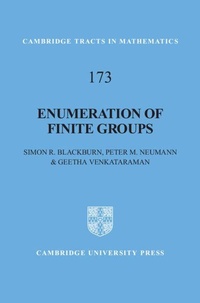
Enumeration of Finite Groups
Published on 18. October 2007
Book
Hardback
294 pages
978-0-521-88217-0 (ISBN)
Description
How many groups of order n are there? This is a natural question for anyone studying group theory, and this Tract provides an exhaustive and up-to-date account of research into this question spanning almost fifty years. The authors presuppose an undergraduate knowledge of group theory, up to and including Sylow's Theorems, a little knowledge of how a group may be presented by generators and relations, a very little representation theory from the perspective of module theory, and a very little cohomology theory - but most of the basics are expounded here and the book is more or less self-contained. Although it is principally devoted to a connected exposition of an agreeable theory, the book does also contain some material that has not hitherto been published. It is designed to be used as a graduate text but also as a handbook for established research workers in group theory.
Reviews / Votes
'... a welcome and well-written addition to the theory of finite groups.' EMS NewsletterMore details
Series
Language
English
Place of publication
Cambridge
United Kingdom
Target group
Professional and scholarly
Illustrations
Worked examples or Exercises
Dimensions
Height: 235 mm
Width: 157 mm
Thickness: 20 mm
Weight
580 gr
ISBN-13
978-0-521-88217-0 (9780521882170)
Copyright in bibliographic data and cover images is held by Nielsen Book Services Limited or by the publishers or by their respective licensors: all rights reserved.
Schweitzer Classification
Other editions
Additional editions
Simon R. Blackburn | Peter M. Neumann | Geetha Venkataraman
Enumeration of Finite Groups
E-Book
12/2007
1st Edition
Cambridge University Press
€97.49
Available for download
Persons
Simon Blackburn is a Professor of Pure Mathematics at Royal Holloway, University of London. He is also currently Head of Department in Mathematics at Royal Holloway. His mathematical interests include group theory, combinatorics and cryptography and some of the connections between these areas. Peter Neumann is a Tutorial Fellow in Mathematics at Queen's College and University Lecturer in Pure Mathematics at Oxford University. His interests include many areas within algebra and group theory, including computational group theory, application of group theory in combinatorics, and nineteenth century history of group theory. Gettha Venkataraman is a Senior Lecturer in Mathematics in St Stephen's College, at the University of Delhi. Her research interests involve enumerations of finite groups and other aspects of finite group theory. She is also interested in mathematics education for schools and the learning and teaching of mathematics at higher levels.
Content
1. Introduction; Part I. Elementary Results: 2. Some basic observations; Part II. Groups of Prime Power Order: 3. Preliminaries; 4. Enumerating p-groups: a lower bound; 5. Enumerating p-groups: upper bounds; Part III. Pyber's Theorem: 6. Some more preliminaries; 7. Group extensions and cohomology; 8. Some representation theory; 9. Primitive soluble linear groups; 10. The orders of groups; 11. Conjugacy classes of maximal soluble subgroups of symmetric groups; 12. Enumeration of finite groups with abelian Sylow subgroups; 13. Maximal soluble linear groups; 14. Conjugacy classes of maximal soluble subgroups of the general linear group; 15. Pyber's theorem: the soluble case; 16. Pyber's theorem: the general case; Part IV. Other Topics: 17. Enumeration within varieties of abelian groups; 18. Enumeration within small varieties of A-groups; 19. Enumeration within small varieties of p-groups; 20. Miscellanea; 21. Survey of other results; 22. Some open problems; Appendix A. Maximising two equations.