

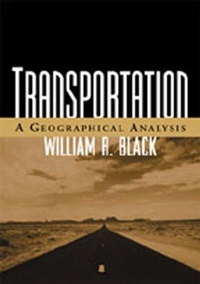
Transportation
A Geographical Analysis
1st Edition
Published on 10. July 2003
Book
Hardback
375 pages
978-1-57230-848-0 (ISBN)
Description
This comprehensive text provides an authoritative introduction to transportation geography. With a primary focus on the United States, the volume also examines problems and trends in Europe and other parts of the developed world. Students gain a solid grasp of the history, definitions, and core concepts of the field, as well as models for analyzing transportation networks and flows between regions. Environmental, economic, and social issues in transportation planning and policy are addressed, and the uses of geographic information systems in transport (GIS-T) are discussed in detail. Written in a clear, straightforward style, the volume emphasizes real-world applications of the concepts discussed and identifies promising directions for future research. No advanced mathematical knowledge on the part of the reader is assumed.
Reviews / Votes
This high-quality book from a noted transport geographer is a welcome addition to the literature. Readers interested in networks, flow analysis, and spatial interaction will find it especially indispensable. Clear and insightful sections on the transport planning process, transport impact analysis, and transport's impact on the environment are major bonuses. From a contemporary perspective, the sections on geographic information systems in transport and the treatment of such current issues as congestion and sustainable transport are critical reading for academics and policymakers alike.--Thomas R. Leinbach, Department of Geography, University of KentuckyThis is the best and most comprehensive analysis available of regional transportation systems in the United States, befitting William R. Black's reputation as one of the field's foremost authorities. Not only is Black's work on the evolution of U.S. transportation insightful, but his development and demonstration of research methodologies is also without peer. The book distills historical and recent policy questions into clear, researchable issues, blending spatial, economic, environmental, and social considerations. It concludes on a positive note of sustainability that is both optimistic and judicious. This book should be required reading for all transportation researchers and analysts. As a text, it is sure to dominate the field for the next decade.--Kingsley E. Haynes, University Professor and Dean, School of Public Policy, George Mason University
It would be difficult to imagine a more useful or comprehensive introductory text in the field of transportation geography. The author successfully manages to infuse the text with his abiding interest in the geographical aspects of all things to do with travel and transport.--Andrew Gillespie, University of Newcastle, UK
- ...provides a major contribution to the transport geography literature....each chapter could easily be used as a lecture topic in its own right. Its strengths are in placing the geographical literature in the centre of the transport literature, as the richness of that material has much to offer all students and researchers. The book is full of nuggets of information and ideas, with an overall clarity of perspective. --Built Environment, 6/8/2003
More details
Language
English
Place of publication
New York
United States
Target group
College/higher education
General and Professional Practice & Development
Dimensions
Height: 254 mm
Width: 178 mm
Weight
820 gr
ISBN-13
978-1-57230-848-0 (9781572308480)
Copyright in bibliographic data and cover images is held by Nielsen Book Services Limited or by the publishers or by their respective licensors: all rights reserved.
Schweitzer Classification
Person
William R. Black, PhD, until his death in 2013, was Professor Emeritus in the Department of Geography at Indiana University in Bloomington. A foundational figure in transport geography, he directed over 20 transportation research and planning projects, published over 200 research papers and reports, and authored, coauthored, or edited seven books. He founded the Transportation Geography Specialty Group of the Association of American Geographers (AAG), was a key figure in the development of the Journal of Transport Geography, and served on numerous panels and committees of the Transportation Research Board of the National Research Council. Dr. Black received the Edward L. Ullman Award for significant contributions to transportation geography from the AAG, which also selected him to present the Fleming Lecture in Transportation Geography.
Content
Part I. Foundations
1. An Introduction to Transportation Geography
2. A History of Transportation
3. Current Transport Systems and Trends
Part II. Network Analysis
4. Basic Elements of Transport Networks: Nodes and Links
5. Measurement of Transportation Networks
6. The Location of Transportation Routes and Links
Part III. Flow Analysis
7. Trade and Commodity Flows
8. Methods of Flow Analysis
9. The Prediction Problem of Flow Generation
10. Spatial Interaction and the Gravity Model
11. Spatial Choices: Destinations, Modes, and Routes
Part IV. Policy, Plans, and Impacts
12. Transport Policy
13. Transport Planning: Rationale and Process
14. Transport Impact Analysis
15. Transportation?s Impact on the Environment
16. Transportation, the Economy, and Economic Development
Part V. Geographic Information Systems in Transport (GIS-T)
17. GIS-T: An Introduction
Part VI. Current Issues and Problems
18. Societal Trends and Their Impact on Transport
19. Congestion
20. Sustainable Transport and Potential Mobility
Part VII. The Future
21. Transportation and Transportation Geography
References
1. An Introduction to Transportation Geography
2. A History of Transportation
3. Current Transport Systems and Trends
Part II. Network Analysis
4. Basic Elements of Transport Networks: Nodes and Links
5. Measurement of Transportation Networks
6. The Location of Transportation Routes and Links
Part III. Flow Analysis
7. Trade and Commodity Flows
8. Methods of Flow Analysis
9. The Prediction Problem of Flow Generation
10. Spatial Interaction and the Gravity Model
11. Spatial Choices: Destinations, Modes, and Routes
Part IV. Policy, Plans, and Impacts
12. Transport Policy
13. Transport Planning: Rationale and Process
14. Transport Impact Analysis
15. Transportation?s Impact on the Environment
16. Transportation, the Economy, and Economic Development
Part V. Geographic Information Systems in Transport (GIS-T)
17. GIS-T: An Introduction
Part VI. Current Issues and Problems
18. Societal Trends and Their Impact on Transport
19. Congestion
20. Sustainable Transport and Potential Mobility
Part VII. The Future
21. Transportation and Transportation Geography
References