

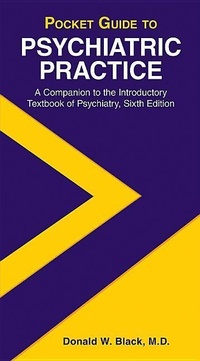
Pocket Guide to Psychiatric Practice
Published on 24. June 2018
Book
Paperback/Softback
400 pages
978-1-61537-154-9 (ISBN)
Description
The long-awaited Pocket Guide to Psychiatric
Practice is a portable and concise companion to its parent textbook,
Introductory Textbook of Psychiatry, Sixth Edition, the
preeminent introduction to psychiatry for residents, medical students, and
other health professionals. The Pocket Guide is designed to be
carried with them on clinical rotations and contains the information needed
for patient assessment and clinical management in an easily accessible and
convenient format. Mirroring the larger text, the guide takes as its premise
that physicians-regardless of their ultimate role in medicine-should be able
to define and recognize mental illnesses, to identify methods for treating
them, and, for those few who become researchers, to help develop methods for
discovering their causes and implementing preventive measures. This pocket
version, compatible with DSM-5, includes criteria sets for the most common
disorders that learners encounter and is organized to follow the
developmental lifespan.
The author, who co-edited the larger text, has
retained many of the attributes that made the parent text successful, while
adding new, user-friendly features:
* Completely up-to-date information on all of the disorders and
descriptions of newly released medications.
* A writing style that is
interesting, consistent, and highly accessible, with no redundancy.
* A
wealth of tables, lists, and other strategies for presenting information in
a concise and easy-to-understand manner.
* Content organized in
parallel with the Introductory Textbook of Psychiatry to make it
easier to locate additional learning resources-such as case vignettes,
useful clinical "pearls," self-assessment questions, and a glossary of
terms-as needed.
* An emphasis on the satisfaction of working with
psychiatric patients of all types and in all settings that will be
appreciated by learners beginning their journey in the field.
Pocket Guide to Psychiatric Practice is a highly readable,
interesting, and useful resource. Although the book is written primarily for
medical students and residents in their first years of training, it will
prove useful for individuals seeking psychiatric training from the
perspectives of other disciplines such as nursing or social work. The
Pocket Guide can be combined with the larger and more detailed
Introductory Textbook of Psychiatry and the student-oriented
Study Guide to Introductory Psychiatry, to constitute a library
of resources on psychiatric disorders and their assessment that sets the
stage for lifelong learning.
Practice is a portable and concise companion to its parent textbook,
Introductory Textbook of Psychiatry, Sixth Edition, the
preeminent introduction to psychiatry for residents, medical students, and
other health professionals. The Pocket Guide is designed to be
carried with them on clinical rotations and contains the information needed
for patient assessment and clinical management in an easily accessible and
convenient format. Mirroring the larger text, the guide takes as its premise
that physicians-regardless of their ultimate role in medicine-should be able
to define and recognize mental illnesses, to identify methods for treating
them, and, for those few who become researchers, to help develop methods for
discovering their causes and implementing preventive measures. This pocket
version, compatible with DSM-5, includes criteria sets for the most common
disorders that learners encounter and is organized to follow the
developmental lifespan.
The author, who co-edited the larger text, has
retained many of the attributes that made the parent text successful, while
adding new, user-friendly features:
* Completely up-to-date information on all of the disorders and
descriptions of newly released medications.
* A writing style that is
interesting, consistent, and highly accessible, with no redundancy.
* A
wealth of tables, lists, and other strategies for presenting information in
a concise and easy-to-understand manner.
* Content organized in
parallel with the Introductory Textbook of Psychiatry to make it
easier to locate additional learning resources-such as case vignettes,
useful clinical "pearls," self-assessment questions, and a glossary of
terms-as needed.
* An emphasis on the satisfaction of working with
psychiatric patients of all types and in all settings that will be
appreciated by learners beginning their journey in the field.
Pocket Guide to Psychiatric Practice is a highly readable,
interesting, and useful resource. Although the book is written primarily for
medical students and residents in their first years of training, it will
prove useful for individuals seeking psychiatric training from the
perspectives of other disciplines such as nursing or social work. The
Pocket Guide can be combined with the larger and more detailed
Introductory Textbook of Psychiatry and the student-oriented
Study Guide to Introductory Psychiatry, to constitute a library
of resources on psychiatric disorders and their assessment that sets the
stage for lifelong learning.
More details
Language
English
Place of publication
VA
United States
Target group
Professional and scholarly
US School Grade: College Graduate Student and over
Product notice
Paperback (trade)
Illustrations
32 Charts; 57 Tables, unspecified
Dimensions
Height: 206 mm
Width: 114 mm
Thickness: 13 mm
Weight
318 gr
ISBN-13
978-1-61537-154-9 (9781615371549)
Copyright in bibliographic data and cover images is held by Nielsen Book Services Limited or by the publishers or by their respective licensors: all rights reserved.
Schweitzer Classification
Other editions
Additional editions
Donald W. Black
Pocket Guide to Psychiatric Practice
E-Book
04/2018
American Psychiatric Association Publishing
€50.99
Available for download
Person
Donald W. Black, M.D., is Professor of Psychiatry
and Director of Residency Training and Vice Chair for Education in the
Department of Psychiatry at the University of Iowa Roy J. and Lucille A.
Carver College of Medicine in Iowa City, Iowa.
and Director of Residency Training and Vice Chair for Education in the
Department of Psychiatry at the University of Iowa Roy J. and Lucille A.
Carver College of Medicine in Iowa City, Iowa.
Content
About the Author
Preface
Part I: Diagnosis and
Psychiatric Interview
Chapter 1. Diagnosis and
Classification
Chapter 2. Interviewing and Assessment
Part II:
Psychiatric Disorders
Chapter 3. Neurodevelopmental (Child)
Disorders
Chapter 4. Schizophrenia Spectrum and Other Psychotic
Disorders
Chapter 5. Mood Disorders
Chapter 6. Anxiety
Disorders
Chapter 7. Obsessive-Compulsive and Related
Disorders
Chapter 8. Trauma- and Stressor-Related Disorders
Chapter
9. Dissociative Disorders
Chapter 10. Somatic Symptom
Disorders
Chapter 11. Feeding and Eating Disorders
Chapter 12.
Sleep-Wake Disorders
Chapter 13. Sexual Dysfunction, Gender Dysphoria,
and Paraphilias
Chapter 14. Disruptive, Impulse-Control, and Conduct
Disorders
Chapter 15. Substance-Related and Addictive
Disorders
Chapter 16. Neurocognitive Disorders
Chapter 17.
Personality Disorders
Part III: Special Topics
Chapter 18.
Psychiatric Emergencies
Chapter 19. Legal Issues
Chapter 20.
Psychotherapy
Chapter 21. Somatic Treatments
Index
Preface
Part I: Diagnosis and
Psychiatric Interview
Chapter 1. Diagnosis and
Classification
Chapter 2. Interviewing and Assessment
Part II:
Psychiatric Disorders
Chapter 3. Neurodevelopmental (Child)
Disorders
Chapter 4. Schizophrenia Spectrum and Other Psychotic
Disorders
Chapter 5. Mood Disorders
Chapter 6. Anxiety
Disorders
Chapter 7. Obsessive-Compulsive and Related
Disorders
Chapter 8. Trauma- and Stressor-Related Disorders
Chapter
9. Dissociative Disorders
Chapter 10. Somatic Symptom
Disorders
Chapter 11. Feeding and Eating Disorders
Chapter 12.
Sleep-Wake Disorders
Chapter 13. Sexual Dysfunction, Gender Dysphoria,
and Paraphilias
Chapter 14. Disruptive, Impulse-Control, and Conduct
Disorders
Chapter 15. Substance-Related and Addictive
Disorders
Chapter 16. Neurocognitive Disorders
Chapter 17.
Personality Disorders
Part III: Special Topics
Chapter 18.
Psychiatric Emergencies
Chapter 19. Legal Issues
Chapter 20.
Psychotherapy
Chapter 21. Somatic Treatments
Index