

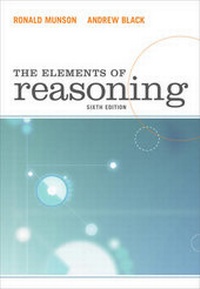
The Elements of Reasoning
6th Edition
Published on 1. January 2011
Book
Paperback/Softback
240 pages
978-0-495-80918-0 (ISBN)
Description
"The Elements of Reasoning" is a concise and lucid introduction to the basic elements of argumentative prose and the conceptual tools necessary to understand, analyze, criticize, and construct arguments. This text is not only perfect for a college course in argument analysis, but also as a reference tool when confronted with arguments outside the classroom experience. While "The Elements of Reasoning" covers the standard formal tools of introductory logic, its emphasis is on practical applications to the kinds of arguments students most often encounter.
Reviews / Votes
Preface. Briefing. Basic Assumptions. Organization. Using This Book. 1. RECOGNIZING ARGUMENTS. What Is an Argument? Three General Considerations. Recognizing Arguments. Multiple Conclusions and Complex Arguments. Exercises. 2. ANALYZING ARGUMENTS. Showing the Structure of Arguments. Strategies of Analysis. Two Special Problems. Analyzing a Complex Argument: An Example. Exercises. 3. EVALUATING ARGUMENTS. Deductive Arguments. Exercises. Nondeductive Arguments. Complex Arguments. Exercises. Overall Argument Evaluation. Exercises. 4. SOME VALID ARGUMENT FORMS. Sentential Form. Exercises. Valid Argument Forms. Two Invalid Argument Forms. Exercises. Using the Forms to Show Validity. Exercises. Conditionals. Equivalent Forms. Exercises. Using Inference and Equivalence Rules. Deductive Proof Strategies. Exercises. 5. MORE VALID ARGUMENT FORMS: CATEGORICAL REASONING AND VENN DIAGRAMS. Categorical Statements. Exercises. Categorical Syllogisms. Exercises. 6. CAUSAL ANALYSIS. Basic Causal Relationships. Contributing Factors as "Causes." Causal Explanations. Testing Causal Claims. Experimental Trials. Exercises. 7. ARGUMENT BY ANALOGY AND MODELS. Analogical Arguments. Models. Evaluating Analogical Reasoning. Exercises. 8. ERRORS IN REASONING: FALLACIES. Fallacies in Supporting a Claim. Fallacies of Criticism and Response. Exercises. 9. DEFINITION. Definition of "Definition." Two Types of Definition. Methods of Definition. Standards of Definition. Working Out a Definition. Exercises. 10. VAGUENESS AND AMBIGUITY. Vagueness. Ambiguity. Exercises. 11. REASONABLE BELIEFS. Granted Claims and Acceptable Beliefs. New Claims, Background Beliefs, and Rationality. Exercises. 12. RULES FOR WRITING. Structure. Style. Exercises: Some Answers, Hints, and Comments. Index.More details
Edition
6th Revised edition
Language
English
Place of publication
Belmont, CA
United States
Publishing group
Cengage Learning, Inc
Target group
College/higher education
Edition type
Revised edition
Dimensions
Height: 246 mm
Width: 189 mm
Thickness: 20 mm
ISBN-13
978-0-495-80918-0 (9780495809180)
Copyright in bibliographic data and cover images is held by Nielsen Book Services Limited or by the publishers or by their respective licensors: all rights reserved.
Schweitzer Classification
Content
1. Introduction to Cognitive Psychology. 2. Cognition and the Brain: Basic Principles. 3. Perception. 4. Attention. 5. Short-Term and Working Memory. 6. Long-Term Memory: Basic Principles. 7. Everyday Memory and Memory Errors. 8. Knowledge. 9. Visual Imagery. 10. Language. 11. Problem Solving. 12. Reasoning and Decision Making.