

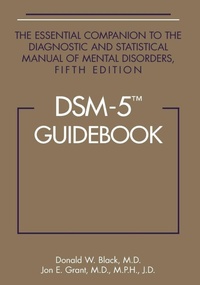
DSM-5 (R) Guidebook
The Essential Companion to the Diagnostic and Statistical Manual of Mental Disorders, Fifth Edition
Published on 2. April 2014
Book
Paperback/Softback
567 pages
978-1-58562-465-2 (ISBN)
Description
DSM-5 Guidebook: The Essential Companion to the
Diagnostic and Statistical Manual of Mental Disorders, Fifth Edition
is a user-friendly, supplementary guide for psychiatrists, psychologists,
and other mental health practitioners who need to know how DSM-5 differs
from its predecessor in terms of organizational structure, diagnostic
categories, and the criteria themselves. While it does not replace the
comprehensive and authoritative DSM-5, it illuminates its content by
teaching mental health professionals how to use the revised diagnostic
criteria and by providing a practical context for its clinical
use.
The book offers many valuable features, including:
* An
historical overview of the development of the DSM in general, and DSM-5 in
particular, a progression that might be said to mirror the evolution of
psychiatry as a whole. The material on the creation of DSM-5 includes
coverage of dimensional assessment, reliability and field trials, and the
controversies that arose during development of DSM-5.
* An indispensable
chapter on how to use DSM-5 that addresses coding, diagnostic certainty, the
demise of the multiaxial system, and the key changes to each diagnostic
category.
* Full coverage of the significant reorganization from
DSM-IV-TR to DSM-5, which is designed to incorporate advances in
neuroscience, brain imaging and genetics. Chapters were reordered to reflect
scientific advances in the understanding of psychiatric disorders, and the
presumed etiological and the pathophysiological relationships among
them.
* Extensive coverage of the decision to integrate dimensional
measures into DSM-5, which may enhance the clinician's ability to assess
symptom variation and severity and aid in patient evaluation, treatment
decisions, and outcome monitoring. The various measures are presented and
their use discussed.
* Finally, as the authors were not part of the
revision process, they offer a fresh, down-to-earth perspective that will
resonate with clinicians by focusing on the changes that will most
significantly impact clinicians' professional lives.
DSM-5
Guidebook provides a roadmap to the many changes in this living
document, DSM-5, and will prove invaluable to psychiatrists, psychologists,
psychiatric nurses, neurologists, social workers, and all who strive to
understand mental illness as it is conceived today.
Diagnostic and Statistical Manual of Mental Disorders, Fifth Edition
is a user-friendly, supplementary guide for psychiatrists, psychologists,
and other mental health practitioners who need to know how DSM-5 differs
from its predecessor in terms of organizational structure, diagnostic
categories, and the criteria themselves. While it does not replace the
comprehensive and authoritative DSM-5, it illuminates its content by
teaching mental health professionals how to use the revised diagnostic
criteria and by providing a practical context for its clinical
use.
The book offers many valuable features, including:
* An
historical overview of the development of the DSM in general, and DSM-5 in
particular, a progression that might be said to mirror the evolution of
psychiatry as a whole. The material on the creation of DSM-5 includes
coverage of dimensional assessment, reliability and field trials, and the
controversies that arose during development of DSM-5.
* An indispensable
chapter on how to use DSM-5 that addresses coding, diagnostic certainty, the
demise of the multiaxial system, and the key changes to each diagnostic
category.
* Full coverage of the significant reorganization from
DSM-IV-TR to DSM-5, which is designed to incorporate advances in
neuroscience, brain imaging and genetics. Chapters were reordered to reflect
scientific advances in the understanding of psychiatric disorders, and the
presumed etiological and the pathophysiological relationships among
them.
* Extensive coverage of the decision to integrate dimensional
measures into DSM-5, which may enhance the clinician's ability to assess
symptom variation and severity and aid in patient evaluation, treatment
decisions, and outcome monitoring. The various measures are presented and
their use discussed.
* Finally, as the authors were not part of the
revision process, they offer a fresh, down-to-earth perspective that will
resonate with clinicians by focusing on the changes that will most
significantly impact clinicians' professional lives.
DSM-5
Guidebook provides a roadmap to the many changes in this living
document, DSM-5, and will prove invaluable to psychiatrists, psychologists,
psychiatric nurses, neurologists, social workers, and all who strive to
understand mental illness as it is conceived today.
Reviews / Votes
Taken as a whole, the Guidebook's primary strengthis its historical perspective on the process of diagnosis and the place of
DSM-5 in that larger context. In other regards, the
Guidebook adds little to the material available in DSM-5
itself. -- Michael D. Jibson & Lisa S. Seyfried, University of Michigan, Ann Arbor, MI, USA * Academic Psychiatry * This is an excellent book. I found it to be user-friendly
and a true guide to using the DSM-5. -- Valerie E. Mathis-Allen, M.D. * Doody's Book Review *
More details
Language
English
Place of publication
VA
United States
Target group
Professional and scholarly
College/higher education
US School Grade: College Graduate Student and over
Product notice
Paperback (trade)
Illustrations
Not illustrated
Dimensions
Height: 260 mm
Width: 177 mm
Thickness: 23 mm
Weight
890 gr
ISBN-13
978-1-58562-465-2 (9781585624652)
Copyright in bibliographic data and cover images is held by Nielsen Book Services Limited or by the publishers or by their respective licensors: all rights reserved.
Schweitzer Classification
Other editions
Additional editions
Donald W. Black | Jon E. Grant
DSM-5® Guidebook
The Essential Companion to the Diagnostic and Statistical Manual of Mental Disorders, Fifth Edition
E-Book
02/2014
1st Edition
American Psychiatric Association Publishing
€58.99
Available for download
Previous edition

Allen J. Frances | etc.
DSM-IV-TR Guidebook
Book
04/2004
American Psychiatric Press Inc.
€88.09
Article exhausted; check for reprint
Persons
Donald W. Black, M.D., is Vice Chair for Education,
Department of Psychiatry, and Professor of Psychiatry at the University of
Iowa Carver College of Medicine in Iowa City, Iowa.
Jon E. Grant,
M.D., M.P.H., J.D., is Professor in the Department of Psychiatry and
Behavioral Neuroscience at the University of Chicago Pritzker School of
Medicine in Chicago, Illinois.
Department of Psychiatry, and Professor of Psychiatry at the University of
Iowa Carver College of Medicine in Iowa City, Iowa.
Jon E. Grant,
M.D., M.P.H., J.D., is Professor in the Department of Psychiatry and
Behavioral Neuroscience at the University of Chicago Pritzker School of
Medicine in Chicago, Illinois.
Content
About the
Authors
Preface
Acknowledgments
Introduction
Chapter 1. The
march to DSM-5
Chapter 2. Use of DSM-5 and major changes from
DSM-IV-TR
Chapter 3. Neurodevelopmental disorders
Chapter 4.
Schizophrenia spectrum and other psychotic disorders
Chapter 5. Mood
disorders
Chapter 6. Anxiety disorders
Chapter 7.
Obsessive-compulsive and related disorders
Chapter 8. Trauma- and
stressor-related disorders
Chapter 9. Dissociative disorders
Chapter
10. Somatic symptom and related disorders
Chapter 11. Feeding and eating
disorders
Chapter 12. Elimination disorders
Chapter 13. Sleep-wake
disorders
Chapter 14. Sexual dysfunctions, gender dysphoria, and
paraphilic disorders
Chapter 15. Disruptive, impulse-control, and
conduct disorders
Chapter 16. Substance-related and addictive
disorders
Chapter 17. Neurocognitive disorders
Chapter 18.
Personality disorders
Chapter 19. Medication-Induced movement disorders
and other conditions that may be a focus of clinical attention
Chapter
20. Assessment measures
Chapter 21. Alternative DSM-5 model for
personality disorders
Chapter 22. Conditions for further
study
References
Appendix: DSM-5 Classification
Index
Authors
Preface
Acknowledgments
Introduction
Chapter 1. The
march to DSM-5
Chapter 2. Use of DSM-5 and major changes from
DSM-IV-TR
Chapter 3. Neurodevelopmental disorders
Chapter 4.
Schizophrenia spectrum and other psychotic disorders
Chapter 5. Mood
disorders
Chapter 6. Anxiety disorders
Chapter 7.
Obsessive-compulsive and related disorders
Chapter 8. Trauma- and
stressor-related disorders
Chapter 9. Dissociative disorders
Chapter
10. Somatic symptom and related disorders
Chapter 11. Feeding and eating
disorders
Chapter 12. Elimination disorders
Chapter 13. Sleep-wake
disorders
Chapter 14. Sexual dysfunctions, gender dysphoria, and
paraphilic disorders
Chapter 15. Disruptive, impulse-control, and
conduct disorders
Chapter 16. Substance-related and addictive
disorders
Chapter 17. Neurocognitive disorders
Chapter 18.
Personality disorders
Chapter 19. Medication-Induced movement disorders
and other conditions that may be a focus of clinical attention
Chapter
20. Assessment measures
Chapter 21. Alternative DSM-5 model for
personality disorders
Chapter 22. Conditions for further
study
References
Appendix: DSM-5 Classification
Index