

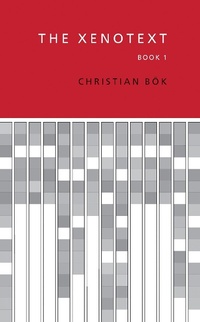
The Xenotext
Book 1
Will be published approx. on 5. November 2015
Book
Paperback/Softback
160 pages
978-1-55245-321-6 (ISBN)
Description
"Many artists seek to attain immortality through their art, but few would expect their work to outlast the human race and live on for billions of years. As Canadian poet Christian Boek has realized, it all comes down to the durability of your materials."-The Guardian
Internationally best-selling poet Christian Boek has spent more than ten years writing what promises to be the first example of "living poetry." After successfully demonstrating his concept in a colony of E. coli, Boek is on the verge of enciphering a beautiful, anomalous poem into the genome of an unkillable bacterium (Deinococcus radiodurans), which can, in turn, "read" his text, responding to it by manufacturing a viable, benign protein, whose sequence of amino acids enciphers yet another poem. The engineered organism might conceivably serve as a post-apocalyptic archive, capable of outlasting our civilization.
Book I of The Xenotext constitutes a kind of "demonic grimoire," providing a scientific framework for the project with a series of poems, texts, and illustrations. A Virgilian welcome to the Inferno, Book I is the "orphic" volume in a diptych, addressing the pastoral heritage of poets, who have sought to supplant nature in both beauty and terror. The book sets the conceptual groundwork for the second volume, which will document the experiment itself. The Xenotext is experimental poetry in the truest sense of the term.
Christian Boek is the author of Crystallography (1994) and Eunoia (2001), which won the Griffin Poetry Prize. He teaches at the University of Calgary in Alberta, Canada.
Internationally best-selling poet Christian Boek has spent more than ten years writing what promises to be the first example of "living poetry." After successfully demonstrating his concept in a colony of E. coli, Boek is on the verge of enciphering a beautiful, anomalous poem into the genome of an unkillable bacterium (Deinococcus radiodurans), which can, in turn, "read" his text, responding to it by manufacturing a viable, benign protein, whose sequence of amino acids enciphers yet another poem. The engineered organism might conceivably serve as a post-apocalyptic archive, capable of outlasting our civilization.
Book I of The Xenotext constitutes a kind of "demonic grimoire," providing a scientific framework for the project with a series of poems, texts, and illustrations. A Virgilian welcome to the Inferno, Book I is the "orphic" volume in a diptych, addressing the pastoral heritage of poets, who have sought to supplant nature in both beauty and terror. The book sets the conceptual groundwork for the second volume, which will document the experiment itself. The Xenotext is experimental poetry in the truest sense of the term.
Christian Boek is the author of Crystallography (1994) and Eunoia (2001), which won the Griffin Poetry Prize. He teaches at the University of Calgary in Alberta, Canada.
More details
Language
English
Place of publication
Toronto
Canada
Product notice
Paperback (trade)
Illustrations
Illustrations
Dimensions
Height: 203 mm
Width: 126 mm
Thickness: 17 mm
Weight
225 gr
ISBN-13
978-1-55245-321-6 (9781552453216)
Copyright in bibliographic data and cover images is held by Nielsen Book Services Limited or by the publishers or by their respective licensors: all rights reserved.
Schweitzer Classification
Person
Christian Boek is the author not only of Crystallography (1994), a pataphysical encyclopedia nominated for the Gerald Lampert Memorial Award, but also of Eunoia (2001), a bestselling work of experimental literature, which has gone on to win the Griffin Prize for Poetic Excellence. Boek teaches English at the University of Calgary.
Content
1. The Late Heavy Bombardment
A long poem about the hellish origins of life on Earth-a series of bombastic firebombs that crescendo, then go quiet: a Virgilian welcome to the Inferno.
2. The March of the Nucleotides
A series of poems and texts, which introduce readers to the basics of genetics, with some pastoral material that illustrates many of the thematic premises for the book.
3. Colony Collapse Disorder
A long, dark poem that translates Book IV of The Georgics by Virgil-(a "pastoral nocturne," providing a pretense for retelling the myth of Orpheus and Eurydice).
4. The Virelay of the Amino Acids
A long, love poem, whose repetitious incantation emulates and embodies the molecular structure of each of the amino acids (the building materials of life).
5. Alpha Helix
A long poem that constitutes a kind of paranoiac catalogue of instances, where helices appear in the most quotidian phenomena, imbuing everything with life.
A long poem about the hellish origins of life on Earth-a series of bombastic firebombs that crescendo, then go quiet: a Virgilian welcome to the Inferno.
2. The March of the Nucleotides
A series of poems and texts, which introduce readers to the basics of genetics, with some pastoral material that illustrates many of the thematic premises for the book.
3. Colony Collapse Disorder
A long, dark poem that translates Book IV of The Georgics by Virgil-(a "pastoral nocturne," providing a pretense for retelling the myth of Orpheus and Eurydice).
4. The Virelay of the Amino Acids
A long, love poem, whose repetitious incantation emulates and embodies the molecular structure of each of the amino acids (the building materials of life).
5. Alpha Helix
A long poem that constitutes a kind of paranoiac catalogue of instances, where helices appear in the most quotidian phenomena, imbuing everything with life.