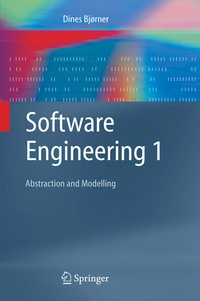
Software Engineering 1
Description
The art, craft, discipline, logic, practice, and science of developing large-scale software products needs a believable, professional base. The textbooks in this three-volume set combine informal, engineeringly sound practice with the rigour of formal, mathematics-based approaches.
Volume 1 covers the basic principles and techniques of formal methods abstraction and modelling. First this book provides a sound, but simple basis of insight into discrete mathematics: numbers, sets, Cartesians, types, functions, the Lambda Calculus, algebras, and mathematical logic. Then it trains its readers in basic property- and model-oriented specification principles and techniques. The model-oriented concepts that are common to such specification languages as B, VDM-SL, and Z are explained here using the RAISE specification language (RSL). This book then covers the basic principles of applicative (functional), imperative, and concurrent (parallel) specification programming. Finally, the volume contains a comprehensive glossary of software engineering, and extensive indexes and references.
These volumes are suitable for self-study by practicing software engineers and for use in university undergraduate and graduate courses on software engineering. Lecturers will be supported with a comprehensive guide to designing modules based on the textbooks, with solutions to many of the exercises presented, and with a complete set of lecture slides.
Reviews / Votes
From the reviews:
"The book under review is the first one from a series of three volumes that provides a compelling framework for a more comprehensive understanding of both formal and practical concerns of software engineering. The major feature distinguishing these textbooks from other current ones . is the natural manner in which the formal techniques smoothly glide from software design towards the requirements prescription phase and beyond to domain description. . By its consistency and rigor, the book is, undoubtedly, remarkably useful to professional software developers." (Tudor Balanescu, Zentralblatt MATH, Vol. 1095 (21), 2006)
More details
Other editions
Additional editions