

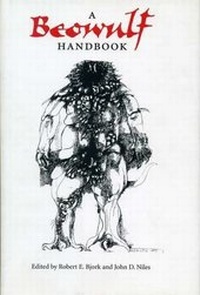
A Beowulf Handbook
Will be published approx. on 1. April 1997
Book
Hardback
478 pages
978-0-85989-543-9 (ISBN)
Description
The most revered work composed in Old English, Beowulf is a landmark of European literature. This handbook supplies a wealth of insights into all major aspects of this wondrous poem and its scholarly tradition and offers both a rapid survey of trends in the study of Beowulf and a more sustained exploration of selected problems. Each chapter begins with a brief summary of its contents followed by a chronology of the most important books and articles on the particular topic it treats. The book has been written to accommodate the needs of a broad audience, from non-specialists who wish simply to read and enjoy Beowulf, to scholars at work on their own research, and students of Old English. This is a volume in the acclaimed series Exeter Medieval Texts and Studies, and will prove an indispensable guide for many years to come. The acclaimed and comprehensive 1988 edition of Beowulf edited by C. L. Wrenn and W. F. Bolton is also available in the series.
Reviews / Votes
This valuable compendium covers the main areas of scholarly inquiry into the poem in eighteen short chapters, followed by lengthy bibliographies and an index. Each chapter is prefaced by a summary of its contents and a detailed, annotated chronology of major contributions to the area treated . . . It is of course immensely convenient to have all the major issues relating to Beowulf treated between one set of covers, by acknowledged experts in their fields, and A Beowulf Handbook can be recommended with enthusiastic confidence for use by undergraduates and advanced students alike. * Parergon, Vol. 17, No 2 * A Beowulf Handbook presents an impressively detailed digest and assessment of the history of the perceived major areas of Beowulf scholarship and criticism, as they have developed from the earliest days of the recovery of the poem to the 1990s, and it gives an informed overview of the current state of scholarly debate about the poem. * English Studies Volume 80 Number 2 * This is a good book for scholars and graduate students working on Beowulf at any level and should become one of the poem's standard research tools.' ' . . . a must for every university library where study of Old English is pursued. It would serve extremely well as recommended reading for any seminar in Beowulf, and appropriate parts of it should be required wherever serious attention is given to textual and philological investigation of the poem. * Arthuriana, Vol. 8, No. 2, Summer * This work fills a need long felt by students of Beowulf. In its eighteen well-organized, clear, and concise chapters, A Beowulf Handbook outlines major moments in scholarship on a wide variety of issues pertaining to the study of Beowulf . . . it is able to serve as both a reference work and an introduction. * Envoi, Fall 1997, Vol. 6.2 *More details
Series
Language
English
Place of publication
United Kingdom
Publishing group
Liverpool University Press
Target group
College/higher education
Professional and scholarly
Dimensions
Height: 230 mm
Width: 153 mm
ISBN-13
978-0-85989-543-9 (9780859895439)
Copyright in bibliographic data and cover images is held by Nielsen Book Services Limited or by the publishers or by their respective licensors: all rights reserved.
Schweitzer Classification
Persons
Robert E. Bjork is a Professor of English at Arizona State University. His published work includes four books on Old English poetry and translations of seven modern Swedish novels. He serves on the Council of the Medieval Academy of America, is past President of the International Society of Anglo-Saxonists, and for the 2004-2005 academic year, was a Member of the Institute for Advanced Study, Princeton. John D. Niles is a Professor of English at the University of California, Berkeley, where he has taught since the early 1970s. He is a specialist in the earliest period of English literature.
Content
Preface
1. Introduction: On "Beowulf", Truth and Interpretation - John D. Niles
2. Date, Provenance, Author, Audiences - Robert E. Bjork and Anita Obermeier;
3. Textual Criticism - R. D. Fulk
4. The Prosody Of "Beowulf" - Robert P. Stockwell;
5. Diction, Variation, The Formula - Katherine O'Brien O'Keeffe
6. Rhetoric and Style - Ursula Schaefer;
7. Sources and Analogues - Theodore M. Andersson
8. Structure and Unity - Thomas A. Shippey
9. Christian and Pagan Elements - Edward B. Irving
10. Digressions and Episodes - Robert E. Bjork
11. Myth and History - John D. Niles
12. Symbolism and Allegory - Alvin A. Lee;
13. The Social Milieu - John M. Hil
14. Gender Roles - Alexandra Hennessey Olsen
15. The Hero and the Theme - George Clark;
16. "Beowulf" and Contemporary Critical Theory - Seth Lerer;
17. "Beowulf" and Archaeology - Catherine M. Hills
18. Translations, Versions, Illustrations - Marijane Osborn
List of Abbreviations
Works Cited
1. Introduction: On "Beowulf", Truth and Interpretation - John D. Niles
2. Date, Provenance, Author, Audiences - Robert E. Bjork and Anita Obermeier;
3. Textual Criticism - R. D. Fulk
4. The Prosody Of "Beowulf" - Robert P. Stockwell;
5. Diction, Variation, The Formula - Katherine O'Brien O'Keeffe
6. Rhetoric and Style - Ursula Schaefer;
7. Sources and Analogues - Theodore M. Andersson
8. Structure and Unity - Thomas A. Shippey
9. Christian and Pagan Elements - Edward B. Irving
10. Digressions and Episodes - Robert E. Bjork
11. Myth and History - John D. Niles
12. Symbolism and Allegory - Alvin A. Lee;
13. The Social Milieu - John M. Hil
14. Gender Roles - Alexandra Hennessey Olsen
15. The Hero and the Theme - George Clark;
16. "Beowulf" and Contemporary Critical Theory - Seth Lerer;
17. "Beowulf" and Archaeology - Catherine M. Hills
18. Translations, Versions, Illustrations - Marijane Osborn
List of Abbreviations
Works Cited