

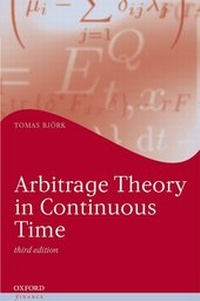
Arbitrage Theory in Continuous Time
3rd Edition
Published on 6. August 2009
Book
Hardback
560 pages
978-0-19-957474-2 (ISBN)
Description
The third edition of this popular introduction to the classical underpinnings of the mathematics behind finance continues to combine sound mathematical principles with economic applications.
Concentrating on the probabilistic theory of continuous arbitrage pricing of financial derivatives, including stochastic optimal control theory and Merton's fund separation theory, the book is designed for graduate students and combines necessary mathematical background with a solid economic focus. It includes a solved example for every new technique presented, contains numerous exercises, and suggests further reading in each chapter.
In this substantially extended new edition Bjork has added separate and complete chapters on the martingale approach to optimal investment problems, optimal stopping theory with applications to American options, and positive interest models and their connection to potential theory and stochastic discount factors.
More advanced areas of study are clearly marked to help students and teachers use the book as it suits their needs.
Concentrating on the probabilistic theory of continuous arbitrage pricing of financial derivatives, including stochastic optimal control theory and Merton's fund separation theory, the book is designed for graduate students and combines necessary mathematical background with a solid economic focus. It includes a solved example for every new technique presented, contains numerous exercises, and suggests further reading in each chapter.
In this substantially extended new edition Bjork has added separate and complete chapters on the martingale approach to optimal investment problems, optimal stopping theory with applications to American options, and positive interest models and their connection to potential theory and stochastic discount factors.
More advanced areas of study are clearly marked to help students and teachers use the book as it suits their needs.
Reviews / Votes
Review from previous edition This book is one of the best of a large number of new books on mathematical and probabilistic models in finance, positioned between the books by Hull and Duffie on a mathematical scale...This is a highly reasonable book and strikes a balance between mathematical development and intuitive explanation * Short Book Reviews *More details
Series
Edition
3rd Revised edition
Language
English
Place of publication
Oxford
United Kingdom
Target group
Professional and scholarly
Graduate students and advanced undergraduates studying finance. Mathematicians looking for an introduction to mathematical finance. Professionals in financial markets
Edition type
Revised edition
Illustrations
23 Figures
Dimensions
Height: 241 mm
Width: 161 mm
Thickness: 32 mm
Weight
938 gr
ISBN-13
978-0-19-957474-2 (9780199574742)
Copyright in bibliographic data and cover images is held by Nielsen Book Services Limited or by the publishers or by their respective licensors: all rights reserved.
Schweitzer Classification
Other editions
New editions
Tomas Bjoerk
Arbitrage Theory in Continuous Time
Book
12/2019
4th Edition
Oxford University Press
€83.50
Available immediately
Previous edition
Tomas Bjork
Arbitrage Theory in Continuous Time
Book
03/2004
2nd Edition
Oxford University Press
€53.23
Article exhausted; check for reprint
Person
Tomas Bjoerk is Professor of Mathematical Finance at the Stockholm School of Economics. His background is in probability theory and he was formerly at the Mathematics Department of the Royal Institute of Technology in Stockholm. He is co-editor of Mathematical Finance and Associate Editor of Finance and Stochastics. He has published numerous journal articles on mathematical finance in general, and in particular on interest rate theory.
Content
1. Introduction ; 2. The Binomial Model ; 3. A More General One period Model ; 4. Stochastic Integrals ; 5. Differential Equations ; 6. Portfolio Dynamics ; 7. Arbitrage Pricing ; 8. Completeness and Hedging ; 9. Parity Relations and Delta Hedging ; 10. The Martingale Approach to Arbitrage Theory ; 11. The Mathematics of the Martingale Approach ; 12. Black-Scholes from a Martingale Point of View ; 13. Multidimensional Models: Classical Approach ; 14. Multidimensional Models: Martingale Approach ; 15. Incomplete Markets ; 16. Dividends ; 17. Currency Derivatives ; 18. Barrier Options ; 19. Stochastic Optimal Control ; 20. The Martingale Approach to Optimal Investment ; 21. Optimal Stopping Theory and American Options ; 22. Bonds and Interest Rates ; 23. Short Rate Models ; 24. Martingale Models for the Short Rate ; 25. Forward Rate Models ; 26. Change of Numeraire ; 27. LIBOR and Swap Market Models ; 28. Potentials and Positive Interest ; 29. Forwards and Futures ; A. Measure and Integration ; B. Probability Theory ; C. Martingales and Stopping Times