

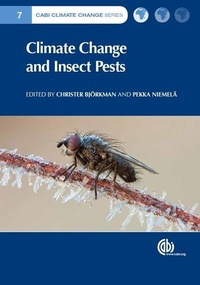
Climate Change and Insect Pests
Published on 1. October 2015
Book
Paperback/Softback
292 pages
978-1-78924-769-5 (ISBN)
Description
Insects, being poikilothermic, are among the organisms that are most likely to respond to changes in climate, particularly increased temperatures. Range expansions into new areas, further north and to higher elevations, are already well documented, as are physiological and phenological responses. It is anticipated that the damage to crops and forests by insects will increase as a consequence of climate change, i.e. increasing temperatures primarily. However, the evidence in support of this common "belief" is sparse. Climate Change and Insect Pests sums up present knowledge regarding both agricultural and forest insect pests and climate change in order to identify future research directions.
More details
Series
Language
English
Place of publication
Wallingford
United Kingdom
Target group
College/higher education
Product notice
Paperback (trade)
Unsewn / adhesive bound
Dimensions
Height: 244 mm
Width: 172 mm
Weight
644 gr
ISBN-13
978-1-78924-769-5 (9781789247695)
Copyright in bibliographic data and cover images is held by Nielsen Book Services Limited or by the publishers or by their respective licensors: all rights reserved.
Schweitzer Classification
Other editions
Additional editions
Christer Bjoerkman | Pekka Niemelae
Climate Change and Insect Pests
E-Book
10/2015
CABI Publishing
€57.99
Available for download
Persons
Editor
Swedish University of Agricultural Sciences, Sweden
University of Turku, Finland
Contributions
University of Eastern Finland, Finland
Stellenbosch University, South Africa
ICIPE, Kenya
University of Idaho, USA
MTT Agrifood Research, Finland
Univ of Wisconsin-Madison, USA
Norwegian Institute for Forest and Landscape, Norway
Content
Part I: General Issues and Patterns 1: Climate Change and Insect Pest Distribution Range 2: Species Distribution Modelling in Predicting Response to Climate Change 3: Adaptive Responses of Plants to Insect Herbivores under Climate Change 4: Boreal Woody Species Resistance Affected by Climate Change 5: Effects of Climate Change on the Interactions Between Insect Pests and Their Natural Enemies Part II: Agricultural Pests 6: Physiological Variation of Insects in Agricultural Landscapes: Potential Impacts of Climate Change 7: Climate Change and Biological Control in Agricultural Systems: Principles and Examples from North America 8: Climate Change Effects on Agricultural Insect Pests in Europe Part III: Forest Pests 9: Abiotic Factors, Climatic Variability and Forest Insect Pests 10: Responses of Tree-killing Bark Beetles to a Changing Climate 11: The Eurasian Spruce Bark Beetle: The Role of Climate 12: Pine Wood Nematode, Pine Wilt Disease, Vector Beetle and Pine Tree: How a Multiplayer System Could Reply to Climate Change 13: Northern Geometrids and Climate Change: From Abiotic Factors to Trophic Interactions 14: Effects of New Forest Management on Insect Damage Risk in a Changing Climate