

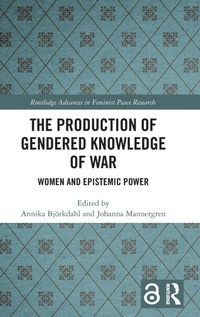
The Production of Gendered Knowledge of War
Women and Epistemic Power
1st Edition
Published on 4. April 2025
Book
Hardback
184 pages
978-1-032-86998-8 (ISBN)
Description
This edited volume critically investigates women's knowledge about war and explores the epistemic agency of women in a range of contemporary settings across the globe.
Women are deeply affected by war, participate in war and resist war. At the same time, knowledge production often ignores and marginalizes women's experiences and gendered ways of knowing war. From Colombia to Israel and Palestine, Liberia, Mali, Myanmar, Nepal, North America, Northern Iraq and Ukraine, the chapters in this book illuminate gendered knowledge production in and about different conflict-affected sites. By taking the embodied and narrative epistemic agency of local 'knowers' seriously, new insights are thereby presented about the role women play in producing knowledge about war. This book proposes new theoretical vantage points in order to understand how epistemic power and epistemic violence are closely related. Bringing the topic of knowledge production into the so-called 'Women, Peace and Security' (WPS) agenda, it analyses how knowledge of the gendered nature of war and security is produced and circulated, and argues that the WPS agenda is a system of knowledge with its own omissions and silences. By theorizing gendered knowledge production and amplifying the voices of women as epistemic agents, this book advances scholarship on gender and war.
This book will be of much interest to students of feminist studies, peace studies, war and conflict studies and International Relations.
The Introduction, Chapter 3, and Chapter 9 of this book is freely available as a downloadable Open Access PDF at http://www.taylorfrancis.com under a Creative Commons Attribution (CC-BY) 4.0 license. Chapter 6 and Chapter 7 of this book is freely available as a downloadable Open Access PDF at http://www.taylorfrancis.com under a Creative Commons Attribution-Non Commercial-No Derivatives (CC-BY-NC-ND) 4.0 license.
Women are deeply affected by war, participate in war and resist war. At the same time, knowledge production often ignores and marginalizes women's experiences and gendered ways of knowing war. From Colombia to Israel and Palestine, Liberia, Mali, Myanmar, Nepal, North America, Northern Iraq and Ukraine, the chapters in this book illuminate gendered knowledge production in and about different conflict-affected sites. By taking the embodied and narrative epistemic agency of local 'knowers' seriously, new insights are thereby presented about the role women play in producing knowledge about war. This book proposes new theoretical vantage points in order to understand how epistemic power and epistemic violence are closely related. Bringing the topic of knowledge production into the so-called 'Women, Peace and Security' (WPS) agenda, it analyses how knowledge of the gendered nature of war and security is produced and circulated, and argues that the WPS agenda is a system of knowledge with its own omissions and silences. By theorizing gendered knowledge production and amplifying the voices of women as epistemic agents, this book advances scholarship on gender and war.
This book will be of much interest to students of feminist studies, peace studies, war and conflict studies and International Relations.
The Introduction, Chapter 3, and Chapter 9 of this book is freely available as a downloadable Open Access PDF at http://www.taylorfrancis.com under a Creative Commons Attribution (CC-BY) 4.0 license. Chapter 6 and Chapter 7 of this book is freely available as a downloadable Open Access PDF at http://www.taylorfrancis.com under a Creative Commons Attribution-Non Commercial-No Derivatives (CC-BY-NC-ND) 4.0 license.
More details
Series
Language
English
Place of publication
London
United Kingdom
Publishing group
Taylor & Francis Ltd
Target group
College/higher education
Professional and scholarly
Postgraduate, Professional Reference, and Undergraduate Advanced
Dimensions
Height: 240 mm
Width: 161 mm
Thickness: 15 mm
Weight
470 gr
ISBN-13
978-1-032-86998-8 (9781032869988)
Copyright in bibliographic data and cover images is held by Nielsen Book Services Limited or by the publishers or by their respective licensors: all rights reserved.
Schweitzer Classification
Other editions
Additional editions
Annika Bjoerkdahl | Johanna Mannergren
The Production of Gendered Knowledge of War
Women and Epistemic Power
E-Book
04/2025
1st Edition
Routledge
€52.49
Available for download
Annika Bjoerkdahl | Johanna Mannergren
The Production of Gendered Knowledge of War
Women and Epistemic Power
E-Book
04/2025
1st Edition
Routledge
€52.49
Available for download
Persons
Annika Bjoerkdahl is a Professor of Political Science at Lund University, Sweden.
Johanna Mannergren is a Professor of Political Science and International Relations at Soedertoern University, Sweden.
Johanna Mannergren is a Professor of Political Science and International Relations at Soedertoern University, Sweden.
Content
Introduction: The Production of Gendered Knowledge of War. Annika Bjoerkdahl and Johanna Mannergren
1: Incorporating embodied knowledge in UN Peacebuilding Fund projects: success stories, silences, and contestations. Maria Martin de Almagro
2: Archival research, security records and violence against women: Evidence from the First Intifada. Sarai Aharoni
3: Knowing violence: human rights documentation, narrative agency and resistance in Myanmar. Jenny Hedstroem and Elisabeth Olivius
4: The Politics of Knowledge, Positionality and Power: The "Inclusivity" of Indigenous Women in Peacemaking in Turtle Island (Canada and the United States). Julia Palmiano Federer, Lena Dedyukina and Polly O. Walker
5: Women, Peace and Security: Women Ex-Combatants, Reintegration and Knowledge Production of War in Postwar Era. Luna KC.
6: What we know and don't know about Malian women's experiences with violent extremism. Jenny Lorentzen
7: Insurgent War Knowledge? Silences and embodied epistemic agency in insurgent women's post-war militancy in Colombia. Priscyll Anctil Avoine.
8: Courageous changemakers. Women's activism in the Ukrainian army. Anastasiia Chupis.
9: Embodied knowledge production through virtual reality: tracing the global circulation of Yazidi women's testimonies. Annika Bjoerkdahl and Johanna Mannergren
Conclusion
1: Incorporating embodied knowledge in UN Peacebuilding Fund projects: success stories, silences, and contestations. Maria Martin de Almagro
2: Archival research, security records and violence against women: Evidence from the First Intifada. Sarai Aharoni
3: Knowing violence: human rights documentation, narrative agency and resistance in Myanmar. Jenny Hedstroem and Elisabeth Olivius
4: The Politics of Knowledge, Positionality and Power: The "Inclusivity" of Indigenous Women in Peacemaking in Turtle Island (Canada and the United States). Julia Palmiano Federer, Lena Dedyukina and Polly O. Walker
5: Women, Peace and Security: Women Ex-Combatants, Reintegration and Knowledge Production of War in Postwar Era. Luna KC.
6: What we know and don't know about Malian women's experiences with violent extremism. Jenny Lorentzen
7: Insurgent War Knowledge? Silences and embodied epistemic agency in insurgent women's post-war militancy in Colombia. Priscyll Anctil Avoine.
8: Courageous changemakers. Women's activism in the Ukrainian army. Anastasiia Chupis.
9: Embodied knowledge production through virtual reality: tracing the global circulation of Yazidi women's testimonies. Annika Bjoerkdahl and Johanna Mannergren
Conclusion