

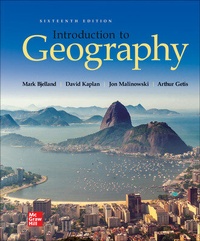
Introduction to Geography
16th Edition
Published on 1. April 2021
Book
Hardback
978-1-260-36413-2 (ISBN)
Description
Introduction to Geography is written to clearly and concisely convey the nature of the field of geography, its intellectual challenges, and the logical interconnections of its parts. Even if students take no further work in geography, they will have come into contact with the richness and breadth of Geography and have new insights and understandings for their present and future roles as informed adults. This new edition provides students content and scope of the subfields of geography, emphasizes its unifying themes, and provides the foundation for further work in their areas of interest.
More details
Edition
16th edition
Language
English
Place of publication
OH
United States
Target group
College/higher education
Dimensions
Height: 285 mm
Width: 239 mm
Thickness: 23 mm
Weight
1336 gr
ISBN-13
978-1-260-36413-2 (9781260364132)
Copyright in bibliographic data and cover images is held by Nielsen Book Services Limited or by the publishers or by their respective licensors: all rights reserved.
Schweitzer Classification
Persons
Mark Bjelland is professor of geography at Calvin University
David H. Kaplan is a professor of geography at Kent State University. He received his Ph.D. from the University of Wisconsin at Madison and his B.A. from The Johns Hopkins University. Dr. Kaplan has published over 40 peer-reviewed articles and chapters, and he has seven books published: Segregation in Cities, Nested Identities, Boundaries and Place, Urban Geography, Landscapes of the Ethnic Economy, Perthes World Atlas, and the four-volume Nations and Nationalism: A Global Historical Overview. His research interests include nationalism, borderlands, ethnic and racial segregation, urban and regional development, housing and finance, and transportation. In his free time, he enjoys spending time with his family, cooking, bicycling, skiing, and gaining a deep appreciation of different places.
Jon C. Malinowski received his B.S. in foreign service from the Edmund A. Walsh School of Foreign Service at Georgetown University and earned his M.A. and Ph.D. in geography from the University of North Carolina at Chapel Hill. He has been a member of the geography faculty at the United States Military Academy at West Point since 1995. In addition to scholarly articles, he is the co-author of several books, including geography texts and trade books on summer camp and West Points changing landscape. His research interests have focused on spatial cognition, childrens geographies, and cultural geography and he has taught courses on Asia, North America, the Middle East and Africa, world regional geography, human geography, behavioral geography, economic geography, and the historical geography of the Hudson Valley. In addition to teaching and research, Dr. Malinowski has held administrative positions in the Environmental Perception and Behavioral Geography Specialty Group of the Association of American Geographers and in the Geography Program at the Academy. He also serves as a member of the Board of Directors for YMCA Camp Belknap in Tuftonboro, New Hampshire.
David H. Kaplan is a professor of geography at Kent State University. He received his Ph.D. from the University of Wisconsin at Madison and his B.A. from The Johns Hopkins University. Dr. Kaplan has published over 40 peer-reviewed articles and chapters, and he has seven books published: Segregation in Cities, Nested Identities, Boundaries and Place, Urban Geography, Landscapes of the Ethnic Economy, Perthes World Atlas, and the four-volume Nations and Nationalism: A Global Historical Overview. His research interests include nationalism, borderlands, ethnic and racial segregation, urban and regional development, housing and finance, and transportation. In his free time, he enjoys spending time with his family, cooking, bicycling, skiing, and gaining a deep appreciation of different places.
Jon C. Malinowski received his B.S. in foreign service from the Edmund A. Walsh School of Foreign Service at Georgetown University and earned his M.A. and Ph.D. in geography from the University of North Carolina at Chapel Hill. He has been a member of the geography faculty at the United States Military Academy at West Point since 1995. In addition to scholarly articles, he is the co-author of several books, including geography texts and trade books on summer camp and West Points changing landscape. His research interests have focused on spatial cognition, childrens geographies, and cultural geography and he has taught courses on Asia, North America, the Middle East and Africa, world regional geography, human geography, behavioral geography, economic geography, and the historical geography of the Hudson Valley. In addition to teaching and research, Dr. Malinowski has held administrative positions in the Environmental Perception and Behavioral Geography Specialty Group of the Association of American Geographers and in the Geography Program at the Academy. He also serves as a member of the Board of Directors for YMCA Camp Belknap in Tuftonboro, New Hampshire.
Content
Chapter 1 Introduction
Chapter 2 Techniques of Geographic Analysis
Chapter 3 Physical Geography: Landforms
Chapter 4 Physical Geography: Weather and Climate
Chapter 5 Population Geography
Chapter 6 Cultural Geography
Chapter 7 Human Interaction
Chapter 8 Political Geography
Chapter 9 Economic Geography: Agriculture and Primary Activities
Chapter 10 Economic Geography: Manufacturing and Services
Chapter 11 An Urban World
Chapter 12 The Geography of Natural Resources
Chapter 13 Human Impact on the Environment
Chapter 2 Techniques of Geographic Analysis
Chapter 3 Physical Geography: Landforms
Chapter 4 Physical Geography: Weather and Climate
Chapter 5 Population Geography
Chapter 6 Cultural Geography
Chapter 7 Human Interaction
Chapter 8 Political Geography
Chapter 9 Economic Geography: Agriculture and Primary Activities
Chapter 10 Economic Geography: Manufacturing and Services
Chapter 11 An Urban World
Chapter 12 The Geography of Natural Resources
Chapter 13 Human Impact on the Environment