

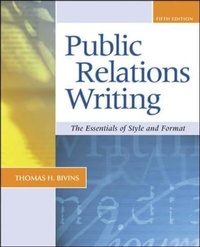
Public Relations Writing: The Essentials of Style and Format with Online Learning Center
5th Edition
Published on 16. August 2004
Book
384 pages
978-0-07-301799-0 (ISBN)
Description
This text equips students with the essential skills for developing and writing public relations materials, covering all areas of public relations writing--including news releases, backgrounders, newsletter and magazine articles, brochures, print advertising copy, and broadcast scripts. Recent technological changes are also covered to give students an understanding of how technology impacts the public relations industry. In the constantly changing world of public relations, the text continues to stress the need for public relations professionals to communicate more effectively to all audiences.
More details
Edition
5th edition
Language
English
Place of publication
United States
Publishing group
McGraw-Hill Education - Europe
Dimensions
Height: 226 mm
Width: 188 mm
Thickness: 15 mm
Weight
567 gr
ISBN-13
978-0-07-301799-0 (9780073017990)
Copyright in bibliographic data and cover images is held by Nielsen Book Services Limited or by the publishers or by their respective licensors: all rights reserved.
Schweitzer Classification
Other editions
New editions
Book
03/2007
6th Edition
McGraw-Hill Professional
€70.55
Article is exhausted; no reprint
Content
PREFACECHAPTER 1: WRITING FOR PUBLIC RELATIONSWHAT IS PUBLIC RELATIONS WRITING?Uncontrolled InformationControlled InformationTHE TOOLS THE PUBLIC RELATIONS WRITERTHE PROCESS OF PUBLIC RELATIONS WRITINGKEY TERMSEXERCISESCHAPTER 2: PLANNING AND RESEARCHDEVELOPING AN ISSUE STATEMENTRESEARCHING THE TOPICUSING THE INTERNET FOR RESEARCHFinding information on the Internet Evaluating Internet ResourcesANALYZING THE TARGET AUDIENCEConducting Target Audience ResearchAnticipating Audience ExpectationsSETTING OBJECTIVESKEY TERMSEXERCISESCHAPTER 3: MESSAGE STRATEGYINFORMATION STRATEGIESExpositionEntertainmentTHE PROCESS OF PERSUASIONPERSUASIVE STRATEGIESCompliance StrategiesArgument Strategies CHOOSING THE APPROPRIATE MEDIUM OR MEDIALEARNING TO ADAPTKEY TERMSEXERCISESCHAPTER 4: ETHICS AND PUBLIC RELATIONS WRITINGETHICAL CONSIDERATIONS OF PERSUASIONLogic FallaciesOther TacticsUnethical Language UseEthics and GhostwritingTHE LEGAL ASPECTS OF PUBLIC RELATIONS WRITINGDefamationPrivacyCopyrightTrademarksKEY TERMSEXERCISECHAPTER 5: MEDIA RELATIONS AND PLACEMENTWHAT IS NEWS?WORKING WITH THE MEDIAGet to Know Journalists' JobsGet to Know Journalists as PeopleGuidelines for Dealing with the MediaGuidelines for InterviewsGuidelines for Correcting ErrorsMEDIA PLACEMENTDeciding Where to Place Your MessageGetting Your Message to the MediaFitting Your Information to Your OutletPRESS KITS COOPERATION IS THE KEYKEY TERMSEXERCISESCHAPTER 6: CRISIS COMMUNICATION WHAT IS A CRISIS?CRISIS PREPARATIONPulling Together a Crisis TeamChoosing a spokespersonCRISIS MANAGEMENTDesignating a Message Media centerDeveloping a MessageResponding to the MediaRECOVERY AND REBUILDING AFTER THE CRISISKEY TERMSEXERCISESCHAPTER 7: NEWS RELEASES AND BACKGROUNDERSWHAT IS A NEWS RELEASE?WRITING A NEWS RELEASEThe LeadUsing Quotations and AttributionsLocal InterestNEWS RELEASE FORMATTiming and Dating ReleasesDatelinesExclusives and SpecialsPRODUCT NEWS RELEASESFeature-oriented ReleasesWRITING NEWS RELEASES FOR BROADCASTBACKGROUNDERSFACT SHEETSKEY TERMSEXERCISECHAPTER 8: ANNUAL REPORTS AND SOCIAL RESPONSIBILITY REPORTSANNUAL REPORTSAnnual Report AudiencesAnnual Report ContentsWriting for Annual ReportsThe Not-for-Profit Annual ReportNot-for-Profit Annual Report ContentsJudging Your Annual ReportSOCIAL RESPONSIBILITY REPORTSPurpose of Social Responsibility ReportsCoverage of Social Responsibility ReportsWriting for Social Responsiblity ReportsSocial Responsibility Report ContentsKEY TERMSEXERCISESCHAPTER 9: NEWSLETTERS, MAGAZINES, AND FEATURE WRITINGNEWSLETTERSTypes of NewslettersWhy a Newsletter?Newsletter ContentNewsletter ArticlesWhere Do Stories Come From?Researching StoriesDesign ConsiderationsStyle SheetsMAGAZINESContent and FormatTypes of ArticlesTRADE JOURNALSFEATURE WRITING FOR NEWSLETTERS AND MAGAZINESFeature StyleWriting the Feature StoryCommon Types of FeaturesEDITORIAL CONSIDERATIONS FOR DISPLAY COPYWriting HeadlinesWriting Subheads and CrossheadsWriting CaptionsWriting Pull QuotesEDITING YOUR ARTICLESKEY TERMSEXERCISESCHAPTER 10: BROCHURES AND OTHER INFORMATIONAL PIECESBROCHURESPlanning Your Brochure Fitting It All TogetherOTHER INFORMATION PIECESFlyersPostersBooklets and hybridsKEY TERMSEXERCISESCHAPTER 11: PRINT ADVERTISINGWRITING PRINT ADVERTISEMENTSHeadlinesVisualsBody CopyFORMATTING PRINT ADSAd Copy FormatAd LayoutsKEY TERMSEXERCISESCHAPTER 12: TELEVISION AND RADIOREACHING BROADCAST AUDIENCESVideo News ReleasesRadio and Television Tapes and ActualitiesInterviews and Talk ShowsCorporate Advertising and Public Service AnnouncementsWRITING FOR TELEVISIONBasic ConceptsWriting for the EyeTelevision ScriptsWRITING FOR RADIOTypes of Radio AnnouncementsHow to Get Your PSAs on the AirKEY TERMSEXERCISESCHAPTER 13: SPEECHES AND PRESENTATIONSTYPES OF SPEECHESMODES OF DELIVERYPREPARATION AND WRITINGSpecifying Your PurposeAnalyzing Your AudienceOrganizing Your SpeechSupporting Your IdeasDELIVERYTHE Q & A SESSIONPRESENTATION MATERIALS Preparing Audio-Visual MaterialScripting for Audio-VisualsKEY TERMSEXERCISESCHAPTER 14: DESIGN, PRINTING, AND DESKTOP PUBLISHINGDESIGN: WHAT IT IS AND WHY IT MIGHT BE GREEK TO YOUDESIGNING PUBLIC RELATIONS MATERIALSPRINCIPLES OF DESIGNBalanceProportionSequence and EmphasisUnityGridsAlignmentType and TypefacesWORKING WITH PRINTERSPrinting ProcessesPaper ChoiceInk ChoiceBindingSwipe FilesComputer Layout Preparation for PrintingPrint Order PreparationA WORD ON DESKTOP PUBLISHINGKEY TERMSEXERCISESCHAPTER 15: COMPUTER WRITING AND THE INTERNETWRITING ON THE COMPUTEROn Your OwnIn CollaborationWRITING FOR THE COMPUTEREmployee Communications: IntranetsCommunicating with Other Publics: The InternetWriting for Web SitesDESIGNING A WEB SITEKEY TERMSEXERCISESCHAPTER 16: WRITING FOR DIVERSE AUDIENCESWRITING FOR THE GLOBAL AUDIENCEStyle Tips Grammar Tips Terminology Tips Punctuation Tips ICONS AND IMAGESBIAS-FREE WRITINGWRITING FOR LOW-LITERACY AUDIENCESWhere Do You Start?Readability Formulas and Computer ProgramsKEY TERMSEXERCISESGLOSSARYINDEX