

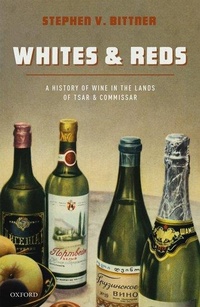
Whites and Reds
A History of Wine in the Lands of Tsar and Commissar
Published on 11. February 2021
Book
Hardback
264 pages
978-0-19-878482-1 (ISBN)
Description
Whites and Reds: A History of Wine in the Lands of Tsar and Commissar tells the story of Russia's encounter with viniculture and winemaking. Rooted in the early-seventeenth century, embraced by Peter the Great, and then magnified many times over by the annexation of the indigenous wine economies and cultures of Georgia, Crimea, and Moldova in the late-eighteenth and early-nineteenth centuries, viniculture and winemaking became an important indicator of Russia's place at the European table. While the Russian Revolution in 1917 left many of the empire's vineyards and wineries in ruins, it did not alter the political and cultural meanings attached to wine. Stalin himself embraced champagne as part of the good life of socialism, and the Soviet Union became a winemaking superpower in its own right, trailing only Spain, Italy, and France in the volume of its production.
Whites and Reds illuminates the ideas, controversies, political alliances, technologies, business practices, international networks, and, of course, the growers, vintners, connoisseurs, and consumers who shaped the history of wine in the Russian Empire and the Soviet Union over more than two centuries. Because wine was domesticated by virtue of imperialism, its history reveals many of the instabilities and peculiarities of the Russian and Soviet empires. Over two centuries, the production and consumption patterns of peripheral territories near the Black Sea and in the Caucasus became a hallmark of Russian and Soviet civilizational identity and cultural refinement. Wine in Russia was always more than something to drink.
Whites and Reds illuminates the ideas, controversies, political alliances, technologies, business practices, international networks, and, of course, the growers, vintners, connoisseurs, and consumers who shaped the history of wine in the Russian Empire and the Soviet Union over more than two centuries. Because wine was domesticated by virtue of imperialism, its history reveals many of the instabilities and peculiarities of the Russian and Soviet empires. Over two centuries, the production and consumption patterns of peripheral territories near the Black Sea and in the Caucasus became a hallmark of Russian and Soviet civilizational identity and cultural refinement. Wine in Russia was always more than something to drink.
Reviews / Votes
Stephen Bittner explores this ocean of wine across currents of imperialism, European idealization, native viniculture traditions, and the Revolution. The result is a finely balanced, enjoyable examination of wine production and connoisseurship in Russia and the Soviet Union ... Overall, this is a sophisticated, yet accessible, analysis of Russian and Soviet identity as filtered through wine. Bittner is quick to provide further references for the theoretical and historiographic context, which will make this appealing to students and helpful to researchers. * Tricia Starks, The Russian Review *More details
Language
English
Place of publication
Oxford
United Kingdom
Target group
Professional and scholarly
Product notice
sewn/stitched
Cloth over boards
Dimensions
Height: 237 mm
Width: 153 mm
Thickness: 25 mm
Weight
536 gr
ISBN-13
978-0-19-878482-1 (9780198784821)
Copyright in bibliographic data and cover images is held by Nielsen Book Services Limited or by the publishers or by their respective licensors: all rights reserved.
Schweitzer Classification
Other editions
Additional editions
E-Book
02/2021
1st Edition
OUP eBook
€66.49
Available for download
E-Book
02/2021
1st Edition
OUP eBook
€66.49
Available for download
Person
Stephen V. Bittner is Professor of History at Sonoma State University. He is the author of The Many Lives of Khrushchev's Thaw: Experience and Memory in Moscow's Arbat and the editor of Dmitrii Shepilov's memoir, The Kremlin's Scholar: A Memoir of Soviet Politics under Stalin and Khrushchev.
Content
Introduction: Identity: Wine and Civilization
1: Terroir: The Landscapes of Winemaking
2: Science: The Great Wine Blight in Late-Tsarist Bessarabia
3: Authenticity: Wine and the Ambivalence of Modernity
4: Commerce: Selling Wine in the Age of Revolution
5: Hospitality: Winemakers and the Stalinist Gift Economy
6: Taste: Soviet Wine and Western Connoisseurship
7: Quality: Wine and Alcoholism in the Age of Mature Socialism
Conclusion: Wine after Socialism
1: Terroir: The Landscapes of Winemaking
2: Science: The Great Wine Blight in Late-Tsarist Bessarabia
3: Authenticity: Wine and the Ambivalence of Modernity
4: Commerce: Selling Wine in the Age of Revolution
5: Hospitality: Winemakers and the Stalinist Gift Economy
6: Taste: Soviet Wine and Western Connoisseurship
7: Quality: Wine and Alcoholism in the Age of Mature Socialism
Conclusion: Wine after Socialism