

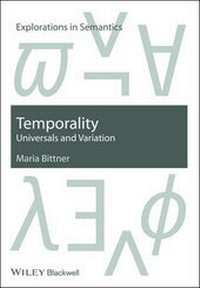
Temporality
Universals and Variation
Published on 13. May 2014
Book
Hardback
348 pages
978-1-4051-9040-4 (ISBN)
Description
Temporality surveys the ways in which languages of different types refer to past, present, and future events, through an in-depth examination of four major language types: tense-based English, tense-aspect-based Polish, aspect-based Chinese, and mood-based Kalaallisut.
* Cutting-edge research on directly compositional dynamic semantics of languages with and without grammatical tense
* New in-depth analysis of temporal, aspectual, modal, as well as nominal discourse reference
* Presents a novel logical language for representing linguistic meaning (Update with Centering)
* Develops a unified theory of tense, aspect, mood, and person as different types of 'grammatical centering systems'
Reviews / Votes
"By combining a genuinely non-partisan perspective on human languages with uncompromising formal rigor, Maria Bittner succeeds in separating what is particular to individual languages from what is truly universal to human language and thought. An unparalleled achievement and a milestone in the history of semantics." -Hans Kamp, University of Stuttgart, Germany "Bittner combines insightful linguistic analysis of four very different languages with the construction of a logic, Update with Centering, tailored to their varied semantic and referential needs, and the definition of a grammar formalism according to which logical forms can be constructed compositionally directly from the surface forms of their sentences in context. Her book is a shining example of linguistics as a cognitive science, and will be read by computer scientists, psychologists, and linguists." -Mark Steedman, University of Edinburgh, UMore details
Series
Edition
1. Auflage
Language
English
Place of publication
Hoboken
United Kingdom
Publishing group
John Wiley and Sons Ltd
Target group
Professional and scholarly
Product notice
sewn/stitched
Paper over boards
Dimensions
Height: 250 mm
Width: 175 mm
Thickness: 23 mm
Weight
786 gr
ISBN-13
978-1-4051-9040-4 (9781405190404)
Schweitzer Classification
Other editions
Additional editions
Book
05/2014
Wiley
€49.50
Article not available at the moment
E-Book
04/2014
Wiley-Blackwell
€40.99
Available for download
E-Book
03/2014
Wiley-Blackwell
€40.99
Available for download
Person
Maria Bittner is a Professor of Linguistics at Rutgers University and a member of the editorial boards of Journal of Semantics and Semantics & Pragmatics. She is well known for her work on cross-linguistic formal semantics, dynamic semantics, and syntax-semantics interface, with special focus on Kalaallisut (Eskimo-Aleut: Greenland). Her early research in LF-based static semantics culminated in Case, Scope, and Binding (1994).
Content
List of Figures ix
Acknowledgments xiii
Glosses xv
Introduction 1
Part I Semantic Universals 13
1 Direct Semantic Composition 15
1.1 Simple Type Logic (TL0) 16
1.2 A CG.TL0 Fragment of English 17
1.3 Dynamic Type Logic (DL0) 23
1.4 A CG.DL0 Fragment of English 27
1.5 Centering: A Blind Spot of English-Based Logics 34
2 Nominal Reference with Centering 41
2.1 Center v. Periphery: Anaphora to Structured Lists 42
2.2 Kalaallisut Third Person Inflections as Top-Level Anaphora 48
2.3 Mandarin Third Person Features as Top-Level Anaphora 53
2.4 English Third Person Pronouns as Shallow Anaphora 57
2.5 Simple Update with Centering (UC0) 61
3 Tense as Temporal Centering 67
3.1 Polish Third Person Inflections as Top-Level Anaphora 68
3.2 Polish Tenses as Top-Level Temporal Reference 69
3.3 English Tenses as Temporal (In)definites 73
3.4 English Tenses as Top-Level Temporal Reference 78
3.5 UC0 with Temporal Centering (UCtau) 85
4 Aspect as Eventuality Centering 93
4.1 Polish Aspect Features v. Inflections 94
4.2 Mandarin Aspect Features v. Particles 101
4.3 English Aspectual Auxiliaries 108
4.4 UCtau with Mereology (UCtau+) 112
5 Quantification as Reference to Sets 118
5.1 Nominal Quantification and Anaphora 119
5.2 Nominal Quantification and Temporal Reference 127
5.3 Temporal Quantification and Anaphora 130
5.4 UCtau+ with Discourse Referents for Sets (UCtau?a) 134
6 Mood as Illocutionary Centering 142
6.1 Illocutionary Moods with(out) Reportative Recentering 143
6.2 (Not-)at-Issue Content as Modal Discourse Reference 146
6.3 (Not-)at-Issue with Start-Up Illocutionary Referents 150
6.4 Dependent Moods as Perspectival (Re)centering 157
6.5 UCdelta?a with Illocutionary Referents (UCepsilon!?a) 160
7 (In)direct Speech and Attitude Reports 166
7.1 Mood with(out) Reportative Recentering Revisited 167
7.2 At-Issue Reports with Finite Complements 174
7.3 At-Issue Reports with Non-Finite Complements 179
7.4 UC: Combining UCtau?a and UCepsilon!?a 185
Part II Temporal Variation 191
8 Tense-Based Temporality in English 193
8.1 Indexical Past with(out) Recentering Aspect 194
8.2 Indexical Non-Past with(out) Recentering Aspect 200
8.3 Reports: Speaker's View of Subject's (Non-)Past 203
8.4 Quantification: Tenses in Distributive Contexts 206
8.5 A CG.UC Fragment of English 209
9 Tense-Aspect-Based Temporality in Polish 219
9.1 Relative Past (Im)perfective 220
9.2 Relative Non-Past (Im)perfective 226
9.3 Reports: Subject's (Non-)Past 230
9.4 Quantification: Distributed (Im)perfectives 233
9.5 A CG.UC Fragment of Polish 237
10 Aspect-Based Temporality in Mandarin 246
10.1 Non-Future: Verifiable Topic State 247
10.2 Future: Prospective Topic State or Comment 253
10.3 Reports: Attitudinal Topic State or Comment 257
10.4 Quantification: Topical Habit or Distributive Comment 260
10.5 A CG.UC Fragment of Mandarin 262
11 Mood-Based Temporality in Kalaallisut 272
11.1 Non-Future: Verifiable Eventualities 273
11.2 Future: Verifiable Eventualities with Future c-Points 278
11.3 Reports: Verifiability from Agent's Perspective 282
11.4 Quantification: Verifiable Habits 287
11.5 A CG.UC Fragment of Kalaallisut 290
Conclusion 298
Bibliography 308
Author Index 319
Subject Index 323