

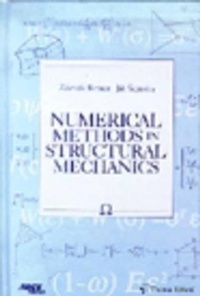
Numerical Methods in Structural Mechanics
1st Edition
Will be published approx. on 5. April 1996
Book
Hardback
422 pages
978-0-7277-2555-4 (ISBN)
Description
Fast development of numerical methods in mechanics has been attracting an increasing number of students, researchers and design specialists from all branches of engineering.
This book has been written to provide an understanding of the nature and the theoretical basis of the most widely used numerical methods - the finite element method (FEM) and the boundary element method (BEM). At the same time, it outlines promising directions for their future development. The book concentrates on the most efficient and reliable methods which have become widely adopted. It contains numerous examples which either illustrate various computational algorithms and compare their accuracy and efficiency, or elucidate the mechanical process under investigation.
This book has been written to provide an understanding of the nature and the theoretical basis of the most widely used numerical methods - the finite element method (FEM) and the boundary element method (BEM). At the same time, it outlines promising directions for their future development. The book concentrates on the most efficient and reliable methods which have become widely adopted. It contains numerous examples which either illustrate various computational algorithms and compare their accuracy and efficiency, or elucidate the mechanical process under investigation.
More details
Language
English
Place of publication
United Kingdom
Publishing group
Emerald Publishing Limited
Target group
Professional and scholarly
Product notice
sewn/stitched
Cloth over boards
Dimensions
Height: 240 mm
Width: 160 mm
Thickness: 31 mm
Weight
757 gr
ISBN-13
978-0-7277-2555-4 (9780727725554)
DOI
10.1680/nmism.25554
Copyright in bibliographic data and cover images is held by Nielsen Book Services Limited or by the publishers or by their respective licensors: all rights reserved.
Schweitzer Classification
Content
Basic notions, equations and principles
Skeletal structures
Plates and shells
Solids
Linear dynamics and stability
Semi-analytical methods
FE solution of special problems
Boundary element method
Problems of non-linear mechanics
Adaptive FE techniques
Systems with random fields
Matrix formulation of gauss elimination
Numerical integration
Skeletal structures
Plates and shells
Solids
Linear dynamics and stability
Semi-analytical methods
FE solution of special problems
Boundary element method
Problems of non-linear mechanics
Adaptive FE techniques
Systems with random fields
Matrix formulation of gauss elimination
Numerical integration