

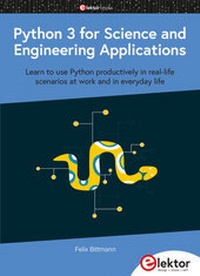
Python 3 for Science and Engineering Applications
Learn to use Python productively in real-life scenarios at work and in everyday life
1st Edition
Published on 16. November 2020
Book
Paperback/Softback
168 pages
978-3-89576-399-1 (ISBN)
Description
If you have mastered the basics of Python and are wanting to explore the language in more depth, this book is for you. By means of concrete examples used in different applications, the book illustrates many aspects of programming (e.g. algorithms, recursion, data structures) and helps problem-solving strategies. Including general ideas and solutions, the specifics of Python and how these can be practically applied are discussed.
Python 3 for Science and Engineering Applications includes:
- practical and goal-oriented learning
- basic Python techniques
- modern Python 3.6+ including comprehensions, decorators and generators
- complete code available online
- more than 40 exercises, solutions documented online
- no additional packages or installation required, 100% pure
Python Topics cover:
- identifying large prime numbers and computing Pi
- writing and understanding recursive functions with memorisation
- computing in parallel and utilising all system cores
- processing text data and encrypting messages
- comprehending backtracking and solving Sudokus
- analysing and simulating games of chance to develop optimal winning strategies
- handling genetic code and generating extremely long palindromes
More details
Other editions
Additional editions
Felix Bittmann
Python 3 for Science and Engineering Applications
Learn to use Python productively in real-life scenarios at work and in everyday life
E-Book
11/2020
1st Edition
Elektor International Media
€24.99
Available for download
Person
Author
Felix Bittmann is a research associate at the Leibniz Institute for Educational Trajectories and a doctoral candidate at the University of Bamberg, Germany. His research interests include social inequality, the role of education in the course of life, quantitative methods, and the philosophy of science. With a focus on statistical analysis and applied research, Python is an integral and multifunctional tool of his daily workflow.