

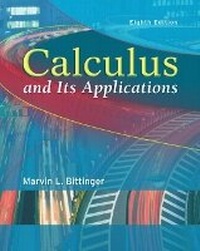
Calculus and Its Applications
8th Edition
Published on 28. July 2003
Book
Hardback
648 pages
978-0-321-16639-5 (ISBN)
Description
The Eighth Edition of Calculus and Its Applications builds on its reputation as one of the most student-oriented and clearly written Applied Calculus texts available. The exercises have been substantially updated to include additional relevant and current topics.
More details
Edition
8th edition
Language
English
Place of publication
New Jersey
United States
Publishing group
Pearson Education (US)
Target group
Professional and scholarly
Dimensions
Height: 262 mm
ISBN-13
978-0-321-16639-5 (9780321166395)
Copyright in bibliographic data and cover images is held by Nielsen Book Services Limited or by the publishers or by their respective licensors: all rights reserved.
Schweitzer Classification
Other editions
New editions
Book
03/2007
9th Edition
Pearson
€97.79
Article exhausted; check for reprint
Previous edition
Marvin L. Bittinger
Calculus and Its Applications
Book
12/1999
7th Edition
Pearson
€49.51
Article exhausted; check for reprint
Person
Marvin Bittinger For over thirty years Professor Marvin L. Bittinger has been teaching math at the university level. Since 1968 he has been employed as a professor of mathematics education at Indiana University - Purdue University at Indianapolis. Professor Bittinger has authored 159 publications on topics ranging from Basic Mathematics to Algebra and Trigonometry to Brief Calculus. He received his BA in Mathematics from Manchester College in 1963 and his PhD in Mathematics Education from Purdue University in 1968. Special honors include being Distinguished Visiting Professor at the United States Air Force Academy and being elected to the Manchester College Board of Trustees from 1992 to 1999. His hobbies include hiking, baseball, golf, and bowling and he enjoys membership in the Professional Bowler's Association and the Society for the Advancement of Baseball Research.
Professor Bittinger has also had the privilege of speaking at a recent mathematics convention giving a lecture entitled, Baseball and Mathematics. In addition, he also has an interest in philosophy and theology, in particular, apologetics. Professor Bittinger currently lives in Carmel, Indiana with his wife Elaine. He has two grown and married sons, Lowell and Chris, and three grandchildren.
Professor Bittinger has also had the privilege of speaking at a recent mathematics convention giving a lecture entitled, Baseball and Mathematics. In addition, he also has an interest in philosophy and theology, in particular, apologetics. Professor Bittinger currently lives in Carmel, Indiana with his wife Elaine. He has two grown and married sons, Lowell and Chris, and three grandchildren.
Content
(Each chapter concludes with a Summary and Review, and a Chapter Test.)
1. Functions, Graphs, and Models.
Graphs and Equations.
Functions and Models.
Finding Domain and Range.
Slope and Linear Functions.
Other Functions and Models.
Mathematical Modeling and Curve Fitting.
Extended Technology Application: The Ecological Effect of Global Warming.
2. Differentiation.
Limits and Continuity: Numerically and Graphically.
Limits: Algebraically.
Average Rates of Change.
Differentiation Using Limits of Difference Quotients.
Differentiation Techniques: The Power and Sum-Difference Rules.
Instantaneous Rates of Change.
Differentiation Techniques: The Product and Quotient Rules.
The Chain Rule.
Higher-Order Derivatives.
Extended Technology Application: Path of a Baseball: The Tale of the Tape.
3. Applications of Differentiation.
Using First Derivatives to Find Maximum and Minimum Values and Sketch Graphs.
Using Second Derivatives to Find Maximum and Minimum Values and Sketch Graphs.
Graph Sketching: Asymptotes and Rational Functions.
Using Derivatives to Find Absolute Maximum and Minimum Values.
Maximum-Minimum Problems: Business and Economic Applications.
Differentials.
Implicit Differentiation and Related Rates.
Extended Technology Application: Maximum Sustainable Harvest.
4. Exponential and Logarithmic Functions.
Exponential Functions.
Logarithmic Functions.
Applications: The Uninhibited Growth Model, dP/dt = kP.
Applications: Decay.
The Derivatives of a x and logax.
An Economics Application: Elasticity of Demand.
Extended Technology Application: The Business of Motion Picture Box-Office Revenue.
5. Integration.
Integration.
Area and Definite Integrals.
Limits of Sums and Accumulations.
Properties of Definite Integrals.
Integration Techniques: Substitution.
Integration Techniques: Integration by Parts.
Integration Techniques: Tables.
Extended Technology Application: Financial Predictions for Sherwin-Williams, Intel, DeBrand, and the Gap.
6. Applications of Integration.
An Economics Application: Consumer's Surplus and Producer's Surplus.
Applications of the Models and .
Improper Integrals.
Probability.
Probability: Expected Value; The Normal Distribution.
Volume.
Differential Equations.
Extended Technology Application: Curve Fitting and the Volume of a Bottle of Soda.
7. Functions of Several Variables.
Functions of Several Variables.
Partial Derivatives.
Higher-Order Partial Derivatives.
Maximum-Minimum Problems.
An Application: The Least-Squares Technique.
Constrained Maximum and Minimum Values: Lagrange Multipliers.
Multiple Integration.
Extended Technology Application: Minimizing Employees' Travel Time in a Building.
Cumulative Review.
Appendix: Review of Basic Algebra.
Tables.
Integration Formulas.
Areas for a Standard Normal Distribution.
Answers.
Index.
1. Functions, Graphs, and Models.
Graphs and Equations.
Functions and Models.
Finding Domain and Range.
Slope and Linear Functions.
Other Functions and Models.
Mathematical Modeling and Curve Fitting.
Extended Technology Application: The Ecological Effect of Global Warming.
2. Differentiation.
Limits and Continuity: Numerically and Graphically.
Limits: Algebraically.
Average Rates of Change.
Differentiation Using Limits of Difference Quotients.
Differentiation Techniques: The Power and Sum-Difference Rules.
Instantaneous Rates of Change.
Differentiation Techniques: The Product and Quotient Rules.
The Chain Rule.
Higher-Order Derivatives.
Extended Technology Application: Path of a Baseball: The Tale of the Tape.
3. Applications of Differentiation.
Using First Derivatives to Find Maximum and Minimum Values and Sketch Graphs.
Using Second Derivatives to Find Maximum and Minimum Values and Sketch Graphs.
Graph Sketching: Asymptotes and Rational Functions.
Using Derivatives to Find Absolute Maximum and Minimum Values.
Maximum-Minimum Problems: Business and Economic Applications.
Differentials.
Implicit Differentiation and Related Rates.
Extended Technology Application: Maximum Sustainable Harvest.
4. Exponential and Logarithmic Functions.
Exponential Functions.
Logarithmic Functions.
Applications: The Uninhibited Growth Model, dP/dt = kP.
Applications: Decay.
The Derivatives of a x and logax.
An Economics Application: Elasticity of Demand.
Extended Technology Application: The Business of Motion Picture Box-Office Revenue.
5. Integration.
Integration.
Area and Definite Integrals.
Limits of Sums and Accumulations.
Properties of Definite Integrals.
Integration Techniques: Substitution.
Integration Techniques: Integration by Parts.
Integration Techniques: Tables.
Extended Technology Application: Financial Predictions for Sherwin-Williams, Intel, DeBrand, and the Gap.
6. Applications of Integration.
An Economics Application: Consumer's Surplus and Producer's Surplus.
Applications of the Models and .
Improper Integrals.
Probability.
Probability: Expected Value; The Normal Distribution.
Volume.
Differential Equations.
Extended Technology Application: Curve Fitting and the Volume of a Bottle of Soda.
7. Functions of Several Variables.
Functions of Several Variables.
Partial Derivatives.
Higher-Order Partial Derivatives.
Maximum-Minimum Problems.
An Application: The Least-Squares Technique.
Constrained Maximum and Minimum Values: Lagrange Multipliers.
Multiple Integration.
Extended Technology Application: Minimizing Employees' Travel Time in a Building.
Cumulative Review.
Appendix: Review of Basic Algebra.
Tables.
Integration Formulas.
Areas for a Standard Normal Distribution.
Answers.
Index.