

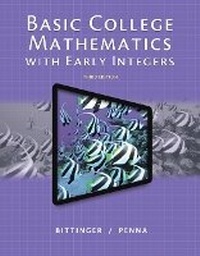
Basic College Mathematics with Early Integers
3rd Edition
Published on 25. February 2014
Book
Paperback/Softback
744 pages
978-0-321-92234-2 (ISBN)
Description
The Bittinger Worktext Series recognizes that math hasn't changed, but students-and the way they learn math-have. This latest edition continues the Bittinger tradition of objective-based, guided learning, while also integrating timely updates to the proven pedagogy. This edition has a greater emphasis on guided learning and helping students get the most out of all of the resources available, including new mobile learning resources, whether in a traditional lecture, hybrid, lab-based, or online course.
Note: You are purchasing a standalone product; MyMathLab does not come packaged with this content. MyMathLab is not a self-paced technology and should only be purchased when required by an instructor. If you would like to purchase both the physical text and MyMathLab, search for:
0321951808 / 9780321951809 Basic College Mathematics with Early Integers, Plus NEW MyMathLab with Pearson eText -- Access Card Package
Package consists of:
0321431308 / 9780321431301 MyMathLab -- Glue-in Access
0321654064 / 9780321654069 MyMathLab Inside Star Sticker
0321922344 / 9780321922342 Basic College Mathematics with Early Integers
Note: You are purchasing a standalone product; MyMathLab does not come packaged with this content. MyMathLab is not a self-paced technology and should only be purchased when required by an instructor. If you would like to purchase both the physical text and MyMathLab, search for:
0321951808 / 9780321951809 Basic College Mathematics with Early Integers, Plus NEW MyMathLab with Pearson eText -- Access Card Package
Package consists of:
0321431308 / 9780321431301 MyMathLab -- Glue-in Access
0321654064 / 9780321654069 MyMathLab Inside Star Sticker
0321922344 / 9780321922342 Basic College Mathematics with Early Integers
More details
Edition
3rd edition
Language
English
Place of publication
United States
Publishing group
Pearson Education (US)
Target group
College/higher education
Dimensions
Height: 10 mm
Width: 10 mm
Thickness: 10 mm
Weight
1415 gr
ISBN-13
978-0-321-92234-2 (9780321922342)
Copyright in bibliographic data and cover images is held by Nielsen Book Services Limited or by the publishers or by their respective licensors: all rights reserved.
Schweitzer Classification
Other editions
Previous edition
Marvin L. Bittinger | Judith A. Penna
Basic College Mathematics with Early Integers plus MyMathLab/MyStatLab Student Access Code Card
Book
04/2011
2nd Edition
Pearson
€160.20
Article exhausted; check for reprint
Persons
Marvin Bittinger has been teaching math at the university level for more than thirty-eight years. Since 1968, he has been employed at Indiana University Purdue University Indianapolis, and is now professor emeritus of mathematics education. Professor Bittinger has authored over 190 publications on topics ranging from basic mathematics to algebra and trigonometry to applied calculus. He received his BA in mathematics from Manchester College and his PhD in mathematics education from Purdue University. Special honors include Distinguished Visiting Professor at the United States Air Force Academy and his election to the Manchester College Board of Trustees from 1992 to 1999. Professor Bittinger has also had the privilege of speaking at many mathematics conventions, most recently giving a lecture entitled "Baseball and Mathematics." His hobbies include hiking in Utah, baseball, golf, and bowling. In addition, he also has an interest in philosophy and theology, in particular, apologetics. Professor Bittinger currently lives in Carmel, Indiana, with his wife Elaine. He has two grown and married sons, Lowell and Chris, and four granddaughters.
Judy Penna received her undergraduate degree in mathematics from Kansas State University and her graduate degree in mathematics from the University of Illinois. Since then, she has taught at Indiana University-Purdue University Indianapolis and at Butler University, and continues to focus on writing quality textbooks for undergraduate mathematics students. In her free time she likes to travel, read, knit, and spend time with her children and grandchildren.
Judy Penna received her undergraduate degree in mathematics from Kansas State University and her graduate degree in mathematics from the University of Illinois. Since then, she has taught at Indiana University-Purdue University Indianapolis and at Butler University, and continues to focus on writing quality textbooks for undergraduate mathematics students. In her free time she likes to travel, read, knit, and spend time with her children and grandchildren.
Content
Index of Applications
Preface
1. Whole Numbers
1.1 Standard Notation
1.2 Addition
1.3 Subtraction
1.4 Multiplication
1.5 Division
1.6 Rounding and Estimating; Order
1.7 Solving Equations
1.8 Applications and Problem Solving
Translating for Success
1.9 Exponential Notation and Order of Operations
Summary and Review
Test
2. Integers
2.1 The Integers
2.2 Addition of Integers
2.3 Subtraction of Integers
Mid-Chapter Review
2.4 Multiplication of Integers
2.5 Division of Integers and Order of Operations
Translating for Success
Summary and Review
Test
3. Fraction Notation: Multiplication and Division
3.1 Factorizations
3.2 Divisibility
3.3 Fractions and Fraction Notation
3.4 Multiplication and Applications
3.5 Simplifying
Mid-Chapter Review
3.6 Multiplying, Simplifying, and Applications
3.7 Division and Applications
Translating for Success
Summary and Review
Test
Cumulative Review
4. Fraction Notation and Mixed Numerals
4.1 Least Common Multiples
4.2 Addition and Applications
4.3 Subtraction, Order, and Applications
Translating for Success
4.4 Mixed Numerals
Mid-Chapter Review
4.5 Addition and Subtraction Using Mixed Numerals; Applications
4.6 Multiplication and Division Using Mixed Numerals; Applications
Translating for Success
4.7 Order of Operations, Complex Fractions, and Estimation
Summary and Review
Test
Cumulative Review
5. Decimal Notation
5.1 Decimal Notation, Order, and Rounding
5.2 Addition and Subtraction
5.3 Multiplication
5.4 Division
Mid-Chapter Review
5.5 Converting from Fraction Notation to Decimal Notation
5.6 Estimating
5.7 Applications and Problem Solving
Translating for Success
Summary and Review
Test
Cumulative Review
6. Ratio and Proportion
6.1 Introduction to Ratios
6.2 Rates and Unit Prices
6.3 Proportions
Mid-Chapter Review
6.4 Applications of Proportions
Translating for Success
6.5 Geometric Applications
Summary and Review
Test
Cumulative Review
7. Percent Notation
7.1 Percent Notation
7.2 Percent Notation and Fraction Notation
7.3 Solving Percent Problems Using Percent Equations
7.4 Solving Percent Problems Using Proportions
Mid-Chapter Review
7.5 Applications of Percent
Translating for Success
7.6 Sales Tax, Commission, and Discount
7.7 Simple Interest and Compound Interest; Credit Cards
Summary and Review
Test
Cumulative Review
8. Data, Graphs, and Statistics
8.1 Averages, Medians, and Modes
8.2 Interpreting Data from Tables and Graphs
Mid-Chapter Review
8.3 Interpreting and Drawing Bar Graphs and Line Graphs
8.4 Interpreting and Drawing Circle Graphs
Translating for Success
Summary and Review
Test
Cumulative Review
9. Measurement
9.1 Linear Measures: American Units
9.2 Linear Measures: The Metric System
9.3 Converting Between American Units and Metric Units
Mid-Chapter Review
9.4 Weight and Mass; Medical Applications
9.5 Capacity; Medical Applications
9.6 Time and Temperature
9.7 Converting Units of Area
Translating for Success
Summary and Review
Test
Cumulative Review
10. Geometry
10.1 Perimeter
10.2 Area
10.3 Circles
Mid-Chapter Review
10.4 Volume
10.5 Angles and Triangles
10.6 Square Roots and the Pythagorean Theorem
Translating for Success
Summary and Review
Test
Cumulative Review
11. Algebra: Solving Equations and Problems
11.1 Introduction to Algebra
11.2 Solving Equations: The Addition Principle
11.3 Solving Equations: The Multiplication Principle
Mid-Chapter Review
11.4 Using the Principles Together
11.5 Applications and Problem Solving
Translating for Success
Summary and Review
Test
Cumulative Review
Answers
Guided Solutions
Glossary
Index
Preface
1. Whole Numbers
1.1 Standard Notation
1.2 Addition
1.3 Subtraction
1.4 Multiplication
1.5 Division
1.6 Rounding and Estimating; Order
1.7 Solving Equations
1.8 Applications and Problem Solving
Translating for Success
1.9 Exponential Notation and Order of Operations
Summary and Review
Test
2. Integers
2.1 The Integers
2.2 Addition of Integers
2.3 Subtraction of Integers
Mid-Chapter Review
2.4 Multiplication of Integers
2.5 Division of Integers and Order of Operations
Translating for Success
Summary and Review
Test
3. Fraction Notation: Multiplication and Division
3.1 Factorizations
3.2 Divisibility
3.3 Fractions and Fraction Notation
3.4 Multiplication and Applications
3.5 Simplifying
Mid-Chapter Review
3.6 Multiplying, Simplifying, and Applications
3.7 Division and Applications
Translating for Success
Summary and Review
Test
Cumulative Review
4. Fraction Notation and Mixed Numerals
4.1 Least Common Multiples
4.2 Addition and Applications
4.3 Subtraction, Order, and Applications
Translating for Success
4.4 Mixed Numerals
Mid-Chapter Review
4.5 Addition and Subtraction Using Mixed Numerals; Applications
4.6 Multiplication and Division Using Mixed Numerals; Applications
Translating for Success
4.7 Order of Operations, Complex Fractions, and Estimation
Summary and Review
Test
Cumulative Review
5. Decimal Notation
5.1 Decimal Notation, Order, and Rounding
5.2 Addition and Subtraction
5.3 Multiplication
5.4 Division
Mid-Chapter Review
5.5 Converting from Fraction Notation to Decimal Notation
5.6 Estimating
5.7 Applications and Problem Solving
Translating for Success
Summary and Review
Test
Cumulative Review
6. Ratio and Proportion
6.1 Introduction to Ratios
6.2 Rates and Unit Prices
6.3 Proportions
Mid-Chapter Review
6.4 Applications of Proportions
Translating for Success
6.5 Geometric Applications
Summary and Review
Test
Cumulative Review
7. Percent Notation
7.1 Percent Notation
7.2 Percent Notation and Fraction Notation
7.3 Solving Percent Problems Using Percent Equations
7.4 Solving Percent Problems Using Proportions
Mid-Chapter Review
7.5 Applications of Percent
Translating for Success
7.6 Sales Tax, Commission, and Discount
7.7 Simple Interest and Compound Interest; Credit Cards
Summary and Review
Test
Cumulative Review
8. Data, Graphs, and Statistics
8.1 Averages, Medians, and Modes
8.2 Interpreting Data from Tables and Graphs
Mid-Chapter Review
8.3 Interpreting and Drawing Bar Graphs and Line Graphs
8.4 Interpreting and Drawing Circle Graphs
Translating for Success
Summary and Review
Test
Cumulative Review
9. Measurement
9.1 Linear Measures: American Units
9.2 Linear Measures: The Metric System
9.3 Converting Between American Units and Metric Units
Mid-Chapter Review
9.4 Weight and Mass; Medical Applications
9.5 Capacity; Medical Applications
9.6 Time and Temperature
9.7 Converting Units of Area
Translating for Success
Summary and Review
Test
Cumulative Review
10. Geometry
10.1 Perimeter
10.2 Area
10.3 Circles
Mid-Chapter Review
10.4 Volume
10.5 Angles and Triangles
10.6 Square Roots and the Pythagorean Theorem
Translating for Success
Summary and Review
Test
Cumulative Review
11. Algebra: Solving Equations and Problems
11.1 Introduction to Algebra
11.2 Solving Equations: The Addition Principle
11.3 Solving Equations: The Multiplication Principle
Mid-Chapter Review
11.4 Using the Principles Together
11.5 Applications and Problem Solving
Translating for Success
Summary and Review
Test
Cumulative Review
Answers
Guided Solutions
Glossary
Index