

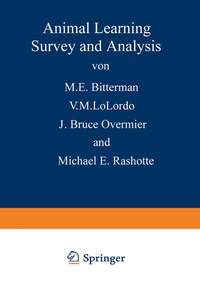
Animal Learning
Survey and Analysis
Published on 15. June 2012
Book
Paperback/Softback
522 pages
978-1-4684-3389-0 (ISBN)
Description
For ten days, a number of neuroscientists met at Reisensburg to attend a series of lectures and discussions, an Institute, on animal learning. The students were drawn from a wide variety of disciplines, including anatomy, biochemistry, pharmacology, physiol ogy and zoology. It is probably true to say that many of them had at best a sketchy knowledge about the learning behavior of animals, about the conditions which are necessary for learning to take place and about the theories that psychologists have constructed about the learning processes. Was the Institute of any benefit to those neuro scientists whose interests lay in studying the functioning of the nervous system by manipulating it or probing it in some direct way? Some twenty years ago the answer to this question would probably have been "No"; and there is a very good reason why this view might have been held, especially by students of the mammalian nervous system. At that time most investigators used anaesthetised animals, or animals immobilized in some other way such as by surgically isolating the brain from the spinal cord, by dividing the brain at various levels or through the use of paralyzing agents. These con ditions achieved two things. On the one hand, they allowed sub stantial advances to be made, particularly in the analysis of sensory processing and in the analysis of the neuronal mechanisms of relatively simple reflex action. On the other hand, the experi mental conditions virtually eliminated complex behavior.
More details
Series
Edition
Softcover reprint of the original 1st ed. 1979
Language
English
Place of publication
New York
United States
Target group
Professional and scholarly
Research
Illustrations
19 s/w Abbildungen
522 p. 19 illus.
Dimensions
Height: 254 mm
Width: 178 mm
Thickness: 29 mm
Weight
982 gr
ISBN-13
978-1-4684-3389-0 (9781468433890)
DOI
10.1007/978-1-4684-3387-6
Schweitzer Classification
Other editions
Additional editions
E-Book
12/2012
Springer
€96.29
Available for download
Book
01/1979
Plenum Publishing Corporation
€232.93
Article exhausted; check different version
Content
1. Historical Introduction.- 2. Classical Conditioning: The Pavlovian Perspective.- 3. Classical Conditioning: Contingency and Contiguity.- 4. Classical Conditioning: Compound CSs and the Rescorla-Wagner Model.- 5. Reward Training: Methods and Data.- 6. Reward Training: Latent Learning.- 7. Reward Training: Contrast Effects.- 8. Reward Training: Extinction.- 9. Punishment.- 10. Avoidance Learning.- 11. Theories of Instrumental Learning.- 12. Generalization.- 13. Discrimination.- 14. Attention.- 15. Constraints on Learning.