

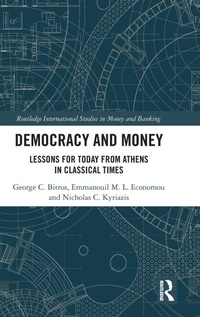
Democracy and Money
Lessons for Today from Athens in Classical Times
1st Edition
Published on 13. July 2020
Book
Hardback
320 pages
978-0-367-50917-0 (ISBN)
Description
The authors of this book argue that post-war fiscal and monetary policies in the U.S. are prone to more frequent and more destabilizing domestic and international financial crises. So, in the aftermath of the one that erupted in 2008, they propose that now we are sleepwalking into another, which under the prevailing institutional circumstances could develop into a worldwide financial Armageddon.
Thinking ahead of such a calamity, this book presents for the first time a model of democratic governance with privately produced money based on the case of Athens in Classical times, and explains why, if it is conceived as a benchmark for reference and adaptation, it may provide an effective way out from the dreadful predicament that state managed fiat money holds for the stability of Western-type democracies and the international financial system.
As the U.S. today, Athens at that time reached the apex of its military, economic, political, cultural, and scientific influence in the world. But Athens triumphed through different approaches to democracy and fundamentally different fiscal and monetary policies than the U.S. Thus the readers will have the opportunity to learn about these differences and appreciate the potential they offer for confronting the challenges contemporary democracies face under the leadership of the U.S.
The book will find audiences among academics, university students, and researchers across a wide range of fields and subfields, as well as legislators, fiscal and monetary policy makers, and economic and financial consultants.
Thinking ahead of such a calamity, this book presents for the first time a model of democratic governance with privately produced money based on the case of Athens in Classical times, and explains why, if it is conceived as a benchmark for reference and adaptation, it may provide an effective way out from the dreadful predicament that state managed fiat money holds for the stability of Western-type democracies and the international financial system.
As the U.S. today, Athens at that time reached the apex of its military, economic, political, cultural, and scientific influence in the world. But Athens triumphed through different approaches to democracy and fundamentally different fiscal and monetary policies than the U.S. Thus the readers will have the opportunity to learn about these differences and appreciate the potential they offer for confronting the challenges contemporary democracies face under the leadership of the U.S.
The book will find audiences among academics, university students, and researchers across a wide range of fields and subfields, as well as legislators, fiscal and monetary policy makers, and economic and financial consultants.
Reviews / Votes
'The book explains how the main political institutions (mainly the Assembly of the citizens and the Council) were functioning regarding monetary matters. It explains the Athenian monetary system as a benchmark for reference and adaptation, which would provide an effective way out of the current dreadful predicament that government managed money holds for the US and the world at large.The authors argue in favor of the imperative that representative democracy in the U.S should be transformed into digital direct democracy, i.e. go back to the form of the Athenian democracy that the American founding fathers would have wished to introduce, but has become feasible, if not inescapable, only in our times by the ongoing revolutionary advances particularly in the fronts of digital technology and cryptography.' - Professor Panagiotis E. Petrakis, Department of Economics, National and Kapodistrian University of Athens, Greece.
'Following an interdisciplinary approach, combining economics, history and political science, the authors address a variety of issues, such as: money related institutions in Classical Athens, public finance, the various coinage decrees, currency issues in ancient Greek federal states, structure and evolution of the economy (in which they show that Athens may be considered the first "modern economy"), alternatives to established central banking, examining modern issues of monetary policies and some of its failures and comparing them to Athens.
It is an interesting, challenging and well-argued book that should interest economists, political scientists, historians but also the general public.' - Professor Napoleon Maravegias, School of Economics and Political Sciences, National and Kapodistrian University of Athens, Greece.
"This book is a comprehensive, useful and timely collection of what we know today of the Athenian economy, which provides challenging arguments on how we might use the wisdom thus gained for future reforms. The combination of different disciplines, the wealth of information provided, the bold policy proposals are remarkable and represent a singular achievement." - Bertram Schefold, Faculty of Economics, Goethe University.
More details
Series
Language
English
Place of publication
London
United Kingdom
Publishing group
Taylor & Francis Ltd
Target group
Professional and scholarly
College/higher education
Illustrations
12 s/w Zeichnungen, 9 s/w Tabellen, 21 s/w Abbildungen, 9 s/w Photographien bzw. Rasterbilder
9 Tables, black and white; 12 Line drawings, black and white; 9 Halftones, black and white; 21 Illustrations, black and white
Dimensions
Height: 240 mm
Width: 161 mm
Thickness: 22 mm
Weight
649 gr
ISBN-13
978-0-367-50917-0 (9780367509170)
Copyright in bibliographic data and cover images is held by Nielsen Book Services Limited or by the publishers or by their respective licensors: all rights reserved.
Schweitzer Classification
Other editions
Additional editions
George C. Bitros | Emmanouil M. L. Economou | Nicholas C. Kyriazis
Democracy and Money
Lessons for Today from Athens in Classical Times
Book
04/2022
1st Edition
Routledge
€51.98
Shipment within 15-20 days
George C. Bitros | Emmanouil M. L. Economou | Nicholas C. Kyriazis
Democracy and Money
Lessons for Today from Athens in Classical Times
E-Book
07/2020
1st Edition
Routledge
€59.49
Available for download
George C. Bitros | Emmanouil M. L. Economou | Nicholas C. Kyriazis
Democracy and Money
Lessons for Today from Athens in Classical Times
E-Book
07/2020
1st Edition
Routledge
€59.49
Available for download
Persons
George C. Bitros is Professor of Political Economy, Emeritus, Athens University of Economics and Business.
Emmanouil M.L. Economou is Adjunct Lecturer at the Department of Economics, University of Thessaly.
Nicholas C. Kyriazis is Professor at the Department of Economics, University of Thessaly.
Emmanouil M.L. Economou is Adjunct Lecturer at the Department of Economics, University of Thessaly.
Nicholas C. Kyriazis is Professor at the Department of Economics, University of Thessaly.
Content
1. Introduction 2. Money-related institutions in classical Athens 3. The system and the tenets of public finance 4. Main currency-related policies 5. Structure and evolution of the economy 6. Money in a market economy without a central bank 7. An assessment of comparative performance 8. Alternatives to established central banking 9. Why look back and how to direct democracy