

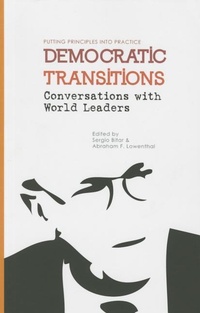
Democratic Transitions
Conversations with World Leaders
Will be published approx. on 10. November 2015
Book
Paperback/Softback
488 pages
978-1-4214-1760-8 (ISBN)
Description
National leaders who played key roles in transitions to democratic governance reveal how these were accomplished in Brazil, Chile, Ghana, Indonesia, Mexico, the Philippines, Poland, South Africa, and Spain. Commissioned by the International Institute for Democracy and Electoral Assistance (International IDEA), these interviews shed fascinating light on how repressive regimes were ended and democracy took hold. In probing conversations with Fernando Henrique Cardoso, Patricio Aylwin, Ricardo Lagos, John Kufuor, Jerry Rawlings, B J Habibie, Ernesto Zedillo, Fidel V Ramos, Aleksander Kwasniewski, Tadeusz Mazowiecki, F W de Klerk, Thabo Mbeki, and Felipe Gonzalez, editors Sergio Bitar and Abraham F Lowenthal focused on each leader's principal challenges and goals as well as their strategies to end authoritarian rule and construct democratic governance. Context-setting introductions by country experts highlight each nation's unique experience as well as recurrent challenges all transitions faced. A chapter by Georgina Waylen analyzes the role of women leaders, often underestimated.
A foreword by Tunisia's former president, Mohamed Moncef Marzouki, underlines the book's relevance in North Africa, West Asia, and beyond. The editors' conclusion distills lessons about how democratic transitions have been and can be carried out in a changing world, emphasizing the importance of political leadership. This unique book should be valuable for political leaders, civil society activists, journalists, scholars, and all who want to support democratic transitions.
A foreword by Tunisia's former president, Mohamed Moncef Marzouki, underlines the book's relevance in North Africa, West Asia, and beyond. The editors' conclusion distills lessons about how democratic transitions have been and can be carried out in a changing world, emphasizing the importance of political leadership. This unique book should be valuable for political leaders, civil society activists, journalists, scholars, and all who want to support democratic transitions.
Reviews / Votes
Democratic Transitions is a balanced, thoughtful, empirically-based volume that adds an important dimension to our understanding of both the theoretical and the policy issues surrounding the spread of democracy abroad. It is a major addition to the literature on post-authoritarian transitions and on the "how-to" of consolidating democracy after dictatorship. In an era of undue pessimism about the fate of democracy worldwide, it is a timely reminder of how democratic transitions can be made to work. Orbis: A Journal of World Affairs ... In evoking all of these collective distilled experiences from some of the world most successful politicians from recent decades, Bitar and Lowenthal also convey their passion for democracy forcefully, and they enable the college freshman and the scholar to understand better the events and processes that have shaped the world for the better in which we live. ReVistaMore details
Language
English
Place of publication
Baltimore, MD
United States
Target group
College/higher education
Professional and scholarly
Product notice
Paperback (trade)
Illustrations
13 s/w Photographien bzw. Rasterbilder, 1 s/w Zeichnung
1 Line drawings, black and white; 13 Halftones, black and white
Dimensions
Height: 234 mm
Width: 157 mm
Thickness: 30 mm
Weight
703 gr
ISBN-13
978-1-4214-1760-8 (9781421417608)
DOI
10.1353/book.72726
Copyright in bibliographic data and cover images is held by Nielsen Book Services Limited or by the publishers or by their respective licensors: all rights reserved.
Schweitzer Classification
Persons
Sergio Bitar, president of Chile's Foundation for Democracy, is a political leader and public intellectual. Abraham F. Lowenthal, professor emeritus of the University of Southern California, was the founding director of the Inter-American Dialogue and the Wilson Center's Latin American Program.
Content
Foreword
Preface
Introduction
Chapter 1.Brazil
Chapter 2. Chile
Chapter 3. Ghana
Chapter 4. Indonesia
Chapter 5. Mexico
Chapter 6. The Philippines
Chapter 7. Poland
Chapter 8. South Africa
Chapter 9. Spain
Chapter 10. Women Activists in Democratic Transitions
Chapter 11. From Authoritarian Rule toward Democratic Governance
Acknowledgments
About the Editors and Contributors
Selected Bibliography
Index
Preface
Introduction
Chapter 1.Brazil
Chapter 2. Chile
Chapter 3. Ghana
Chapter 4. Indonesia
Chapter 5. Mexico
Chapter 6. The Philippines
Chapter 7. Poland
Chapter 8. South Africa
Chapter 9. Spain
Chapter 10. Women Activists in Democratic Transitions
Chapter 11. From Authoritarian Rule toward Democratic Governance
Acknowledgments
About the Editors and Contributors
Selected Bibliography
Index