

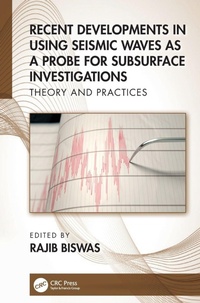
Recent Developments in Using Seismic Waves as a Probe for Subsurface Investigations
Theory and Practices
1st Edition
Published on 30. September 2022
Book
Hardback
424 pages
978-1-032-01208-7 (ISBN)
Description
Seismology has come a long way. Being the scientific study of seismic waves and their allied phenomena, it has entered a multidisciplinary realm. As the main tool, it provides a wealth of information when applied systematically to dig inside the Earth structure. Notwithstanding, the utility of seismic waves has increased manifold. Starting from knowing the epicenter of seismic events, it has influenced mapping of civil engineering structures such as dams and bridges, as well as huge constructions. Although there is no dearth of technical papers in the area of seismic waves, there is an absence of synchronized and recent coherent contents in the direction of seismic waves.
The book will be a unique contribution to the field of seismology, with the aim of assimilating theory and practices. It will provide a comprehensive glimpse of recent advancements in this area with a strong unification of theory and practices. The main objective of the book is to present an in-depth analysis of the theory and real implementations of seismic waves as versatile probes that would be integrated with modern and future perspectives. The current and the future strategies to be discussed in the relevant areas of seismic waves will be another boon for readers.
This book will cater to the needs of novices, researchers and practitioners. Additionally, the contents of the book will be useful for undergraduate as well as postgraduate students of earth science disciplines.
The book will be a unique contribution to the field of seismology, with the aim of assimilating theory and practices. It will provide a comprehensive glimpse of recent advancements in this area with a strong unification of theory and practices. The main objective of the book is to present an in-depth analysis of the theory and real implementations of seismic waves as versatile probes that would be integrated with modern and future perspectives. The current and the future strategies to be discussed in the relevant areas of seismic waves will be another boon for readers.
This book will cater to the needs of novices, researchers and practitioners. Additionally, the contents of the book will be useful for undergraduate as well as postgraduate students of earth science disciplines.
More details
Language
English
Place of publication
London
United Kingdom
Publishing group
Taylor & Francis Ltd
Target group
College/higher education
Professional and scholarly
Academic, Postgraduate, Professional, and Professional Practice & Development
Illustrations
186 farbige Abbildungen, 142 Farbfotos bzw. farbige Rasterbilder, 44 farbige Zeichnungen, 19 s/w Tabellen
19 Tables, black and white; 44 Line drawings, color; 142 Halftones, color; 186 Illustrations, color
Dimensions
Height: 250 mm
Width: 175 mm
Thickness: 28 mm
Weight
930 gr
ISBN-13
978-1-032-01208-7 (9781032012087)
Copyright in bibliographic data and cover images is held by Nielsen Book Services Limited or by the publishers or by their respective licensors: all rights reserved.
Schweitzer Classification
Other editions
Additional editions
Rajib Biswas
Recent Developments in Using Seismic Waves as a Probe for Subsurface Investigations
Theory and Practices
E-Book
09/2022
1st Edition
CRC Press
€231.99
Available for download
Rajib Biswas
Recent Developments in Using Seismic Waves as a Probe for Subsurface Investigations
Theory and Practices
E-Book
09/2022
1st Edition
CRC Press
€231.99
Available for download
Person
Dr. Rajib Biswas has been actively engaged in seismological research since 2008. He had completed one major research project in ambient noise recordings and thereby evaluated site effects of two prominent urban area. He is serving as editorial board member of several journals. He has published more than 85 articles in peer reviewed journals.
Content
1. Deep earth imaging: An application of seismic wave (travel time inversion) 2. Waveform modelling 3. Theory and practices involved in depth and source localization of anisotropy: Recent developments in subsurface investigation 4. Sedimentary basin configuration of different basin structures of Northeast India by teleseismic body wave imaging 5. Seismic wave amplification and localized ground effects: A geological tool for future land use code and land use planning in the low seismic area 6. HVSR as a versatile tool for subsurface investigation 7. Application of teleseismic receiver function in investigation of crustal thickness and Poisson's ratio 8. Lg wave attenuation in special context to Indo-Burman mobile belt of North-East India 9. Analysis of fluctuation in radon concentration and its correlation with geophysical phenomena of a seismically active region 10. Seismicity pattern during violent roof movements in longwall mines 11. Source parameters and scaling relation of the Baikal rift's earthquakes 12. Seismic anisotropy for understanding the dynamics of crust and upper mantle: A case study in the northwest Himalaya and eastern Ladakh-Karakoram zone 13. Lessons learned from earthquakes 14. Integrated geotechnical and geophysical approaches to assess integrity of tank foundations for a crude oil terminal project in the Middle East