

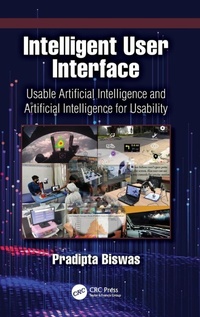
Intelligent User Interface
Usable Artificial Intelligence and Artificial Intelligence for Usability
1st Edition
Will be published approx. on 17. February 2026
Book
Hardback
184 pages
978-1-041-08733-5 (ISBN)
Description
The book aims to mainstream UI/UX design process by explaining latest AI/ML models in a comprehensible way and highlighting case studies on developing intelligent user interfaces for XR systems, human robot interaction, cockpit design and trajectory prediction. The book also discussed latest standards and guidelines relevant to UI/UX design, layout and equipment list for setting up lab on intelligent interaction design involving robots, drones and XR systems.
This book:
Covers a wide array of topics ranging from human factors, computer vision, AR/VR systems, Large Language Model, and usability evaluation techniques including statistical hypothesis techniques.
Discusses latest AI systems such as Vision Transformers, LLM based Human Robot Interface and Virtual Reality based Spacecraft simulation system.
Provides a list of freely downloadable software on the covered topics.
Contains graphical illustrations and a list of quick facts for easy revision and recalling of basic concepts in each chapter.
Gives new project idea on intelligent user interfaces that can be explored by students and early career researchers.
The intended audience of this book are engineering and design students and faculty members, user interface designers, and product managers who would like to be aware of latest AI/ML without diving into too much theoretical details and use it for their project or product development.
This book:
Covers a wide array of topics ranging from human factors, computer vision, AR/VR systems, Large Language Model, and usability evaluation techniques including statistical hypothesis techniques.
Discusses latest AI systems such as Vision Transformers, LLM based Human Robot Interface and Virtual Reality based Spacecraft simulation system.
Provides a list of freely downloadable software on the covered topics.
Contains graphical illustrations and a list of quick facts for easy revision and recalling of basic concepts in each chapter.
Gives new project idea on intelligent user interfaces that can be explored by students and early career researchers.
The intended audience of this book are engineering and design students and faculty members, user interface designers, and product managers who would like to be aware of latest AI/ML without diving into too much theoretical details and use it for their project or product development.
More details
Language
English
Place of publication
London
United Kingdom
Publishing group
Taylor & Francis Ltd
Target group
College/higher education
Postgraduate and Undergraduate Advanced
Illustrations
38 s/w Photographien bzw. Rasterbilder, 43 s/w Zeichnungen, 8 s/w Tabellen, 81 s/w Abbildungen
8 Tables, black and white; 43 Line drawings, black and white; 38 Halftones, black and white; 81 Illustrations, black and white
Dimensions
Height: 240 mm
Width: 161 mm
Thickness: 15 mm
Weight
461 gr
ISBN-13
978-1-041-08733-5 (9781041087335)
Copyright in bibliographic data and cover images is held by Nielsen Book Services Limited or by the publishers or by their respective licensors: all rights reserved.
Schweitzer Classification
Other editions
Additional editions
Pradipta Biswas
Intelligent User Interface
Usable Artificial Intelligence and Artificial Intelligence for Usability
E-Book
02/2026
1st Edition
CRC Press
€128.99
Available for download
Pradipta Biswas
Intelligent User Interface
Usable Artificial Intelligence and Artificial Intelligence for Usability
E-Book
02/2026
1st Edition
CRC Press
€128.99
Available for download
Person
Pradipta Biswas is an Associate Professor at the Department of Design and Manufacturing, associate faculty at the Robert Bosch Centre for Cyber Physical Systems and Curriculum Committee member of HAL-IISc Skill Development Centre at Indian Institute of Science. His experiment on human computer interaction is one of the seven experiments selected for the Axiom-4 mission to be launched on 10th June. He was elected a vice chairman of ITU Study Group 9 (2022-24) and also a Co-Chair of the IRG AVA (2020-24) and Focus Group on Smart TV at International Telecommunication Union, the telecom branch of United Nations. He is a convenor of BIS (Bureau of Indian Standard) Panel on Metaverse.
His research focuses on user modelling and multimodal human-machine interaction for aviation and automotive environments and for assistive technology. He set up and lead the Interaction Design (I3D) Lab. His research won Microsoft's AI 4 Accessibility Grant Award, Facebook's Responsible AR/VR Award and research grants from Collins Aerospace (on AR-AI integration), Siemens (on Holoportation) , British Telecom (on AR/VR Systems), Faurecia Groupe Services Ltd. (on Automotive UI), Wipro Ltd (On Autonomous Vehicle), Defence Research and Development Organization (DRDO), Indian Space Research Organization (ISRO), Departments of Science & Technology (DST) and BioTechnology (DBT) and was featured in New Scientist, NDTV, All India Radio and various other media outlets.
Earlier, Pradipta was a Senior Research Associate at the Engineering Department, Research Fellow at Wolfson College and Research Associate at Trinity Hall of University of Cambridge. He completed PhD in Computer Science at the Rainbow Group of University of Cambridge Computer Laboratory and Trinity College in 2010 and was awarded a Gates-Cambridge Scholarship in 2006. He is a member of the UKRI International Development Peer Review College, and was a professional member of the Society of Flight Test Engineers British Computer Society, Associate Fellow at the UK Higher Education Academy and Royal Society of Medicine.
His research focuses on user modelling and multimodal human-machine interaction for aviation and automotive environments and for assistive technology. He set up and lead the Interaction Design (I3D) Lab. His research won Microsoft's AI 4 Accessibility Grant Award, Facebook's Responsible AR/VR Award and research grants from Collins Aerospace (on AR-AI integration), Siemens (on Holoportation) , British Telecom (on AR/VR Systems), Faurecia Groupe Services Ltd. (on Automotive UI), Wipro Ltd (On Autonomous Vehicle), Defence Research and Development Organization (DRDO), Indian Space Research Organization (ISRO), Departments of Science & Technology (DST) and BioTechnology (DBT) and was featured in New Scientist, NDTV, All India Radio and various other media outlets.
Earlier, Pradipta was a Senior Research Associate at the Engineering Department, Research Fellow at Wolfson College and Research Associate at Trinity Hall of University of Cambridge. He completed PhD in Computer Science at the Rainbow Group of University of Cambridge Computer Laboratory and Trinity College in 2010 and was awarded a Gates-Cambridge Scholarship in 2006. He is a member of the UKRI International Development Peer Review College, and was a professional member of the Society of Flight Test Engineers British Computer Society, Associate Fellow at the UK Higher Education Academy and Royal Society of Medicine.
Content
1. Introduction. 2. Human Factors. 3. Basics of AI/ML. 4. Modalities of Interaction. 5. Computer Vision. 6. Textual Information Processing. 7. Information Visualization. 8. User Study. 9. Human Robot Interaction. 10. Case Studies on Cockpit Design. 11. Case Studies on Trajectory Prediction. 12. Standardization. 13. Concluding Remarks.