

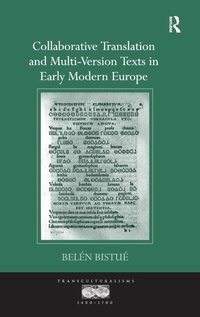
Collaborative Translation and Multi-Version Texts in Early Modern Europe
1st Edition
Published on 6. November 2013
Book
Hardback
196 pages
978-1-4724-1158-7 (ISBN)
Description
Focusing on team translation and the production of multilingual editions, and on the difficulties these techniques created for Renaissance translation theory, this book offers a study of textual practices that were widespread in medieval and Renaissance Europe but have been excluded from translation and literary history. The author shows how collaborative and multilingual translation practices challenge the theoretical reflections of translators, who persistently call for a translation text that offers a single, univocal version and maintains unity of style. In order to explore this tension, Bistue discusses multi-version texts, in both manuscript and print, from a diverse variety of genres: the Scriptures, astrological and astronomical treatises, herbals, goliardic poems, pamphlets, the Greek and Roman classics, humanist grammars, geography treatises, pedagogical dialogs, proverb collections, and romances. Her analyses pay careful attention to both European vernaculars and classical languages, including Arabic, which played a central role in the intense translation activity carried out in medieval Spain. Comparing actual translation texts and strategies with the forceful theoretical demands for unity that characterize the reflections of early modern translators, the author challenges some of the assumptions frequently made in translation and literary analysis. The book contributes to the understanding of early modern discourses and writing practices, including the emerging theoretical discourse on translation and the writing of narrative fiction--both of which, as Bistue shows, define themselves against the models of collaborative translation and multi-version texts.
Reviews / Votes
'...a richly detailed challenge to some cherished idees fixes. The book poses the act of translation as a collaborative and/or serial practice that challenges not only medieval and early modern theorists' efforts to stabilize and codify translation, but also modern critical efforts to read translations in certain ways (as non-authorial, as products of singular agency, as invisible?). The author presents as chief evidence multilingual books and multi-version books, both manuscript and printed codices, and the range of these is wonderful to behold.' A.E.B. Coldiron, Florida State University '... a unique and truly innovative study in translation and premodern literary studies.' Publishing Research Quarterly '[Bistue's] facility with a range of materials that jump across centuries, borders, and subject matter is equally impressive and her findings should reinvigorate literary and translation studies of this period.' SHARP NewsMore details
Series
Language
English
Place of publication
London
United Kingdom
Publishing group
Taylor & Francis Ltd
Target group
College/higher education
Dimensions
Height: 240 mm
Width: 161 mm
Thickness: 15 mm
Weight
470 gr
ISBN-13
978-1-4724-1158-7 (9781472411587)
Copyright in bibliographic data and cover images is held by Nielsen Book Services Limited or by the publishers or by their respective licensors: all rights reserved.
Schweitzer Classification
Other editions
Additional editions
Book
11/2016
1st Edition
Routledge
€73.80
Shipment within 10-20 days
E-Book
05/2016
Routledge
€68.49
Available for download
E-Book
05/2016
Routledge
€68.49
Available for download
Person
Belen Bistue is Tenured Researcher for CONICET, and Assistant Professor of British and North American Literature at Universidad Nacional de Cuyo, Argentina.
Content
Introduction: Collaborative Practices, Multi-Version Texts, and the Difficulty of Thinking Translation; Chapter 1 Res difficilis; Chapter 2 Unthinkable Practices; Chapter 3 Unthinkable Texts; Chapter 4 Translation as a Discredited Text-Model in Early Modern Fiction; epilogue Epilogue: Imagining Translation in Early Modern Europe;