

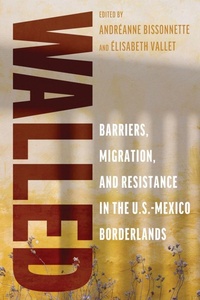
Walled
Barriers, Migration, and Resistance in the U.S.-Mexico Borderlands
Published on 30. April 2025
Book
Hardback
304 pages
978-0-8165-5434-8 (ISBN)
Description
In 1993, then-U.S. President Bill Clinton oversaw the construction of the first stretch of the U.S.-Mexico border walls. Since that pivotal moment, every subsequent U.S. president has allowed for the construction of additional miles of walls or fences. Despite his initial pledge to halt the expansion of border walls, in July 2022, President Joe Biden authorized the construction of new sections in four locations within Arizona. This decision underscores the enduring complexity and contentious nature of the U.S.-Mexico border infrastructure.
From the bustling San Diego-Tijuana region to the borderlands of Brownsville-Matamoros, the U.S.-Mexico border is marked by extensive stretches of walls. Over the past thirty years, these walls have evolved from purely physical barriers into multifaceted systems encompassing administrative, legal, legislative, and biometric components. This volume invites readers to reflect on the transformations of the border since the construction of the initial fourteen miles of wall, and the subsequent addition of 1,940 miles. It provides a comprehensive exploration of the border's evolution, and its profound and lasting impacts.
Bringing together recognized scholars in border studies, Walled delves into the varied manifestations and lived experiences associated with U.S.-Mexico border walls. The introduction by AndrEanne Bissonnette and Elisabeth Vallet offers a thorough review of the border walls' thirty-year history, placing it within a global context. Contributions offer diverse perspectives of the border experience, from state policies and migrant experiences to the daily lives of border residents. Topics such as militarization, migration, artistic resistance, and humanitarian aid are carefully examined. This volume is an essential resource for policymakers, activists, scholars, and anyone seeking to understand the intricate realities of border communities and the far-reaching consequences of border policies.
Contributors
Susana BAez-Ayala
AndrEanne Bissonnette
Mathilde Bourgeon
Silvia M. ChAvez-Baray
Irasema Coronado
Thalia D'Aragon-GiguEre
Erin Hoekstra
Anthony Jimenez
T. Mark Montoya
Eva M. Moya
Scott Nicol
HEctor Antonio Padilla Delgado
Lisa Sun-Hee Park
Tony Payan
Patricia Ravelo-Blancas
David A. Shirk
Allyson Teague
Elisabeth Vallet
From the bustling San Diego-Tijuana region to the borderlands of Brownsville-Matamoros, the U.S.-Mexico border is marked by extensive stretches of walls. Over the past thirty years, these walls have evolved from purely physical barriers into multifaceted systems encompassing administrative, legal, legislative, and biometric components. This volume invites readers to reflect on the transformations of the border since the construction of the initial fourteen miles of wall, and the subsequent addition of 1,940 miles. It provides a comprehensive exploration of the border's evolution, and its profound and lasting impacts.
Bringing together recognized scholars in border studies, Walled delves into the varied manifestations and lived experiences associated with U.S.-Mexico border walls. The introduction by AndrEanne Bissonnette and Elisabeth Vallet offers a thorough review of the border walls' thirty-year history, placing it within a global context. Contributions offer diverse perspectives of the border experience, from state policies and migrant experiences to the daily lives of border residents. Topics such as militarization, migration, artistic resistance, and humanitarian aid are carefully examined. This volume is an essential resource for policymakers, activists, scholars, and anyone seeking to understand the intricate realities of border communities and the far-reaching consequences of border policies.
Contributors
Susana BAez-Ayala
AndrEanne Bissonnette
Mathilde Bourgeon
Silvia M. ChAvez-Baray
Irasema Coronado
Thalia D'Aragon-GiguEre
Erin Hoekstra
Anthony Jimenez
T. Mark Montoya
Eva M. Moya
Scott Nicol
HEctor Antonio Padilla Delgado
Lisa Sun-Hee Park
Tony Payan
Patricia Ravelo-Blancas
David A. Shirk
Allyson Teague
Elisabeth Vallet
Reviews / Votes
"This is a great contribution to the field of border studies. To date, no volume has looked at the course of the U.S.-Mexico wall from its inception until the present-thirty years later-and analyzed the wide-ranging impacts this political institution has on the lives of people that live in its midst. It will surely be read for many years to come."-Matthew Longo, author of The Politics of Borders: Sovereignty, Security, and the Citizen after 9/11More details
Language
English
Place of publication
Tucson
United States
Target group
Professional and scholarly
Product notice
sewn/stitched
Cloth over boards
Illustrations
25 b&w illustrations, 5 tables
Dimensions
Height: 234 mm
Width: 155 mm
Thickness: 23 mm
Weight
499 gr
ISBN-13
978-0-8165-5434-8 (9780816554348)
Copyright in bibliographic data and cover images is held by Nielsen Book Services Limited or by the publishers or by their respective licensors: all rights reserved.
Schweitzer Classification
Persons
AndrEanne Bissonnette is a postdoctoral researcher at the Border Policy Research Institute at Western Washington University and holds a PhD in political science. Her research, anchored in an intersectional analysis, focuses on Latinas' experiences and perceptions of reproductive health services in the United States.
Elisabeth Vallet is an associate professor at RMCC-Saint Jean, director of the Center for Geopolitical Studies (Raoul-Dandurand Chair, University of Quebec at Montreal-UQAM), and co-researcher for the Borders in the 21th Century Program at the University of Victoria.
Elisabeth Vallet is an associate professor at RMCC-Saint Jean, director of the Center for Geopolitical Studies (Raoul-Dandurand Chair, University of Quebec at Montreal-UQAM), and co-researcher for the Borders in the 21th Century Program at the University of Victoria.