

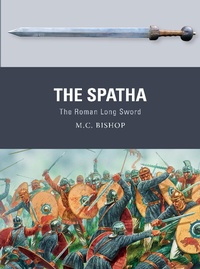
The Spatha
The Roman Long Sword
Published on 23. January 2020
Book
Paperback/Softback
80 pages
978-1-4728-3239-9 (ISBN)
Description
Adopted from the Celts in the 1st century BC, the spatha, a lethal and formidable chopping blade, became the primary sword of the Roman soldier in the Later Empire.
Over the following centuries, the blade, its scabbard, and its system of carriage underwent a series of developments, until by the 3rd century AD it was the universal sidearm of both infantry and cavalry.
Thanks to its long reach, the spatha was the ideal cavalry weapon, replacing the long gladius hispaniensis in the later Republican period. Easy maintenance was key to its success and the spatha was designed to be easily repaired in the field where access to a forge may have been limited. Its influence survived into the Dark Ages with Byzantine, Carolingian and Viking blades.
Drawing together historical accounts, excavated artefacts and the results of the latest scientific analyses of the blades, renowned authority M.C. Bishop reveals the full history of the development, technology, training and use of the spatha: the sword that defended an empire.
Over the following centuries, the blade, its scabbard, and its system of carriage underwent a series of developments, until by the 3rd century AD it was the universal sidearm of both infantry and cavalry.
Thanks to its long reach, the spatha was the ideal cavalry weapon, replacing the long gladius hispaniensis in the later Republican period. Easy maintenance was key to its success and the spatha was designed to be easily repaired in the field where access to a forge may have been limited. Its influence survived into the Dark Ages with Byzantine, Carolingian and Viking blades.
Drawing together historical accounts, excavated artefacts and the results of the latest scientific analyses of the blades, renowned authority M.C. Bishop reveals the full history of the development, technology, training and use of the spatha: the sword that defended an empire.
More details
Series
Language
English
Place of publication
United Kingdom
Publishing group
Bloomsbury Publishing PLC
Target group
Professional and scholarly
Illustrations
Colour artwork plates; black & white and colour photographs and illustrations
Dimensions
Height: 246 mm
Width: 182 mm
Thickness: 7 mm
Weight
264 gr
ISBN-13
978-1-4728-3239-9 (9781472832399)
Copyright in bibliographic data and cover images is held by Nielsen Book Services Limited or by the publishers or by their respective licensors: all rights reserved.
Schweitzer Classification
Other editions
Additional editions
E-Book
01/2020
1st Edition
Osprey Publishing
€15.49
Available for download
E-Book
01/2020
1st Edition
Osprey Publishing
€15.49
Available for download
Persons
Writer, publisher and archaeologist M.C. Bishop is an authority of all aspects of Ancient Rome at war, with particular emphasis on arms and armour of the era. He has written, co-written or edited dozens of books and articles on the subject, including volumes on the gladius and pilum for the Osprey Weapon series.
Peter Dennis studied Illustration at Liverpool Art College. He has since contributed to hundreds of books, predominantly on historical subjects, including many Osprey titles. A keen wargamer and modelmaker, he is based in Nottinghamshire, UK.
Peter Dennis studied Illustration at Liverpool Art College. He has since contributed to hundreds of books, predominantly on historical subjects, including many Osprey titles. A keen wargamer and modelmaker, he is based in Nottinghamshire, UK.
Content
Introduction
Development: Changing function
Use: The cut and thrust
Impact: The sword that defended an empire
Conclusion
Bibliography
Index
Development: Changing function
Use: The cut and thrust
Impact: The sword that defended an empire
Conclusion
Bibliography
Index