

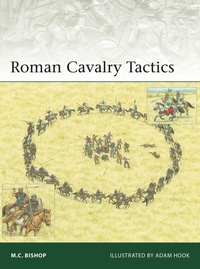
Roman Cavalry Tactics
Published on 28. August 2025
Book
Paperback/Softback
64 pages
978-1-4728-6337-9 (ISBN)
Description
A fully illustrated study of the Roman cavalry's evolution, this fascinating book chronicles tactics and composition from the time of the Republic to the fall of the Dominate.
The cavalry 'wings' that probed ahead of the Roman Army played a key role in its campaigns of conquest, masking its marching flanks and seeking to encircle enemies in battle. However, the original small cavalry arm provided by the citizen nobility had proved inadequate before the end of the Republic, and Julius Caesar's cavalry was largely made up of hired allies. During the Early Principate, the armies under Augustus continued in this vein, incorporating large numbers of non-citizen auxiliary cavalry units. The provinces came under increasing attack throughout and following the chaotic mid-3rd century, and Rome took lessons from its 'barbarian' enemies in how to improve its military mobility, adopting both new, heavily armoured shock cavalry and horse-archers, and vitally shaping the tactics employed during the Dominate.
In this engaging study, Roman Army expert M.C. Bishop charts how the cavalry grew to become the dominant force in Roman field armies by the twilight of the Western Empire. Eight newly commissioned artwork plates and a rich selection of artefact photographs and archaeological sources provide vivid detail and insight, helping to bring to the life the evolving tactics, clothing and weaponry of Rome's cavalry from the 2nd century BC through to the 5th century AD.
The cavalry 'wings' that probed ahead of the Roman Army played a key role in its campaigns of conquest, masking its marching flanks and seeking to encircle enemies in battle. However, the original small cavalry arm provided by the citizen nobility had proved inadequate before the end of the Republic, and Julius Caesar's cavalry was largely made up of hired allies. During the Early Principate, the armies under Augustus continued in this vein, incorporating large numbers of non-citizen auxiliary cavalry units. The provinces came under increasing attack throughout and following the chaotic mid-3rd century, and Rome took lessons from its 'barbarian' enemies in how to improve its military mobility, adopting both new, heavily armoured shock cavalry and horse-archers, and vitally shaping the tactics employed during the Dominate.
In this engaging study, Roman Army expert M.C. Bishop charts how the cavalry grew to become the dominant force in Roman field armies by the twilight of the Western Empire. Eight newly commissioned artwork plates and a rich selection of artefact photographs and archaeological sources provide vivid detail and insight, helping to bring to the life the evolving tactics, clothing and weaponry of Rome's cavalry from the 2nd century BC through to the 5th century AD.
Reviews / Votes
"Throughout there are brief, useful sections on tactics, organisation and equipment and summaries of cavalry actions in relevant battles." * Ancient Warfare Magazine * Roman Cavalry Tactics offers a clear and highly informative overview of mounted warfare across the history of the Roman army. * Maverick Scale Models *More details
Series
Language
English
Place of publication
United Kingdom
Publishing group
Bloomsbury Publishing PLC
Illustrations
8 colour artwork plates; black & white and colour photographs and illustrations.
Dimensions
Height: 242 mm
Width: 179 mm
Thickness: 5 mm
Weight
210 gr
ISBN-13
978-1-4728-6337-9 (9781472863379)
Copyright in bibliographic data and cover images is held by Nielsen Book Services Limited or by the publishers or by their respective licensors: all rights reserved.
Schweitzer Classification
Persons
M.C. Bishop is an authority on all aspects of Ancient Rome at war, with particular emphasis on arms and armour of the era. He has written, co-written or edited dozens of books and articles on the subject, including volumes on the gladius, pilum and spatha for the Osprey Weapon series and Roman shields and armour for Osprey Elite.
Adam Hook studied graphic design, and began his work as an illustrator in 1983. He specializes in detailed historical reconstructions.
Adam Hook studied graphic design, and began his work as an illustrator in 1983. He specializes in detailed historical reconstructions.
Content
Introduction
The Republic (Before 27 BC)
The Early Principate (27 BC-AD 117)
The High and Late Principate (AD 117-192 and 192-284)
The Dominate (AD 284-476)
Conclusions
Bibliography
Index
The Republic (Before 27 BC)
The Early Principate (27 BC-AD 117)
The High and Late Principate (AD 117-192 and 192-284)
The Dominate (AD 284-476)
Conclusions
Bibliography
Index