

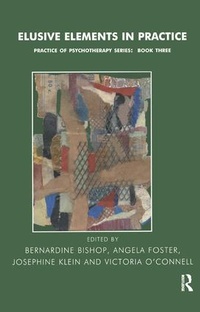
Elusive Elements in Practice
Published on 31. December 2004
Book
Paperback/Softback
99 pages
978-1-85575-947-3 (ISBN)
Description
The third volume in the The Practice of Psychotherapy series, Elusive Elements in Practice brings together a collection of papers, examining their ideas and theories more commonly regarded as off-centre, or indeed elusive, in psychoanalytic psychotherapy. The papers in this volume concentrate on the religious and spiritual dimension of the therapeutic encounter, the "aesthetic experience", creativity and mysticism. These "moments of relatedness", or meetings of minds, are discussed and examined with the help of clinical examples.'...[psychotherapists] tend to agree on what is just too eccentric and is to be regarded with reserve and suspicion. These ideas are left on the margins and, getting less attention, they are more elusive. They will not get concentrated consideration either in the consulting room or in the study. This is one reason why they are more elusive. But such neglect may cause potentially good ideas to be lost, as well as ridiculous ones.'- From the IntroductionContributors:Patricia Allen; Bernardine Bishop; Faye Carey; Nathan Field; Angela Foster; Josephine Klein; Steven Mendoza; and Victoria O'Connell.
Reviews / Votes
'The therapeutic elements this collection deals with may be elusive, but they are also eminently practical. Stephen Mendoza (following Bion) writes on "faith", Josephine Klein on the importance of true "recognition" for the patient; others write on the consequences of the baby's experience of the mother's beauty. These therapists venture to look into a more affirmative territory, most of it impeccably psychoanalytic but hitherto obscured, perhaps, by Freud's celebrated pessimism. The result is a courageous and original collection of papers, which offer a great deal of "food for thought".'- David M. Black, British Psycho-Analytical SocietyMore details
Series
Language
English
Place of publication
London
United Kingdom
Publishing group
Taylor & Francis Ltd
Target group
College/higher education
Professional and scholarly
Professional Practice & Development
Dimensions
Height: 231 mm
Width: 149 mm
Weight
174 gr
ISBN-13
978-1-85575-947-3 (9781855759473)
Copyright in bibliographic data and cover images is held by Nielsen Book Services Limited or by the publishers or by their respective licensors: all rights reserved.
Schweitzer Classification
Other editions
Additional editions
Bernardine Bishop | Angela Foster | Josephine Klein
Elusive Elements in Practice
Book
07/2019
1st Edition
Routledge
€167.13
Shipment within 15-20 days
Bernardine Bishop | Angela Foster | Josephine Klein
Elusive Elements in Practice
E-Book
04/2018
1st Edition
Routledge
€47.49
Available for download
Persons
Bernardine Bishop, the great-granddaughter of the poet Alice Meynell, was one of the witnesses from the Lady Chatterley trial in 1960. After writing two early novels, she taught in a London comprehensive school for ten years and then went on to have a distinguished career as a psychotherapist, during which time she was a member of the London Centre for Psychotherapy and of the Lincoln Centre for Psychotherapy. Cancer forced her retirement in 2010 and thereafter she returned to her first love, fiction. Angela Foster had a career in social work and higher education before training as a psychotherapist. She has a private practice and is a partner in Foster Roberts Cardona, which provides organizational consultancy and professional development services. She teaches at the Tavistock Clinic and has published widely in the field of mental health. Josephine Klein was an academic for the first twenty years of her professional life and then a psychotherapist in private practice, now retired. She is a Fellow of the London Centre for Psychotherapy and was until recently a member of the British Association of Psychotherapists. Victoria O'Connell comes from a background of working with children and adolescents who have emotional difficulties and is now a psychoanalytic psychotherapist in private practice.
Content
The London Centre for Psychotherapy -- Introduction -- Mechanisms and mysteries -- Love, the aesthetic conflict and the self -- The emerging religious dimension of knowing in psychoanalysis -- Therapy by design: style in the therapeutic encounter -- Narcissism, the mystics' remedy