

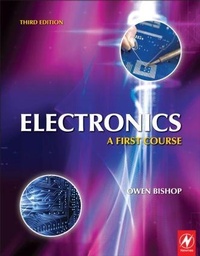
Electronics
A First Course
3rd Edition
Published on 22. December 2010
Book
Paperback/Softback
252 pages
978-1-85617-695-8 (ISBN)
Description
Owen Bishop's First Course starts with the basics of electricity and component types, introducing students to practical work almost straight away. No prior knowledge of electronics is required. The approach is student-centred with self-test features to check understanding, including numerous activities suitable for practicals, homework and other assignments. Multiple choice questions are incorporated throughout the text in order to aid student learning. Key facts, formulae and definitions are highlighted to aid revision, and theory is backed up by numerous examples within the book. Each chapter ends with a set of problems that includes exam-style questions, for which numerical answers are provided at the end of the book. This text is ideal for a wide range of introductory courses in electronics, technology, physics and engineering. The coverage has been carefully matched to the latest UK syllabuses including GCSE Electronics, GCSE Design & Technology, Engineering GCSE and Edexcel's BTEC First in Engineering, resulting in a text that meets the needs of students on all Level 2 electronics units and courses. Owen Bishop's talent for introducing the world of electronics has long been a proven fact with his textbooks, professional introductions and popular circuit construction guides being chosen by thousands of students, lecturers and electronics enthusiasts.
More details
Edition
3rd edition
Language
English
Place of publication
Oxford
United Kingdom
Publishing group
Taylor & Francis Ltd
Target group
Adult education
Primary & secondary/elementary & high school
Electronics GCSE (AQA, WJEC); GCSE Short Course in Electronics (WJEC); BTEC First Certificate / Diploma in Electronics (Edexcel); GCSE Design & Technology.
Introductory background reading for students of BTEC National. Any reader new to the field of electronics.
Introductory background reading for students of BTEC National. Any reader new to the field of electronics.
Edition type
New edition
Product notice
Paperback (trade)
sewn/stitched
Illustrations
Approx. 600 illustrations
Dimensions
Height: 277 mm
Width: 217 mm
Thickness: 15 mm
Weight
722 gr
ISBN-13
978-1-85617-695-8 (9781856176958)
Copyright in bibliographic data and cover images is held by Nielsen Book Services Limited or by the publishers or by their respective licensors: all rights reserved.
Schweitzer Classification
Other editions
Additional editions
Book
07/2021
3rd Edition
Routledge
€155.40
Shipment within 15-20 days
E-Book
12/2010
3rd Edition
Routledge
€69.99
Available for download
E-Book
12/2010
3rd Edition
Routledge
€69.99
Available for download
Previous edition

Book
04/2006
2nd Edition
Newnes
€24.75
Article exhausted; check for reprint
Person
Owen Bishop has been author of over 70 books, mostly electronic and many in the field of science education. Contributor to numerous electronic magazines such as Everyday Practical Electronics, Elektor Electronics, Electronics Australia and Electronics Today International. Former Science Education Advisor in developing countries as staff member of the British Council and as a part of the UN Educational and Scientific Organisation.
Content
Part 1: Electricity 1 Electrons 2 Static and current electricity 3 Cells and batteries 4 Current, voltage and power 5 Alternating currents 6 Mains electricity 7 Plugs and features 8 Electricity in the home 9 Sources of energy 10 More sources of energy Part 2: Electronic components 11 Resistance 12 Resistors 13 More about resistors 14 Resistor networks 15 Capacitors 16 Charging capacitors 17 Inductors 18 SI units 19 Switches 20 Diodes 21 Rectifier diodes 22 Light-emitting diodes 23 Light-dependent resistors 24 Thermistors 25 Transistors 26 Transistor action 27 Transistor switches 28 Thyristors 29 Field effect transistors Part 3: Electronic systems 30 The structure of a system 31 Sensors 32 Interfacing sensors 33 Amplifying signals 34 Timing 35 Logic 36 Logical systems 37 Logical sequences 38 Storing data 39 Microcontrollers 40 Programs 41 Visual output 42 Audible output 43 Mechanical output Part 4: Electronic systems in action 44 Audio systems 45 Radio transmission 46 Radio reception 47 Digital communications 48 Computers 49 Control systems Appendices Symbols used for circuits. Symbols used in flowcharts. Answers to questions.