

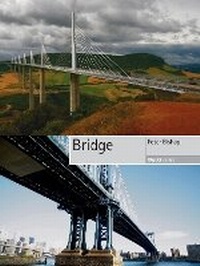
Bridge
Published on 1. October 2007
Book
Paperback/Softback
240 pages
978-1-86189-346-8 (ISBN)
Description
Whether a humble string of planks swaying across a trickling stream or the soaring towers of the Golden Gate Bridge, bridges are one of man's great engineering feats. In Bridge, Peter Bishop provides a comprehensive historical account of their role in the advancement of human culture.
From ancient Roman arches to the rail bridge of Lhasa to the suspension bridge over Niagara Falls, we traverse in this book the full span of the globe to examine numerous types of bridges and their diverse architectural styles. Bridge includes iconic examples such as the Brooklyn, Sydney Harbour and London's Millennium bridges and 'mega-spans' such as Hong Kong's Tsing Ma Bridge; the integral role of bridges in railroad networks; and the social dynamics of class and mobility that surround urban bridges in cities such as New York. Drawing upon sources in art, politics, science, philosophy and the media, Bishop argues that the cultural meaning of bridges today revolves around the idea of expanding geographical claims, rather than connecting to others, and he explores the implications of that idea for the future.
A fascinating and richly illustrated study, Bridge will engage enthusiasts of planning, architecture and design alike.
From ancient Roman arches to the rail bridge of Lhasa to the suspension bridge over Niagara Falls, we traverse in this book the full span of the globe to examine numerous types of bridges and their diverse architectural styles. Bridge includes iconic examples such as the Brooklyn, Sydney Harbour and London's Millennium bridges and 'mega-spans' such as Hong Kong's Tsing Ma Bridge; the integral role of bridges in railroad networks; and the social dynamics of class and mobility that surround urban bridges in cities such as New York. Drawing upon sources in art, politics, science, philosophy and the media, Bishop argues that the cultural meaning of bridges today revolves around the idea of expanding geographical claims, rather than connecting to others, and he explores the implications of that idea for the future.
A fascinating and richly illustrated study, Bridge will engage enthusiasts of planning, architecture and design alike.
Reviews / Votes
. . . an excellent book, consistently thought-provoking . . . it emphasised to me that much of what goes unchallenged by bridge engineers is just the result of our immersion in one of many possible stories about bridges and their creation. This book offers some of those diverse narratives, while making clear that many more remain to be told. * <i>The Happy Pontist</i> *More details
Series
Language
English
Place of publication
London
United Kingdom
Illustrations
127 illustrations, 36 in colour
Dimensions
Height: 156 mm
Width: 208 mm
ISBN-13
978-1-86189-346-8 (9781861893468)
Copyright in bibliographic data and cover images is held by Nielsen Book Services Limited or by the publishers or by their respective licensors: all rights reserved.
Schweitzer Classification
Other editions
Additional editions

Person
Peter Bishop is Associate Professor in the School of Communications, Information and New Media, at the University of South Australia. He is the author of many books including, most recently, An Archetypal Constable: National Identity and The Geography of Nostalgia (1995).
Content
1 The Telling of the Bridge Jazz on a bridge; The modern bridge; Telling the bridge: a double construction; Engineering as story; One bridge: Two tales; Gendered bridges; New spaces; The intimate bridge; Psycho-philosophical bridges; The bridge as technology; Bridge biographies; The bridge as stage and target; Invisible bridges; The bridge as accident; Vertical politics and technologies of power; Bridge as crossing; Bridge as condensation and displacement; The smart bridge; Approaching the bridge 2 Technologies of Connection Jazz bridge as border-technology; The bridge as gift; Ponticide at Stari Most; Protesting the bridge: Hindmarsh Island; An unwanted connection? Over the bridge to Skye; Bridges and the politics of verticality; Walking the bridge and framing reconciliation; New mobilities, new boundaries, new crossings 3 The technology of assemblage: bridges and the construction of the city Introduction; Bridges and the invention of the cosmopolitan city (1800-1870); Changing perceptions, changing representations; Representation - celebration and vitality; The underside of the city bridge; Bridges and the invention of the Cosmopolitan City (1880-1920); Automobility and the city bridge (1920 - 1990); The bridge and the branding of the city; Reimagining the city bridge 4 Technologies of Extension: Burt Creek to Lhasa Burt Creek Bridge; Sumdar's bridge at Tanggulashan; The bridge as technology of extension; Crossing tracks; The technology and politics of horizontality; Bridges and the nineteenth century rail networks: Britain; Bridges and the nineteenth century rail networks: Africa and India; Bridges and the nineteenth century rail networks: the USA; The rail-bridge to Lhasa; Bridges from Alice Springs to Darwin; Selling the bridge - propaganda and promotion 5 Spanning Technologies Transcendent Span; One Hundred Years of Span; Risk and the Culture of Span; The Westgate Bridge Collapse; Super-spans and mega-cities: Hong Kong's Tsing Ma Bridge; The future of super-spans