

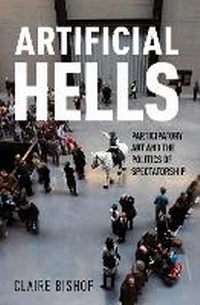
Artificial Hells
Participatory Art and the Politics of Spectatorship
Published on 24. July 2012
Book
Paperback/Softback
390 pages
978-1-84467-690-3 (ISBN)
Description
Since the 1990s, critics and curators have broadly accepted the notion that participatory art is the ultimate political art: that by encouraging an audience to take part an artist can promote new emancipatory social relations. Around the world, the champions of this form of expression are numerous, ranging from art historians such as Grant Kester, curators such as Nicolas Bourriaud and Nato Thompson, to performance theorists such as Shannon Jackson.
Artificial Hells is the first historical and theoretical overview of socially engaged participatory art, known in the US as "social practice." Claire Bishop follows the trajectory of twentieth-century art and examines key moments in the development of a participatory aesthetic. This itinerary takes in Futurism and Dada; the Situationist International; Happenings in Eastern Europe, Argentina and Paris; the 1970s Community Arts Movement; and the Artists Placement Group. It concludes with a discussion of long-term educational projects by contemporary artists such as Thomas Hirschhorn, Tania Bruguera, Pawe? Althamer and Paul Chan.
Since her controversial essay in Artforum in 2006, Claire Bishop has been one of the few to challenge the political and aesthetic ambitions of participatory art. In Artificial Hells, she not only scrutinizes the emancipatory claims made for these projects, but also provides an alternative to the ethical (rather than artistic) criteria invited by such artworks. Artificial Hells calls for a less prescriptive approach to art and politics, and for more compelling, troubling and bolder forms of participatory art and criticism.
Artificial Hells is the first historical and theoretical overview of socially engaged participatory art, known in the US as "social practice." Claire Bishop follows the trajectory of twentieth-century art and examines key moments in the development of a participatory aesthetic. This itinerary takes in Futurism and Dada; the Situationist International; Happenings in Eastern Europe, Argentina and Paris; the 1970s Community Arts Movement; and the Artists Placement Group. It concludes with a discussion of long-term educational projects by contemporary artists such as Thomas Hirschhorn, Tania Bruguera, Pawe? Althamer and Paul Chan.
Since her controversial essay in Artforum in 2006, Claire Bishop has been one of the few to challenge the political and aesthetic ambitions of participatory art. In Artificial Hells, she not only scrutinizes the emancipatory claims made for these projects, but also provides an alternative to the ethical (rather than artistic) criteria invited by such artworks. Artificial Hells calls for a less prescriptive approach to art and politics, and for more compelling, troubling and bolder forms of participatory art and criticism.
Reviews / Votes
Claire Bishop has articulated an important historical overview of the global emergence of participatory art ... Her controversial and thought-provoking conclusions courageously trouble our assumptions about the effectiveness of political artworks, questioning their oppositional quality, their effects on the audiences they reach, and their relation to the institutions that promote them. * Frank Jewett Mather Award, 2013 * Bishop's arguments are convincingly supported and potentially very contentious...A critically challenging work of vital scholarship. * Publishers Weekly * An essential title for contemporary art history scholars and students as well as anyone who has witnessed a participatory art 'happening' and thought, 'Now that's art!' or 'That's art?' * Library Journal * Bishop seeks a standard for judging participatory works...She draws on the writings of French philosopher Jacques Ranciere to argue that art must maintain a degree of autonomy and unreadability in order to resist co-option by the political and economic forces intent on imposing a false social consensus. -- Eleanor Heartney * Art in America * Pellucid -- Alexander Provan * New York Observer * The good intentions of contemporary artists frequently pave a road to hell. Claire Bishop follows their descent into the inferno and invites her readers to share her fascination with what she finds along the way. Artificial Hells combines vast historical knowledge with a precise analysis of individual artistic practices. So much so that at the end of her new book we have begun to fall in love with hell-under the condition that it remains artificial. -- Boris Groys, author of <i>Art Power</i>More details
Language
English
Place of publication
London
United Kingdom
Dimensions
Height: 234 mm
Width: 157 mm
Thickness: 25 mm
Weight
634 gr
ISBN-13
978-1-84467-690-3 (9781844676903)
Copyright in bibliographic data and cover images is held by Nielsen Book Services Limited or by the publishers or by their respective licensors: all rights reserved.
Schweitzer Classification
Other editions
New editions
Book
01/2023
Verso Books
€25.00
Available immediately
Additional editions
E-Book
07/2012
Verso Books
from
€49.39
Available for download
Person
Claire Bishop is a British art historian, critic, and Professor of Art History at The Graduate Center, CUNY, New York. Bishop is known as one of the central theorists of participation in visual art and performance, Her books have been translated into over eighteen languages and she is a frequent contributor to art journals including Artforum and October. She is also the author of Radical Museology, or, What's Contemporary in Museums of Contemporary Art.