

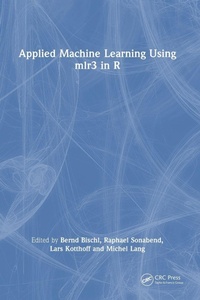
Applied Machine Learning Using mlr3 in R
1st Edition
Published on 18. January 2024
Book
Hardback
340 pages
978-1-032-51567-0 (ISBN)
Description
mlr3 is an award-winning ecosystem of R packages that have been developed to enable state-of-the-art machine learning capabilities in R. Applied Machine Learning Using mlr3 in R gives an overview of flexible and robust machine learning methods, with an emphasis on how to implement them using mlr3 in R. It covers various key topics, including basic machine learning tasks, such as building and evaluating a predictive model; hyperparameter tuning of machine learning approaches to obtain peak performance; building machine learning pipelines that perform complex operations such as pre-processing followed by modelling followed by aggregation of predictions; and extending the mlr3 ecosystem with custom learners, measures, or pipeline components.
Features:
In-depth coverage of the mlr3 ecosystem for users and developers
Explanation and illustration of basic and advanced machine learning concepts
Ready to use code samples that can be adapted by the user for their application
Convenient and expressive machine learning pipelining enabling advanced modelling
Coverage of topics that are often ignored in other machine learning books
The book is primarily aimed at researchers, practitioners, and graduate students who use machine learning or who are interested in using it. It can be used as a textbook for an introductory or advanced machine learning class that uses R, as a reference for people who work with machine learning methods, and in industry for exploratory experiments in machine learning.
Features:
In-depth coverage of the mlr3 ecosystem for users and developers
Explanation and illustration of basic and advanced machine learning concepts
Ready to use code samples that can be adapted by the user for their application
Convenient and expressive machine learning pipelining enabling advanced modelling
Coverage of topics that are often ignored in other machine learning books
The book is primarily aimed at researchers, practitioners, and graduate students who use machine learning or who are interested in using it. It can be used as a textbook for an introductory or advanced machine learning class that uses R, as a reference for people who work with machine learning methods, and in industry for exploratory experiments in machine learning.
Reviews / Votes
"... each concept and functionality within the mlr3 ecosystem is clearly explained with code examples, and,where necessary, supplemented by diagrams and illustrations. . . Overall, the book is an excellent resource for students, practitioners, and researchers interested in building machine learning models in R."
~Xueying Tang, University of Arizona
More details
Language
English
Place of publication
Boca Raton
United Kingdom
Publishing group
Taylor & Francis Ltd
Target group
Professional and scholarly
Academic
Illustrations
53 s/w Abbildungen, 43 farbige Abbildungen, 53 s/w Zeichnungen, 43 farbige Zeichnungen, 20 s/w Tabellen
20 Tables, black and white; 43 Line drawings, color; 53 Line drawings, black and white; 43 Illustrations, color; 53 Illustrations, black and white
Dimensions
Height: 260 mm
Width: 183 mm
Thickness: 24 mm
Weight
865 gr
ISBN-13
978-1-032-51567-0 (9781032515670)
Copyright in bibliographic data and cover images is held by Nielsen Book Services Limited or by the publishers or by their respective licensors: all rights reserved.
Schweitzer Classification
Other editions
Additional editions
Bernd Bischl | Raphael Sonabend | Lars Kotthoff
Applied Machine Learning Using mlr3 in R
E-Book
01/2024
1st Edition
Taylor & Francis
€89.99
Available for download
Bernd Bischl | Raphael Sonabend | Lars Kotthoff
Applied Machine Learning Using mlr3 in R
Book
01/2024
1st Edition
Chapman & Hall/CRC
€120.30
Shipment within 10-20 days
Bernd Bischl | Raphael Sonabend | Lars Kotthoff
Applied Machine Learning Using mlr3 in R
E-Book
01/2024
1st Edition
Taylor & Francis
€89.99
Available for download
Persons
Bernd Bischl is a professor of Statistical Learning and Data Science in LMU Munich and co-director of the Munich Center for Machine Learning. He studied Computer Science, Artificial Intelligence and Data Science and holds a PhD in statistics. His research interests include AutoML, model selection, interpretable ML and the development of statistical software. He wrote the initial version of mlr and still leads the mlr3 developers, now largely focusing on design, code review and strategic development.
Raphael Sonabend is a founder and director of OSPO Now and a visiting researcher at Imperial College London. They hold a PhD in statistics, specializing in machine learning applications for survival analysis. They wrote the mlr3 packages mlr3proba and mlr3benchmark.
Lars Kotthoff is an associate professor of Computer Science at the University of Wyoming, US. He has studied and held academic appointments in Germany, UK, Ireland, and Canada. Lars has been contributing to mlr for about a decade. His research aims to automate machine learning and other areas of AI.
Michel Lang is the scientific coordinator of the Research Center Trustworthy Data Science and Security. He has a PhD in statistics and has been developing statistical software for over a decade. He joined the mlr team in 2014 and wrote the initial version of mlr3.
Raphael Sonabend is a founder and director of OSPO Now and a visiting researcher at Imperial College London. They hold a PhD in statistics, specializing in machine learning applications for survival analysis. They wrote the mlr3 packages mlr3proba and mlr3benchmark.
Lars Kotthoff is an associate professor of Computer Science at the University of Wyoming, US. He has studied and held academic appointments in Germany, UK, Ireland, and Canada. Lars has been contributing to mlr for about a decade. His research aims to automate machine learning and other areas of AI.
Michel Lang is the scientific coordinator of the Research Center Trustworthy Data Science and Security. He has a PhD in statistics and has been developing statistical software for over a decade. He joined the mlr team in 2014 and wrote the initial version of mlr3.
Content
1. Introduction and Overview. 2. Data and Basic Modeling. 3. Evaluation and Benchmarking. 4. Hyperparameter Optimization. 5. Advanced Tuning Methods and Black Box Optimization. 6. Feature Selection. 7. Sequential Pipelines. 8. Non-sequential Pipelines and Tuning. 9. Preprocessing. 10. Advanced Technical Aspects of mlr3 .11. Model Interpretation and Explanation. 12. Model Interpretation. 13. Beyond Regression and Classification. 14. Algorithmic Fairness.