

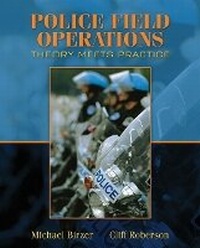
Police Field Operations
Theory Meets Practice
Published on 18. October 2007
Book
Hardback
624 pages
978-0-205-50828-0 (ISBN)
Description
This text covers major areas of police operations including patrol, investigations, crime mapping, police operations in culturally diverse communities, community policing, persons with physical disabilities, and juveniles, hot pursuit issues, communications, gangs, and drugs.
More details
Language
English
Place of publication
United States
Publishing group
Pearson Education (US)
Target group
Professional and scholarly
Dimensions
Height: 254 mm
Width: 203 mm
Weight
1134 gr
ISBN-13
978-0-205-50828-0 (9780205508280)
Copyright in bibliographic data and cover images is held by Nielsen Book Services Limited or by the publishers or by their respective licensors: all rights reserved.
Schweitzer Classification
Other editions
New editions
Book
02/2014
2nd Edition
Pearson
€183.69
Shipment within 15-20 days
Persons
Michael L. Birzer is Associate Professor of Criminal Justice and Director of the School of Community Affairs at Wichita State University. His research interests center on police behavior and practices. He recently completed research that examined police relations with the African-American community. In 2007, Professor Birzer published with Cliff Roberson, Policing, Today and Tomorrow -- Prentice-Hall.
Cliff Roberson LLM, Ph.D is an Emeritus Professor of Criminal Justice at Washburn University and Retired Professor of Criminology from California State University-Fresno. His previous academic experiences include Associate Vice-President for Academic Affairs, Arkansas Tech University; Dean of Arts and Sciences, University of Houston, Victoria; Director of Programs, National College of District Attorneys; Director of Justice Center, California State University, Fresno; and Assistant Professor of Criminal Justice, St. Edwards University. He has authored or co-authored 47 books and texts.
Cliff Roberson LLM, Ph.D is an Emeritus Professor of Criminal Justice at Washburn University and Retired Professor of Criminology from California State University-Fresno. His previous academic experiences include Associate Vice-President for Academic Affairs, Arkansas Tech University; Dean of Arts and Sciences, University of Houston, Victoria; Director of Programs, National College of District Attorneys; Director of Justice Center, California State University, Fresno; and Assistant Professor of Criminal Justice, St. Edwards University. He has authored or co-authored 47 books and texts.
Content
1. Police Patrol: The Backbone of Policing
Introduction
A sketch of the police
Development of police patrol
Purpose of police patrol
Differential Response
Effectiveness of Police Patrol
Reactive, proactive and coactive patrol
Organizational features
Types of police patrol
Allocation of patrol personnel
Special Tactical Teams
Managing and supervising the patrol function
Becoming a police patrol officer
Training
2. Police Field Procedures
Introduction
Preparing for the tour of duty
Patrolling the beat
Handling offenders
Civil unrest
High speed pursuits
Weather and natural disasters
The police K-9
Traffic stops
Emergency vehicle operation
The use of force
3.Police Operations in a Community Policing Environment
Introduction
The emergence of community policing
Core components of community policing
What community policing is not
Incorporating community policing on the job
Community policing and terrorism
Does community policing work
4.Crime Scene and Preliminary Investigation
Introduction
The role of patrol in the preliminary investigation
Initial steps in the investigation
Photographing the scene
Crime scene search
The nature of evidence
Types of evidence
Evidence collection
Cybercrime
5.Interviewing and interrogation
Introduction
Principles of Interviewing
Field Interviews/Investigative Stops
Principles of Interrogation
Use of the Polygraph
Human Lie Detector
Law of Interviewing and Interrogation
Voluntariness of a Confession
Non-Testimonial Evidence
Immunity
Art of Listening
6. Handling Calls for Service
Introduction
The Police Service Role
Disputes
Suspicious Characters
Prowlers
Missing and Runaway Children
Missing Adults
Welfare Checks
The Mentally Ill
Abandoned Vehicles
Stalled Vehicles
Directing Traffic
Lost Property
Stolen Property
Repeat Calls
Citizen Contacts
7. Forensics
Introduction
Duties of a Forensic Scientist
FBI Forensic Laboratory
Crime Scene
Body Fluids
Fibers
DNA
Questioned Documents
Fingerprints
Firearms
Digital Evidence
8. Legal constraints that impact police operations
Introduction
Searches
Warrant Clause of the Fourth Amendment
Exceptions to the Fourth Amendment
Arrests
Exclusionary rule
Civil Liability
Use of Force
9. Police reports & other correspondence
Introduction
Field Notes
Report Writing
Chain of Custody Reports
Special Reports
Records
Writing Styles
Computerized Reports
Recording Witness Recollections
Testifying in Court
10. Police communications
Introduction
Police Language
Radio Communications
Telephone Communications
Special Communications Issues
Computer Systems
Computer Networks
11. Gangs and Drugs
Introduction
Gangs
Hispanic Gangs
Female Gangs
Indian Country Gangs
Outlaw Motorcycle Gangs
National Gangs
Drug Enforcement
Drug Legislation
Alcohol Related Offenses
Solutions to Drug and Alcohol Abuse
Drug Testing of Police Officers
Gangs and Drugs
12. Police Operations in Culturally Diverse Communities
Introduction
Minority perceptions of police
Skeletons in the closest
Contemporary problems
The state of police-minority relations
Police operations in minority communities
De-Escalation of potential problems
Demographics of police officers
Recruitment and selection of minorities and female police
Service vs. law enforcement
13. Crime Mapping and Analysis
Introduction
Crime Analysts
Crime Mapping
Should Crime Information Be Made Public?
Does Crime Simply Move Around The Corner?
Crime Hot Spot Theories on Crime
14. Handling Terrorism and Natural Disasters
Introduction
Terrorism and the Police Officer
War on Terrorism
Terrorism Alerts
Assessing Terrorist Threats
Antiterrorist and Disaster Recovery Agencies
Bomb Threats
15. Ethics and police operations
Introduction
What is ethics?
What constitutes ethical behavior?
Ethics as a restriction on behavior
Kantian ethics
Moral development
Values
Law enforcement values
Lying and deception
Off-duty employment
Internal affairs unit
International Association of Ethics Trainers