

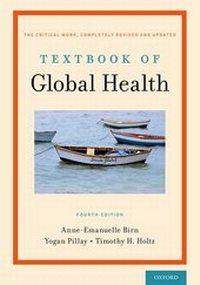
Textbook of Global Health
4th Edition
Published on 12. July 2018
Book
Paperback/Softback
712 pages
978-0-19-091652-7 (ISBN)
Description
THE CRITICAL WORK IN GLOBAL HEALTH, NOW COMPLETELY REVISED AND IN PAPERBACK
"This book compels us to better understand the contexts in which health problems emerge and the forces that underlie and propel them." -Archbishop Emeritus Desmond Mpilo Tutu
H1N1. Diabetes. Ebola. Zika. Each of these health problems is rooted in a confluence of social, political, economic, and biomedical factors that together inform our understanding of global health. The imperative for those who study global health is to understand these factors individually and, especially, synergistically.
Fully revised and updated, this fourth edition of Oxford's Textbook of Global Health offers a critical examination of the array of societal factors that shape health within and across countries, including how health inequities create consequences that must be addressed by public health, international aid, and social and economic policymaking.
The text equips students, activists, and health professionals with the building blocks for a contextualized understanding of global health, including essential threads that are combined in no other work:
? historical dynamics of the field
? the political economy of health and development
? analysis of the current global health structure, including its actors, agencies, and activities
? societal determinants of health, from global trade and investment treaties to social policies to living and working conditions
? the role of health data and measuring health inequities
? major causes of global illness and death, including under crises, from a political economy of health vantage point that goes beyond communicable vs. non-communicable diseases to incorporate contexts of social and economic deprivation, work, and globalization
? the role of trade/investment and financial liberalization, precarious work, and environmental degradation and contamination
? principles of health systems and the politics of health financing
? community, national, and transnational social justice approaches to building healthy societies and practicing global health ethically and equitably
Through this approach the Textbook of Global Health encourages the reader -- be it student, professional, or advocate -- to embrace a wider view of the global health paradigm, one that draws from political economy considerations at community, national, and transnational levels. It is essential and current reading for anyone working in or around global health.
"This book compels us to better understand the contexts in which health problems emerge and the forces that underlie and propel them." -Archbishop Emeritus Desmond Mpilo Tutu
H1N1. Diabetes. Ebola. Zika. Each of these health problems is rooted in a confluence of social, political, economic, and biomedical factors that together inform our understanding of global health. The imperative for those who study global health is to understand these factors individually and, especially, synergistically.
Fully revised and updated, this fourth edition of Oxford's Textbook of Global Health offers a critical examination of the array of societal factors that shape health within and across countries, including how health inequities create consequences that must be addressed by public health, international aid, and social and economic policymaking.
The text equips students, activists, and health professionals with the building blocks for a contextualized understanding of global health, including essential threads that are combined in no other work:
? historical dynamics of the field
? the political economy of health and development
? analysis of the current global health structure, including its actors, agencies, and activities
? societal determinants of health, from global trade and investment treaties to social policies to living and working conditions
? the role of health data and measuring health inequities
? major causes of global illness and death, including under crises, from a political economy of health vantage point that goes beyond communicable vs. non-communicable diseases to incorporate contexts of social and economic deprivation, work, and globalization
? the role of trade/investment and financial liberalization, precarious work, and environmental degradation and contamination
? principles of health systems and the politics of health financing
? community, national, and transnational social justice approaches to building healthy societies and practicing global health ethically and equitably
Through this approach the Textbook of Global Health encourages the reader -- be it student, professional, or advocate -- to embrace a wider view of the global health paradigm, one that draws from political economy considerations at community, national, and transnational levels. It is essential and current reading for anyone working in or around global health.
Reviews / Votes
[P]rovides an important focus on the political economy of health and highlights the importance of a social-justice approach, incorporating the social and political economies of LMICs, to building healthy societies. * Lancet Global Health * I find it stunning that [the] authors ... have produced a text so dense and comprehensive which is yet so eminently readable. The fruits of their labors, clearly resulting from exhaustive time and effort devoted to research and study, provide clear and convincing expert analysis of how we have arrived at the current state of international public health. * Jules R. Duval, Journal of Occupational and Environmental Medicine * A densely packed treatise on the history, influences, philosophies, and future of global health. Fills an important gap in the training and experience of most clinicians ... [I]t belongs at every institutional program on global health, whether the focus is clinical, policy, or public health * Family Medicine * A monumental work for health justice. Textbook of Global Health [...] must be made compulsory reading in the training of all public health workers. * Economic & Political Weekly *More details
Edition
4th Revised edition
Language
English
Place of publication
New York
United States
Target group
College/higher education
Edition type
Revised edition
Dimensions
Height: 251 mm
Width: 178 mm
Thickness: 38 mm
Weight
1270 gr
ISBN-13
978-0-19-091652-7 (9780190916527)
Copyright in bibliographic data and cover images is held by Nielsen Book Services Limited or by the publishers or by their respective licensors: all rights reserved.
Schweitzer Classification
Other editions
Additional editions
Anne-Emanuelle Birn | Yogan Pillay | Timothy H. Holtz
Textbook of Global Health
Book
03/2017
4th Edition
Oxford University Press Inc
€148.60
Shipment within 15-20 days
Persons
Anne-Emanuelle Birn is Professor of Critical Development Studies (UTSC) and Social and Behavioural Health Sciences (Dalla Lana School of Public Health) at the University of Toronto, where she served as Canada Research Chair in International Health from 2003 to 2013. She is widely published in North America, Latin America, Europe, and Africa; her books include: Marriage of Convenience: Rockefeller International Health and Revolutionary Mexico (2006); and Comrades in Health: US Health Internationalists, Abroad and at Home (2013). Professor Birn's honors include Fulbright and Rotary fellowships, election to the Delta Omega Public Health Honor Society, and numerous endowed lectureships across the Americas and Asia. In 2014 she was recognized among the top 100 Women Leaders in Global Health.
Yogan Pillay is Deputy Director General for HIV, Tuberculosis, and Maternal, Newborn, and Child Health Programmes in the National Department of Health, South Africa. He has 20 years' experience in the
planning and implementation of health system reforms and has published widely on the topics of HIV, tuberculosis, and health systems.
Timothy H. Holtz is an Adjunct Associate Professor of Global Health at the Rollins School of Public Health at Emory University. His field experience has focused on infectious disease epidemiology and disease control, and he has worked with the U.S. Centers for Disease Control and Prevention and as a consultant to the World Health Organization. From 2002-2010 Dr. Holtz worked in southern Africa, Eastern Europe, and South America on multidrug-resistant tuberculosis control and tuberculosis/HIV program capacity building. He is an internationally recognized expert on the emerging threat of anti-tuberculosis drug resistance and was part of the team of scientists that discovered extensively drug-resistant tuberculosis (XDR TB). He has also directed an HIV prevention clinical trial research program in Thailand, and an HIV and TB technical assistance program in
India. He is a founding member of Doctors for Global Health, a health and social justice nongovernmental organization with projects in the U.S., Latin America, and sub-Saharan Africa.
Yogan Pillay is Deputy Director General for HIV, Tuberculosis, and Maternal, Newborn, and Child Health Programmes in the National Department of Health, South Africa. He has 20 years' experience in the
planning and implementation of health system reforms and has published widely on the topics of HIV, tuberculosis, and health systems.
Timothy H. Holtz is an Adjunct Associate Professor of Global Health at the Rollins School of Public Health at Emory University. His field experience has focused on infectious disease epidemiology and disease control, and he has worked with the U.S. Centers for Disease Control and Prevention and as a consultant to the World Health Organization. From 2002-2010 Dr. Holtz worked in southern Africa, Eastern Europe, and South America on multidrug-resistant tuberculosis control and tuberculosis/HIV program capacity building. He is an internationally recognized expert on the emerging threat of anti-tuberculosis drug resistance and was part of the team of scientists that discovered extensively drug-resistant tuberculosis (XDR TB). He has also directed an HIV prevention clinical trial research program in Thailand, and an HIV and TB technical assistance program in
India. He is a founding member of Doctors for Global Health, a health and social justice nongovernmental organization with projects in the U.S., Latin America, and sub-Saharan Africa.
Author
Professor of Critical Development Studies and Global HealthProfessor of Critical Development Studies and Global Health, University of Toronto
Deputy Director General for HIV, Tuberculosis, and Maternal, Newborn, and Child Health ProgrammesDeputy Director General for HIV, Tuberculosis, and Maternal, Newborn, and Child Health Programmes, National Department of Health, South Africa
Adjunct Associate Professor of Global HealthAdjunct Associate Professor of Global Health, Rollins School of Public Health, Emory University
Content
Praise for the Textbook of Global Health
Preface: Why Global Health?
Acknowledgements
About the Authors
1. The Historical Origins of Modern International Health
2. Between International and Global Health: Contextualizing the Present
3. Political Economy of Health and Development
4. Global Health Actors and Activities
5. Data on Health: What Do We Know, What Do We Need to Know, and Why Does it Matter
6. Epidemiologic Profiles of Global Health and Disease
7. Health Equity and the Societal Determinants of Health
8. Health under Crises and the Limits to Humanitarianism
9. Globalization, Trade, Work, and Health
10. Health and the Environment
11. Understanding and Organizing Health Care Systems
12. Health Economics and the Politics of Health Financing
13. Building Healthy Societies: From Ideas to Action
14. Social Justice Approaches to Global Health
Index
Preface: Why Global Health?
Acknowledgements
About the Authors
1. The Historical Origins of Modern International Health
2. Between International and Global Health: Contextualizing the Present
3. Political Economy of Health and Development
4. Global Health Actors and Activities
5. Data on Health: What Do We Know, What Do We Need to Know, and Why Does it Matter
6. Epidemiologic Profiles of Global Health and Disease
7. Health Equity and the Societal Determinants of Health
8. Health under Crises and the Limits to Humanitarianism
9. Globalization, Trade, Work, and Health
10. Health and the Environment
11. Understanding and Organizing Health Care Systems
12. Health Economics and the Politics of Health Financing
13. Building Healthy Societies: From Ideas to Action
14. Social Justice Approaches to Global Health
Index