

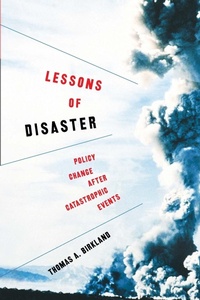
Lessons of Disaster
Policy Change after Catastrophic Events
Published on 7. November 2006
Book
Paperback/Softback
240 pages
978-1-58901-121-2 (ISBN)
Description
Even before the wreckage of a disaster is cleared, one question is foremost in the minds of the public: "What can be done to prevent this from happening again?" Today, news media and policymakers often invoke the "lessons of September 11" and the "lessons of Hurricane Katrina." Certainly, these unexpected events heightened awareness about problems that might have contributed to or worsened the disasters, particularly about gaps in preparation. Inquiries and investigations are made that claim that "lessons" were "learned" from a disaster, leading us to assume that we will be more ready the next time a similar threat looms, and that our government will put in place measures to protect us. In "Lessons of Disaster", Thomas Birkland takes a critical look at this assumption. We know that disasters play a role in setting policy agendas - in getting policymakers to think about problems - but does our government always take the next step and enact new legislation or regulations? To determine when and how a catastrophic event serves as a catalyst for true policy change, the author examines four categories of disasters: aviation security, homeland security, earthquakes, and hurricanes.
He explores lessons learned from each, focusing on three types of policy change: change in the larger social construction of the issues surrounding the disaster; instrumental change, in which laws and regulations are made; and political change, in which alliances are created and shifted. Birkland argues that the type of disaster affects the types of lessons learned from it, and that certain conditions are necessary to translate awareness into new policy, including media attention, salience for a large portion of the public, the existence of advocacy groups for the issue, and the preexistence of policy ideas that can be drawn upon. This timely study concludes with a discussion of the interplay of multiple disasters, focusing on the initial government response to Hurricane Katrina and the negative effect the September 11 catastrophe seems to have had on reaction to that tragedy.
He explores lessons learned from each, focusing on three types of policy change: change in the larger social construction of the issues surrounding the disaster; instrumental change, in which laws and regulations are made; and political change, in which alliances are created and shifted. Birkland argues that the type of disaster affects the types of lessons learned from it, and that certain conditions are necessary to translate awareness into new policy, including media attention, salience for a large portion of the public, the existence of advocacy groups for the issue, and the preexistence of policy ideas that can be drawn upon. This timely study concludes with a discussion of the interplay of multiple disasters, focusing on the initial government response to Hurricane Katrina and the negative effect the September 11 catastrophe seems to have had on reaction to that tragedy.
Reviews / Votes
A valuable book for students of disaster policy and for students of policy change more generally... After reading this book, it is hard not to become an advocate for aggressive disaster mitigation, as opposed to the preponderant paradigm of disaster relief. Perspectives on Politics Readers interested in disaster policy and emergency management will find Lessons instructive and illuminating. The case studies are contextually rich and demonstrate the relationship between focusing events and disaster policies quite deftly. Moreover, readers will find Birkland's thorough knowledge of the policy process impressive ... A worthwhile resource for grasping how concepts of learning may help explain the fits and starts of U.S. disaster policy making. Public Administration ReviewMore details
Series
Language
English
Place of publication
Washington, DC
United States
Target group
Professional and scholarly
US School Grade: College Graduate Student and over
Product notice
Paperback (trade)
Illustrations
Not illustrated
Dimensions
Height: 227 mm
Width: 153 mm
Thickness: 15 mm
Weight
333 gr
ISBN-13
978-1-58901-121-2 (9781589011212)
Copyright in bibliographic data and cover images is held by Nielsen Book Services Limited or by the publishers or by their respective licensors: all rights reserved.
Schweitzer Classification
Other editions
Additional editions
E-Book
11/2006
Georgetown University Press
€31.99
Available for download
Persons
Thomas A. Birkland is the William T. Kretzer Professor of Public Policy in the School of Public and International Affairs at North Carolina State University. He is the author of After Disaster: Agenda Setting, Public Policy, and Focusing Events.
Content
Illustrations Preface Acknowledgments 1. Theories and Models of Policy Change and LearningKnowledge, Learning, and Policy ChangeA Model of Event-Related Policy ChangeLearning and Lessons in This StudyMethodsThe Case StudiesConclusion 2. September 11, Learning, and Policy ChangeWhat is Homeland Security?Events and Reports: The Emergence of the Homeland Security ProblemThe September 11 Attacks as Focusing EventsSeptember 11, Policy Failure, Learning, and ChangeConclusions: Learning after September 11 3. Learning from Aviation Security DisastersHistorical Trends in Aviation SecurityAgenda Change and Security IncidentsPolicy Change, Learning, and ImplementationImplementation Problems in Aviation SecurityConclusions 4. Learning From Earthquakes and HurricanesWhy Natural Hazards MatterDisaster Mitigation as a Primary Goal of Disaster PolicyEarthquakes and Hurricanes on National and Local AgendasLegislation and RegulationLearning from Disasters at the State and Local LevelConclusions 5. Summary and ConclusionsLearning and the Policy ProcessRevisiting the PropositionsAssessing the Elements of the ModelFactors that Promote and Inhibit LearningFocusing Events and the Accumulation of KnowledgePolicy Implementation and LessonsHurricane Katrina and the Unlearning Of LessonsNotes ReferencesIndex Notes