

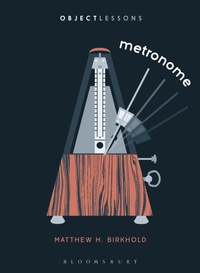
Metronome
Published on 13. November 2025
Book
Paperback/Softback
184 pages
979-8-7651-0887-1 (ISBN)
Description
Object Lessons is a series of short, beautifully designed books about the hidden lives of ordinary things.
When the metronome was invented in 1815, it transformed the music world. Composers and musicians now had a tool that could help them maintain a precise and consistent tempo. And while giants of classical music like Beethoven early embraced the metronome and proponents came to see its essential role in music instruction, critics believed it created mindless players and inhibited the creation of great art.
The metronome evokes strong feelings because of its uncompromising power. Through it, we are connected to the past, propelled into the future, and kept focused on the present. For that reason, this object has appeared in unlikely settings as athletes, scientists, psychologists, authors, and other professionals have found uses for it beyond music.
Metronome uncovers the surprising and fraught history of a timeless object.
When the metronome was invented in 1815, it transformed the music world. Composers and musicians now had a tool that could help them maintain a precise and consistent tempo. And while giants of classical music like Beethoven early embraced the metronome and proponents came to see its essential role in music instruction, critics believed it created mindless players and inhibited the creation of great art.
The metronome evokes strong feelings because of its uncompromising power. Through it, we are connected to the past, propelled into the future, and kept focused on the present. For that reason, this object has appeared in unlikely settings as athletes, scientists, psychologists, authors, and other professionals have found uses for it beyond music.
Metronome uncovers the surprising and fraught history of a timeless object.
Reviews / Votes
Metronome is part historical retelling, part sociological examination of the place of the little object's presence in our lives ... The book's humor grounds this multidisciplinary exploration. There is a lot of historical musical gossip that even the most occasional musician could appreciate. * Hippocampus Magazine * In this clever and thoughtful exploration, Matthew Birkhold reveals how a simple ticking device became both liberator and tyrant, reshaping not just how we make music but how we understand rhythm, precision, and ultimately, our own humanity. * Christopher Cerrone, Composer, and Faculty, Mannes School of Music, The New School, USA * Matthew Birkhold reveals the fascinating history of the metronome that not only covers music, but touches upon dance, art, education, philosophy, physics, psychology, and sports medicine. Devised by Johann Nepomuk Maelzel in 1815, Beethoven was an early supporter, but soon Maelzel's metronome (the original M.M.) inspired passionate debates amongst musicians, conductors, composers, pedagogues, and musicologists. Birkhold has successfully unveiled the deeper meanings of an innocuous device that spells out perfect time, as opposed to human time. An illuminating read. * Fumi Tomita, Associate Professor of Jazz, University of Massachusetts Amherst, USA * Marvellous ... A genial and insightful exploration of the metronome's place in Western music and culture. * Library Journal *More details
Series
Language
English
Place of publication
New York
United States
Publishing group
Bloomsbury Publishing Plc
Dimensions
Height: 163 mm
Width: 122 mm
Thickness: 20 mm
Weight
165 gr
ISBN-13
979-8-7651-0887-1 (9798765108871)
Copyright in bibliographic data and cover images is held by Nielsen Book Services Limited or by the publishers or by their respective licensors: all rights reserved.
Schweitzer Classification
Other editions
Person
Matthew H. Birkhold is Associate Professor of German at Ohio State University, USA. He is the author of Chasing Icebergs (2023) and Characters before Copyright (2019). His writing has appeared in the New York Times, The Atlantic, The Paris Review, Foreign Affairs, and Atlas Obscura.
Content
Introduction
1. Authority
2. Training
3. Anxiety
4. Beauty
5. Rebellion
Conclusion
Acknowledgements
Notes
Works Cited
Index
1. Authority
2. Training
3. Anxiety
4. Beauty
5. Rebellion
Conclusion
Acknowledgements
Notes
Works Cited
Index