

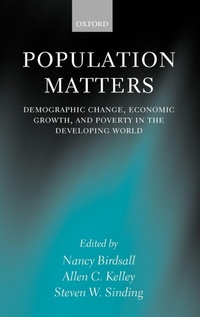
Population Matters
Demographic Change, Economic Growth, and Poverty in the Developing World
Published on 30. August 2001
Book
Hardback
456 pages
978-0-19-924407-2 (ISBN)
Description
The effect of demography on economic performance has been the subject of intense debate in economics for nearly two centuries. In recent years opinion has swung between the Malthusian views of Coale and Hoover, and the cornucopian views of Julian Simon. Unfortunately, until recently, data were too weak and analytical models too limited to provide clear insights into the relationship. As a result, economists as a group have not been clear or conclusive.
This volume, which is based on a collection of papers that heavily rely on data from the 1980s and 1990s and on new analytical approaches, sheds important new light on demographic--economic relationships, and it provides clearer policy conclusions than any recent work on the subject. In particular, evidence from developing countries throughout the world shows a pattern in recent decades that was not evident earlier: countries with higher rates of population growth have tended to see less economic growth. An analysis of the role of demography in the "Asian economic miracle" strongly suggests that changes in age structures resulting from declining fertility create a one-time "demographic gift" or window of opportunity, when the working age population has relatively few dependants, of either young or old age, to support. Countries which recognize and seize on this opportunity can, as the Asian tigers did, realize healthy bursts in economic output. But such results are by no means assured: only for countries with otherwise sound economic policies will the window of opportunity yield such dramatic results. Finally, several of the studies demonstrate the likelihood of a causal relationship between high fertility and poverty. While the direction of causality is not always clear and very likely is reciprocal (poverty contributes to high fertility and high fertility reinforces poverty), the studies support the view that lower fertility at the country level helps create a path out of poverty for many families.
Population Matters represents an important further step in our understanding of the contribution of population change to economic performance. As such, it will be a useful volume for policymakers both in developing countries and in international development agencies.
This volume, which is based on a collection of papers that heavily rely on data from the 1980s and 1990s and on new analytical approaches, sheds important new light on demographic--economic relationships, and it provides clearer policy conclusions than any recent work on the subject. In particular, evidence from developing countries throughout the world shows a pattern in recent decades that was not evident earlier: countries with higher rates of population growth have tended to see less economic growth. An analysis of the role of demography in the "Asian economic miracle" strongly suggests that changes in age structures resulting from declining fertility create a one-time "demographic gift" or window of opportunity, when the working age population has relatively few dependants, of either young or old age, to support. Countries which recognize and seize on this opportunity can, as the Asian tigers did, realize healthy bursts in economic output. But such results are by no means assured: only for countries with otherwise sound economic policies will the window of opportunity yield such dramatic results. Finally, several of the studies demonstrate the likelihood of a causal relationship between high fertility and poverty. While the direction of causality is not always clear and very likely is reciprocal (poverty contributes to high fertility and high fertility reinforces poverty), the studies support the view that lower fertility at the country level helps create a path out of poverty for many families.
Population Matters represents an important further step in our understanding of the contribution of population change to economic performance. As such, it will be a useful volume for policymakers both in developing countries and in international development agencies.
Reviews / Votes
Provides a very valuable discussion, with detailed references, of the knotty methodological issues inherent in the demography-development debate. . . . Anyone concerned with how population change affects the development prospects of poor countries will profit from reading these essays. * Jeffrey D. Sachs, Director, The Earth Institute, Columbia University *More details
Language
English
Place of publication
Oxford
United Kingdom
Target group
Professional and scholarly
Illustrations
numerous tables and figures
Dimensions
Height: 240 mm
Width: 161 mm
Thickness: 29 mm
Weight
851 gr
ISBN-13
978-0-19-924407-2 (9780199244072)
Copyright in bibliographic data and cover images is held by Nielsen Book Services Limited or by the publishers or by their respective licensors: all rights reserved.
Schweitzer Classification
Other editions
Additional editions
Nancy Birdsall | Allen C. Kelley | Steven Sinding
Population Matters
Demographic Change, Economic Growth, and Poverty in the Developing World
Book
04/2003
Oxford University Press
€73.70
Shipment within 15-20 days
Persons
Nancy Birdsall is President of the Center for Global Development and Senior Associate at the Carnegie Endowment for International Peace, where she directs the economic reform project. She was the Executive Vice President of the Inter-American Development Bank from 1993 until September 1998. She is the author of numerous publications on economic development issues. Her most recent work is on the causes and effects of inequality in a globalizing world.
Allen C. Kelley is James B. Duke Professor of Economics, Duke University.
Steven W. Sinding is Director-General of the International Planned Parenthood Federation, headquartered in London. He directs a global federation of 147 affiliates operating programmes in 180 countries, and six regional offices around the world. Prior to joing IPPF, Dr Sinding was Professor of Population and Family Health at the Mailman School of Public Health, Columbia University, and Adjunct Professor of Public Policy in Columbia's School for International and Public Affairs.
Allen C. Kelley is James B. Duke Professor of Economics, Duke University.
Steven W. Sinding is Director-General of the International Planned Parenthood Federation, headquartered in London. He directs a global federation of 147 affiliates operating programmes in 180 countries, and six regional offices around the world. Prior to joing IPPF, Dr Sinding was Professor of Population and Family Health at the Mailman School of Public Health, Columbia University, and Adjunct Professor of Public Policy in Columbia's School for International and Public Affairs.
Content
I. SETTING THE STAGE ; 1. How and Why Population Matters: New Findings, New Issues ; 2. The Population Debate in Historical Perspective: Revisionism Revised ; 3. Dependency Burdens in the Developing World ; II. POPULATION CHANGE AND THE ECONOMY ; 4. Economic and Demographic Change: A Synthesis of Models, Findings, and Perspectives ; 5. Demographic Change, Economic Growth and Inequality ; 6. Saving, Wealth, and Population ; 7. Cumulative Causality, Economic Growth and the Demographic Transition ; III. FERTILITY, POVERTY AND THE FAMILY ; 8. Population and Poverty in Households: A Review of Reviews ; 9. Demographic Transition and Poverty: Effects Via Economic Growth, Distribution, and Conversion ; 10. Inequality and the Family in Latin America ; 11. Demographic Changes and Poverty in Brazil ; IV. POPULATION, AGRICULTURE AND NATURAL RESOURCES ; 12. Rural Population Growth, Agricultural Change and Natural Resource Management in Developing Countries: A Review of Hypotheses and Some Evidence from Honduras ; V. SOME ECONOMICS OF POPULATION POLICY ; 13. Why Micro Matters ; 14. New Findings in Economics and Demography: Implications for Policies to Reduce Poverty