

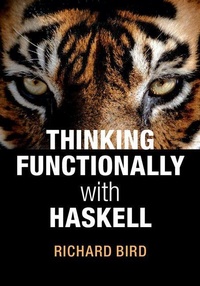
Thinking Functionally with Haskell
Published on 9. October 2014
Book
Paperback/Softback
354 pages
978-1-107-45264-0 (ISBN)
Description
Richard Bird is famed for the clarity and rigour of his writing. His new textbook, which introduces functional programming to students, emphasises fundamental techniques for reasoning mathematically about functional programs. By studying the underlying equational laws, the book enables students to apply calculational reasoning to their programs, both to understand their properties and to make them more efficient. The book has been designed to fit a first- or second-year undergraduate course and is a thorough overhaul and replacement of his earlier textbooks. It features case studies in Sudoku and pretty-printing, and over 100 carefully selected exercises with solutions. This engaging text will be welcomed by students and teachers alike.
More details
Language
English
Place of publication
Cambridge
United Kingdom
Target group
College/higher education
Professional and scholarly
Product notice
Paperback (trade)
Illustrations
Worked examples or Exercises; 1 Line drawings, unspecified
Dimensions
Height: 244 mm
Width: 170 mm
Thickness: 20 mm
Weight
618 gr
ISBN-13
978-1-107-45264-0 (9781107452640)
Copyright in bibliographic data and cover images is held by Nielsen Book Services Limited or by the publishers or by their respective licensors: all rights reserved.
Schweitzer Classification
Other editions
Additional editions
Richard Bird
Thinking Functionally with Haskell
E-Book
10/2014
1st Edition
Cambridge University Press
€43.99
Available for download
Richard Bird
Thinking Functionally with Haskell
Book
10/2014
Cambridge University Press
€150.50
Shipment within 15-20 days
Person
Richard Bird is Emeritus Professor of Computer Science at Oxford University Computing Laboratory and a Fellow of Lincoln College, Oxford. He has authored many books, including Algebra of Programming (1996) and Pearls of Functional Algorithm Design (Cambridge University Press, 2010).
Content
Preface; 1. What is functional programming?; 2. Expressions, types and values; 3. Numbers; 4. Lists; 5. A simple Sudoku solver; 6. Proofs; 7. Efficiency; 8. Pretty-printing; 9. Infinite lists; 10. Imperative functional programming; 11. Parsing; 12. A simple equational calculator; Index.