

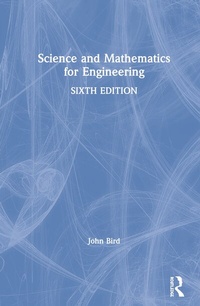
Science and Mathematics for Engineering
6th Edition
Published on 10. October 2019
Book
Hardback
562 pages
978-0-367-20475-4 (ISBN)
Description
A practical introduction to the engineering science and mathematics required for engineering study and practice.
Science and Mathematics for Engineering is an introductory textbook that assumes no prior background in engineering. This new edition covers the fundamental scientific knowledge that all trainee engineers must acquire in order to pass their examinations and has been brought fully in line with the compulsory science and mathematics units in the new engineering course specifications. A new chapter covers present and future ways of generating electricity, an important topic.
John Bird focuses upon engineering examples, enabling students to develop a sound understanding of engineering systems in terms of the basic laws and principles. This book includes over 580 worked examples, 1300 further problems, 425 multiple choice questions (with answers), and contains sections covering the mathematics that students will require within their engineering studies, mechanical applications, electrical applications and engineering systems.
This book is supported by a companion website of materials that can be found at www.routledge/cw/bird. This resource includes fully worked solutions of all the further problems for students to access, and the full solutions and marking schemes for the revision tests found within the book for instructor use. In addition, all 447 illustrations will be available for downloading by lecturers.
Science and Mathematics for Engineering is an introductory textbook that assumes no prior background in engineering. This new edition covers the fundamental scientific knowledge that all trainee engineers must acquire in order to pass their examinations and has been brought fully in line with the compulsory science and mathematics units in the new engineering course specifications. A new chapter covers present and future ways of generating electricity, an important topic.
John Bird focuses upon engineering examples, enabling students to develop a sound understanding of engineering systems in terms of the basic laws and principles. This book includes over 580 worked examples, 1300 further problems, 425 multiple choice questions (with answers), and contains sections covering the mathematics that students will require within their engineering studies, mechanical applications, electrical applications and engineering systems.
This book is supported by a companion website of materials that can be found at www.routledge/cw/bird. This resource includes fully worked solutions of all the further problems for students to access, and the full solutions and marking schemes for the revision tests found within the book for instructor use. In addition, all 447 illustrations will be available for downloading by lecturers.
Reviews / Votes
"The book is one of my personal 'go to' books when seeking appropriate worked examples, diagrams, and solutions due to its capable style and composition and sheer coverage - the subject matter that is covered is considerable and thorough."- Michael Lanigan, Waterford Institute of Technology
"John Bird has always hit the mark in terms of being 'helpful' to students particularly in his most recent books as they provide full worked solutions... I think that new materials are important in order to refresh topics and I agree that the section on new energy sources is particularly important and relevant at this time."
- Sandra Schia, Kingston College (Surrey) "The book is one of my personal 'go to' books when seeking appropriate worked examples, diagrams, and solutions due to its capable style and composition and sheer coverage - the subject matter that is covered is considerable and thorough."
- Michael Lanigan, Waterford Institute of Technology
"John Bird has always hit the mark in terms of being 'helpful' to students particularly in his most recent books as they provide full worked solutions... I think that new materials are important in order to refresh topics and I agree that the section on new energy sources is particularly important and relevant at this time."
- Sandra Schia, Kingston College (Surrey)
More details
Edition
6th edition
Language
English
Place of publication
London
United Kingdom
Publishing group
Taylor & Francis Ltd
Target group
College/higher education
Professional and scholarly
Adult education
Adult education, Further/Vocational Education, Professional, and Undergraduate
Illustrations
489 s/w Abbildungen, 42 s/w Photographien bzw. Rasterbilder, 447 s/w Zeichnungen, 8 farbige Tabellen
8 Tables, color; 447 Line drawings, black and white; 42 Halftones, black and white; 489 Illustrations, black and white
Dimensions
Height: 276 mm
Width: 219 mm
Weight
1782 gr
ISBN-13
978-0-367-20475-4 (9780367204754)
Copyright in bibliographic data and cover images is held by Nielsen Book Services Limited or by the publishers or by their respective licensors: all rights reserved.
Schweitzer Classification
Other editions
Additional editions
John Bird
Science and Mathematics for Engineering
Book
10/2019
6th Edition
Routledge
€69.50
Shipment within 15-20 days
John Bird
Science and Mathematics for Engineering
E-Book
10/2019
6th Edition
Routledge
€73.49
Available for download
John Bird
Science and Mathematics for Engineering
E-Book
10/2019
6th Edition
Routledge
€73.49
Available for download
Previous edition
John Bird
Science for Engineering
Book
07/2017
5th Edition
Routledge
€222.84
Article exhausted; check for reprint
Person
John Bird is the former Head of Applied Electronics in the Faculty of Technology at Highbury College, Portsmouth, U.K. More recently, he has combined freelance lecturing at the University of Portsmouth, with Examiner responsibilities for Advanced Mathematics with City and Guilds and examining for the International Baccalaureate Organisation. He is the author of over 130 textbooks on engineering and mathematical subjects with worldwide sales of over one million copies. He is a chartered engineer, a chartered mathematician, a chartered scientist and a Fellow of three professional institutions and is currently lecturing at the Defence School of Marine Engineering in the Defence College of Technical Training at H.M.S. Sultan, Gosport, Hampshire, U.K, one of the largest technical training establishments in Europe.
Content
Preface. SECTION I APPLIED MATHEMATICS. 1. Basic arithmetic. 2. Fractions, decimals and percentages. 3. Indices, units, prefixes and engineering notation. 4. Calculations and evaluation of formulae. 5. Basic algebra. 6. Solving simple equations. 7. Transposing formulae. 8. Solving simultaneous equations. 9. Straight line graphs. 10. Introduction to trigonometry. 11. Area of common shapes. 12. The circle. 13. Volumes of common solids. SECTION II MECHANICAL APPLICATIONS. 14. SI units and density. 15. Atomic structure of matter. 16. Speed and velocity. 17. Acceleration. 18. Force, mass and acceleration. 19. Forces acting at a point. 20. Work, energy and power. 21. Simply supported beams. 22. Linear and angular motion. 23. Friction. 24. Simple machines. 25. The effects of forces on materials. 26. Linear momentum and impulse. 27. Torque. 28. Pressure in fluids. 29. Heat energy and transfer. 30. Thermal expansion. 31. Ideal gas laws. 32. The measurement of temperature. Revision Test 12: Thermal expansion, ideal gas laws and temperature measurement. SECTION III ELECTRICAL APPLICATIONS. 33. An introduction to electric circuits. 34. Resistance variation. 35. Batteries and alternative sources of energy. 36. Series and parallel networks. 37. Kirchhoff's laws. 38. Magnetism and electromagnetism. 39. Electromagnetic induction. 40. Alternating voltages and currents. 41. Capacitors and inductors. 42. Electrical measuring instruments and measurements. 43. Ways of generating electricity - the present and the future. SECTION IV ENGINEERING SYSTEMS. 44. Introduction to engineering systems. List of formulae for science and engineering. Answers to Practice Exercises. Glossary of terms. Index.